
Road and gravel riders who get a flat or need to restore pressure mid-ride may want powered inflation without repeated hand strokes. These compact electric pumps vary in pressure capacity, valve connection, charging needs, and carry weight, so the right choice depends on your tires and how you carry your repair kit.
We compare 5 options for November 2026, including models with digital gauges and automatic shutoff. Check your tire’s pressure guidance and the pump’s valve fittings before buying; our guide to pumps for Presta valves covers another common compatibility question.
At a Glance: Which One Fits You
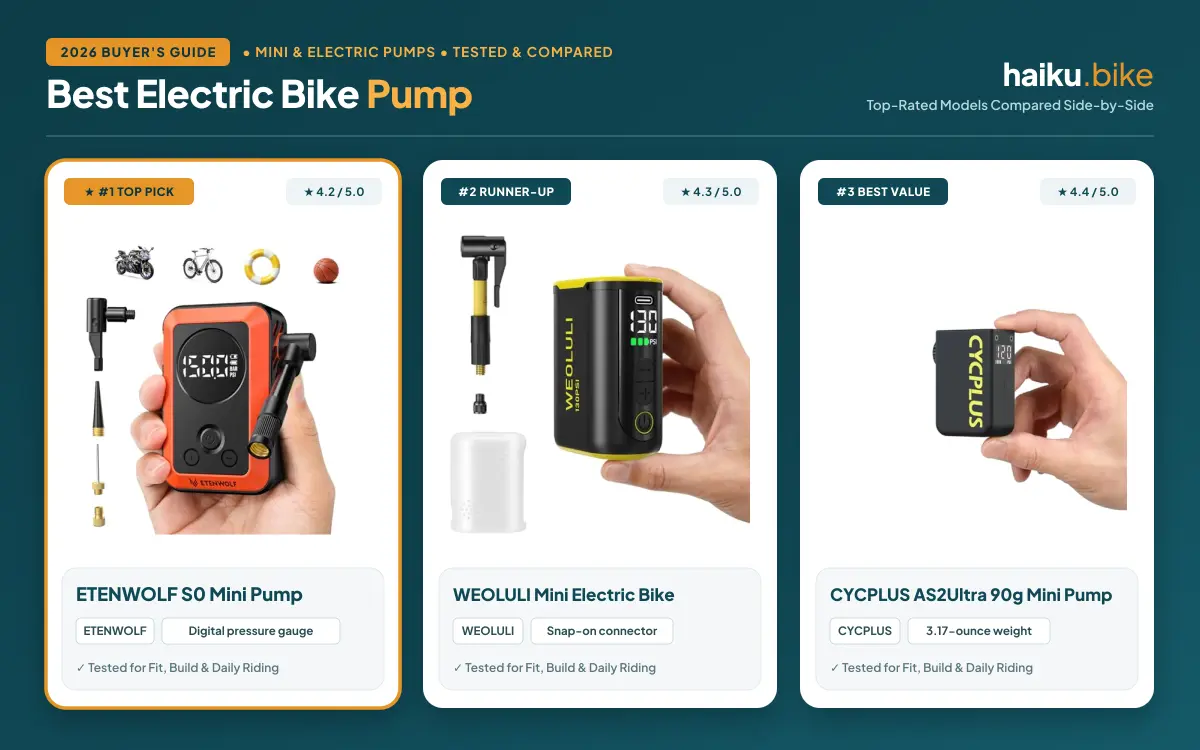
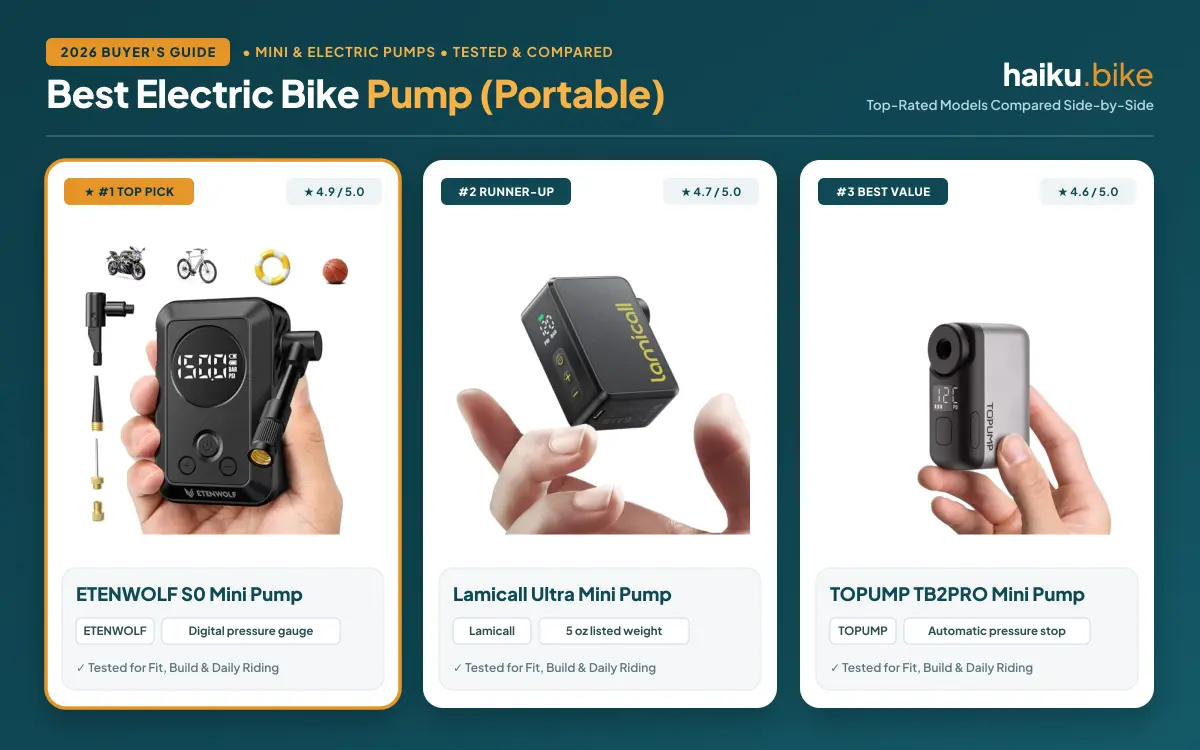
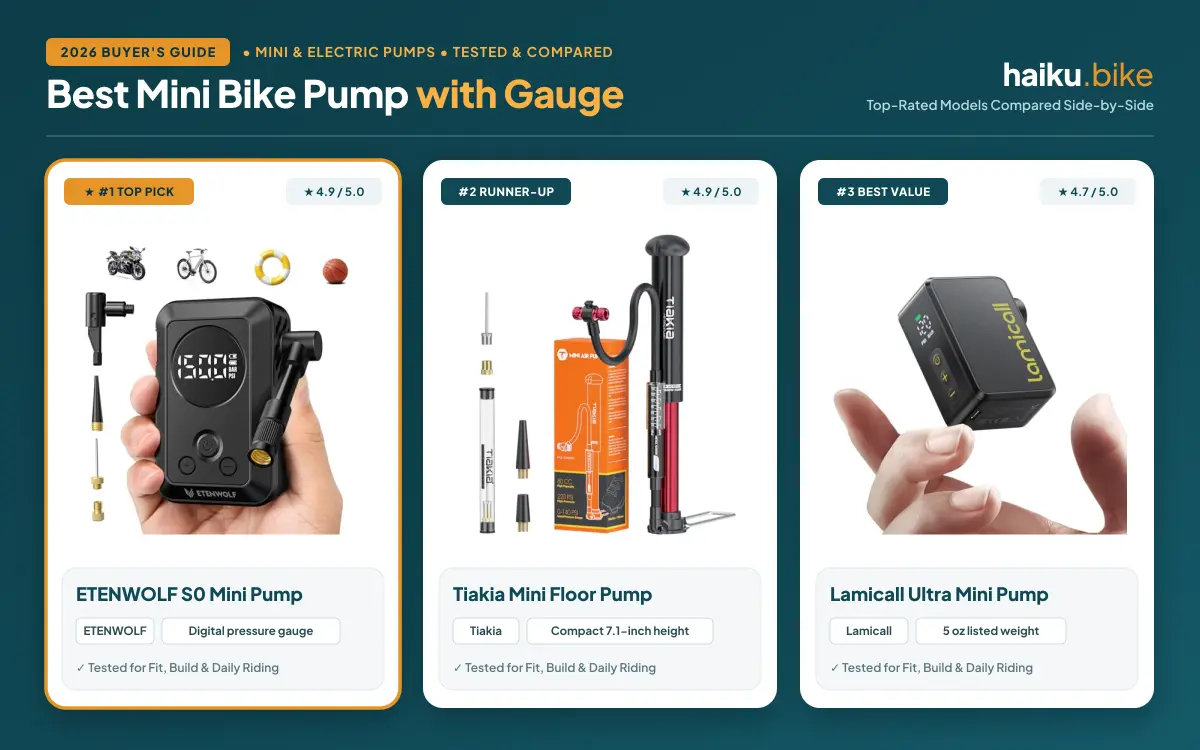
- Best overall: ETENWOLF S0 Mini Bike Pump earns this spot because it lists a 150 PSI maximum, digital gauge, and 0.54 lb weight.
- Best value: Lamicall Ultra Mini Electric Bike Pump, 120 PSI earns this spot because it combines a listed 5 oz weight, automatic stop, and Type-C charging.
- Best for low carry weight: CYCPLUS Tiny Electric Bike Pump AS2Ultra, 90g earns this spot because its listed weight is 90 g.
- Best for higher pressure capacity: Fanttik X9 Ace Mini Electric Bike Pump, 150PSI earns this spot because its maker lists a 150 PSI maximum and 5,000 mAh battery.

Pros
- Automatic pressure shutoff
- Digital pressure gauge
- Schrader and Presta adapters included
- Ball needle and balloon valve included
- Memory for last pressure setting
Cons
- Up to eight flat tires per charge
- Requires battery recharging
- No frame-mount hardware listed

Pros
- 5 oz listed weight
- Presta and Schrader compatibility
- Automatic pressure shutoff
- Real-time pressure display
- Type-C charging
Cons
- No water resistance rating listed
- Requires cooling after overheat shutdown
- Battery capacity not specified
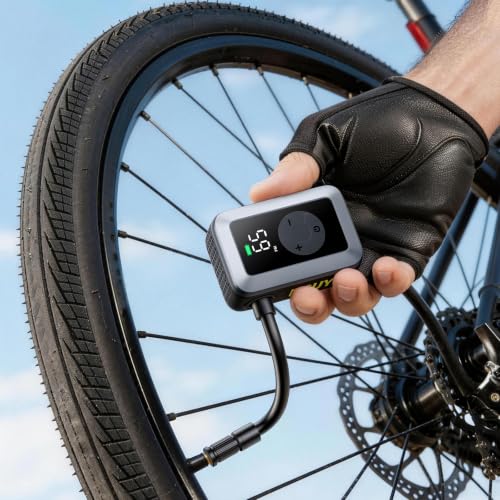
Pros
- Presta and Schrader adapters included
- Digital gauge with auto-stop
- About 0.3 lb
- USB-C charging
- 24-month warranty
Cons
- Motor may get noisy
- Motor may heat during use

Pros
- 3.17-ounce weight
- Presta and Schrader compatibility
- Automatic shutoff
- Pressure gauge with ±1 PSI stated accuracy
- 25-minute stated recharge time
Cons
- Maximum pressure rated at 120 PSI
- No stated water-resistance rating

Pros
- Presta and Schrader compatibility
- Automatic pressure shutoff
- 5,000 mAh battery
- Up to 8 inflations per charge
- About 0.85 lb
Cons
- 25-minute continuous-use limit
- Requires battery charging
Side-by-Side Comparison
| Pump | Maximum pressure | Listed weight | Valve compatibility | Battery or charging detail |
|---|---|---|---|---|
| ETENWOLF S0 Mini Bike Pump | 150 PSI | 0.54 lb | Presta and Schrader | 2,400 mAh; maker claims up to eight fully flat tires |
| Lamicall Ultra Mini Electric Bike Pump, 120 PSI | 120 PSI | 5 oz | Presta and Schrader | Maker claims full charge in 30 minutes |
| DSUY Mini Bike Tire Pump | 120 PSI | Not listed | Presta and Schrader | Maker claims up to 14 inflations from 80 to 100 PSI on a 700×23C tire |
| CYCPLUS Tiny Electric Bike Pump AS2Ultra, 90g | 120 PSI | 90 g | Presta and Schrader | Maker claims full charge in 25 minutes |
| Fanttik X9 Ace Mini Electric Bike Pump, 150PSI | 150 PSI | Not listed | Presta and Schrader | 5,000 mAh; maker claims eight tires per charge |
Pressure capacity and weight create the clearest trade-off in this comparison. Riders prioritizing pocket carry may prefer the CYCPLUS pump’s listed 90 g, while riders seeking more pressure capacity can consider ETENWOLF or Fanttik; inflation and battery figures are maker claims.
Common Mistakes to Avoid
Valve adapters are easy to overlook when packing an electric pump. ETENWOLF’s package details list a Presta adapter, while its product instructions describe the adapter as a separate accessory; confirm the exact package contents for the version you buy and keep the fitting with the pump.
A pump’s maximum pressure is not a recommended tire pressure. Check the tire maker’s guidance and select a pump with suitable capacity, rather than inflating to the pump’s stated ceiling.
Inflation-time claims do not always describe the same tire size or starting pressure. ETENWOLF reports a 700×23C tire moving from 80 to 100 PSI in 20 seconds, while CYCPLUS cites a 700×25C tire moving from zero to 80 PSI in 52 seconds; those figures are not direct comparisons.
Rechargeable pumps need charge checks and careful operation. Follow the maker’s instructions, allow the device to cool when directed, and check battery charge before a ride; Lamicall specifies overheat protection and advises cooling before another use or recharge.
Best Mini Bike Pump Buying Guide
Pressure Capacity and Tire Needs
Pressure capacity matters because a pump must reach the pressure your tire setup requires. ETENWOLF and Fanttik list 150 PSI maximums, while Lamicall, DSUY, and CYCPLUS list 120 PSI; compare each ceiling with your tire maker’s recommended range.
A higher maximum does not mean every tire should be inflated to that figure. Check the pressure guidance printed on your tire or supplied by its maker, then choose a pump with adequate capacity for your setup.
Inflation-speed claims need context, including tire size and starting pressure. When comparing product information, look for both details instead of treating a seconds figure as a universal estimate for your own tire.
Valve Connection and Hose Design
Valve compatibility determines whether a pump can connect to your bicycle’s tube without an additional fitting. All five pumps in this guide list Presta and Schrader compatibility, but their adapter arrangements and hose designs differ.
ETENWOLF’s package details list a Presta adapter, while DSUY includes adapters and a Schrader hose for angled or hard-to-reach valves. Fanttik uses an integrated rotating hose and valve assembly, and CYCPLUS includes an extra hose.
Before ordering, check which fittings come in the package and how they attach to your valve. Riders with deep rims or awkward valve positions may find a flexible hose easier to connect than a direct-fit adapter.
Gauge, Preset, and Automatic Stop
A digital gauge and automatic stop can make roadside inflation easier to control. ETENWOLF, DSUY, and CYCPLUS specify gauge accuracy of ±1 PSI, while Lamicall lists a real-time display, preset pressure, memory, and automatic pause.
Check whether the display shows pressure during inflation and whether the controls let you set a target beforehand. DSUY says its screen also shows battery level and units, which can help riders monitor charge and avoid unit confusion.
Automatic shutoff reduces the need to stop inflation manually, but it does not replace checking your target. Set pressure according to tire guidance, confirm the displayed unit, and follow the pump maker’s instructions for attaching and removing the valve connection.
Battery Capacity and Recharging
Battery details help determine how a rechargeable pump fits into ride planning, but published inflation counts depend on tire size and starting pressure. ETENWOLF lists a 2,400 mAh battery and claims up to eight fully flat tires, while Fanttik lists 5,000 mAh and claims eight tires per charge.
Other makers describe different charging or inflation conditions. Lamicall claims a full charge in 30 minutes and at least two 700×25C tires inflated from zero to 110 PSI; CYCPLUS claims a 25-minute full charge and at least two 700×25 tires from zero to 110 PSI.
These claims use distinct conditions, so they do not establish a reliable ranking for every rider. Consider how many tires you might need to inflate, whether you can recharge between rides, and whether the maker provides battery-care instructions.
Weight, Size, and Carrying
Weight and dimensions matter when storage space is limited in a jersey pocket or saddle bag. CYCPLUS lists its AS2Ultra at 90 g, Lamicall lists 5 oz, and ETENWOLF lists 0.54 lb.
DSUY describes its pump as compact but does not list a weight, and Fanttik describes its pump as palm-sized without listing a weight. If carry weight drives your decision, compare published dimensions and weights rather than relying on general compactness claims.
A pump’s included accessories also affect how conveniently it fits your carry setup. Review the package for a storage bag, adapter, hose, and charging cable, then consider whether those parts fit alongside your other roadside repair supplies.
Heat, Charging, and Other Uses
Operating and charging instructions matter because electric pumps can generate heat during inflation. Lamicall specifies a high-temperature alert and automatic shutdown, while DSUY notes that its brushless motor may produce heat and noise.
Fanttik describes a cooling system for continuous operation, but riders should still follow the supplied instructions rather than assuming every pump can run without breaks. Check whether the maker gives guidance on cooling, charging, and storage before relying on a pump for repeated inflation.
Some models also serve uses beyond bicycles: ETENWOLF says its pump can inflate motorcycles and sports balls, and Fanttik lists motorcycle use. Riders comparing other pump formats can browse the Pumps & Tire Care category and the Mini & Electric Pumps category.
How We Chose
We score each pump with the Haiku Ride Score: core performance 30%, build and weather resistance 20%, ease of use 20%, compatibility and battery 15%, and value 15%. These categories help us compare pressure control, practical carry, valve fit, and battery considerations across compact pumps.
We evaluate manufacturer specifications, compatibility information, and long-term owner feedback where available, while distinguishing stated features from missing details. We research and draft our guides with software tools, including AI, then run automated checks on product fit, sourcing, and our editorial rules. Our editor spot-checks guides rather than reading each one before publication. Our how we review page explains the method.
Price and Value: What Each Budget Gets You
Budget
At the lower end of this category, compact electric pumps can offer a digital pressure display, automatic stopping, and valve compatibility for roadside inflation. The Lamicall Ultra Mini Electric Bike Pump, 120 PSI adds a listed 5 oz weight and Type-C charging. Riders give up the higher pressure ceiling found on some alternatives, so check that its maximum suits your tire needs.
Mid-Range
Mid-range options can combine preset controls, automatic shutoff, and multiple fittings without making low carry weight the main design priority. The DSUY Mini Bike Tire Pump lists a gauge with ±1 PSI accuracy and includes a Schrader hose for angled valves. Its maker does not list a weight, so riders who count every ounce should compare it with models that publish one.
Premium
At the higher end, riders may prioritize especially low listed weight, fast charging, or higher pressure capacity rather than a broader feature set. The CYCPLUS Tiny Electric Bike Pump AS2Ultra, 90g lists a 90 g weight and 25-minute full charge, while ETENWOLF and Fanttik list 150 PSI maximums. Premium positioning does not remove trade-offs: compare carry weight, fittings, and each maker’s conditions.
Choosing Something Else
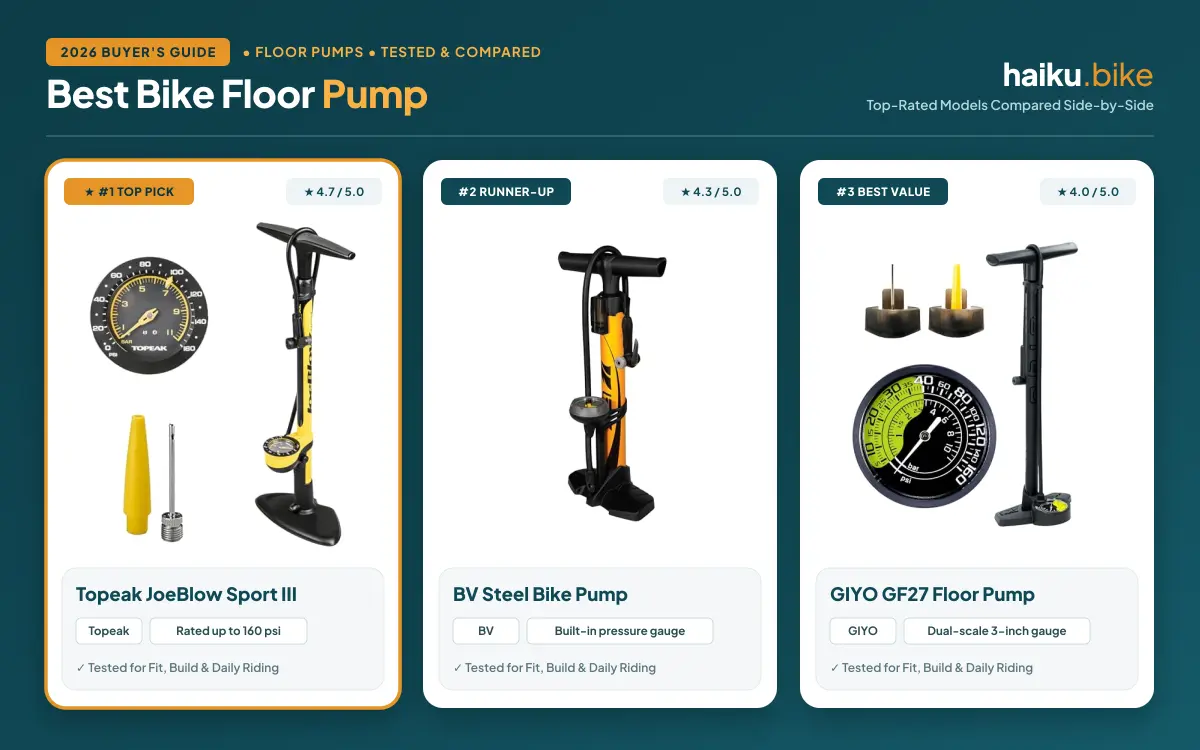
A manual mini pump suits riders who prefer not to manage a rechargeable battery or charging schedule. Hand inflation requires more physical effort, but a manual pump can serve as a simple roadside backup. Riders who mostly inflate tires at home can also consider a floor pump, which is easier to use for routine pressure adjustments.
Final Thoughts
Riders seeking pressure capacity and a digital gauge can consider the ETENWOLF S0 Mini Bike Pump. Its maker lists a 150 PSI maximum and 0.54 lb weight, but it is heavier than CYCPLUS’s listed option; check the package and adapter details for your intended valve setup.
Riders prioritizing low listed weight may prefer the CYCPLUS Tiny Electric Bike Pump AS2Ultra, 90g, which lists a 90 g weight and 120 PSI maximum. The Lamicall Ultra Mini Electric Bike Pump, 120 PSI suits riders who value a 5 oz pump, automatic stop, and Type-C charging, though its pressure ceiling is lower than 150 PSI options.
The Fanttik X9 Ace Mini Electric Bike Pump, 150PSI may suit riders who want an integrated rotating hose, 150 PSI maximum, and a listed 5,000 mAh battery. The DSUY Mini Bike Tire Pump offers a display, ±1 PSI accuracy claim, and several adapters, but its weight is not listed.
Riders who do not want battery charging may prefer a manual pump, while riders focused on routine home inflation may want a floor pump. Compare options in our floor pump category or review our guide to pumps for Presta valves before choosing.
FAQs
Do mini bike pumps work with Presta and Schrader valves?
Mini bike pumps in this guide list compatibility with both Presta and Schrader valves, but adapter and hose designs differ. ETENWOLF’s package details list a Presta adapter, and DSUY includes a Schrader hose. Check the package contents and connection instructions before riding, especially if your bike uses Presta valves.
Can a mini bike pump inflate road bike tires?
A mini bike pump can inflate road tires when its pressure capacity and valve connection suit your setup. ETENWOLF and Fanttik list 150 PSI maximums; Lamicall, DSUY, and CYCPLUS list 120 PSI. Follow your tire maker’s pressure guidance, because a pump’s maximum capacity is not a recommended inflation target.
How many tires can an electric mini bike pump inflate per charge?
An electric mini bike pump’s per-charge capacity depends on tire size, starting pressure, and the maker’s stated conditions. ETENWOLF claims up to eight fully flat tires, while Fanttik claims eight tires per charge. Treat those figures as maker claims rather than guaranteed results, and check the pump’s charge before setting out.
How accurate are mini bike pump digital gauges?
Mini bike pump gauge accuracy varies, and only some makers state a precision figure. ETENWOLF, DSUY, and CYCPLUS specify ±1 PSI, while other models list displays without the same accuracy claim. Confirm the unit shown, set pressure using your tire maker’s guidance, and treat stated precision as a manufacturer specification.
Do electric mini bike pumps stop automatically?
Several electric mini bike pumps in this guide list automatic stopping or pausing when the selected pressure is reached. Preset controls vary, so check how your chosen pump sets and displays its target. Stay nearby, attach the valve carefully, and follow the maker’s operating instructions when using an adapter or hose.
Can a mini electric bike pump overheat?
A mini electric bike pump can warm during inflation, and makers describe different heat protections. Lamicall specifies a high-temperature alert and automatic shutdown; DSUY notes that its motor may produce heat. Follow the pump’s instructions and allow it to cool when directed. Do not recharge a hot pump if its maker advises against it.
How should I store a rechargeable mini bike pump?
A rechargeable mini bike pump should be stored according to its maker’s battery-care instructions. Lamicall recommends charging before storage and recharging every six months during long-term storage. Keep the pump, valve fittings, and charging cable together, then check the battery before a ride so the device is ready for roadside inflation.
Which Best Mini Bike Pump features matter most in 2026?
The most important Best Mini Bike Pump features in 2026 depend on tire pressure, valve type, and carry preference. Start with compatible fittings and adequate pressure capacity, then compare gauge controls, battery claims, charging, and listed weight. Riders considering manual alternatives can browse the Pumps & Tire Care category.
Write Your Review
No reviews yet. Be the first to share your experience!