
For commuters and riders heading beyond easy walking distance, a portable bike pump can turn a roadside flat into a manageable stop. Compact electric inflators reduce hand effort, while a manual pump avoids batteries and charging. The right choice depends on your tire, valve, target pressure, and preferred way to carry gear.
We compared 5 pumps from brands including BV, Fanttik, ETENWOLF and more for November 2026. These options span palm-size electric inflators and a longer steel hand pump; browse our Mini & Electric Pumps category for more formats.
At a Glance: Which One Fits You
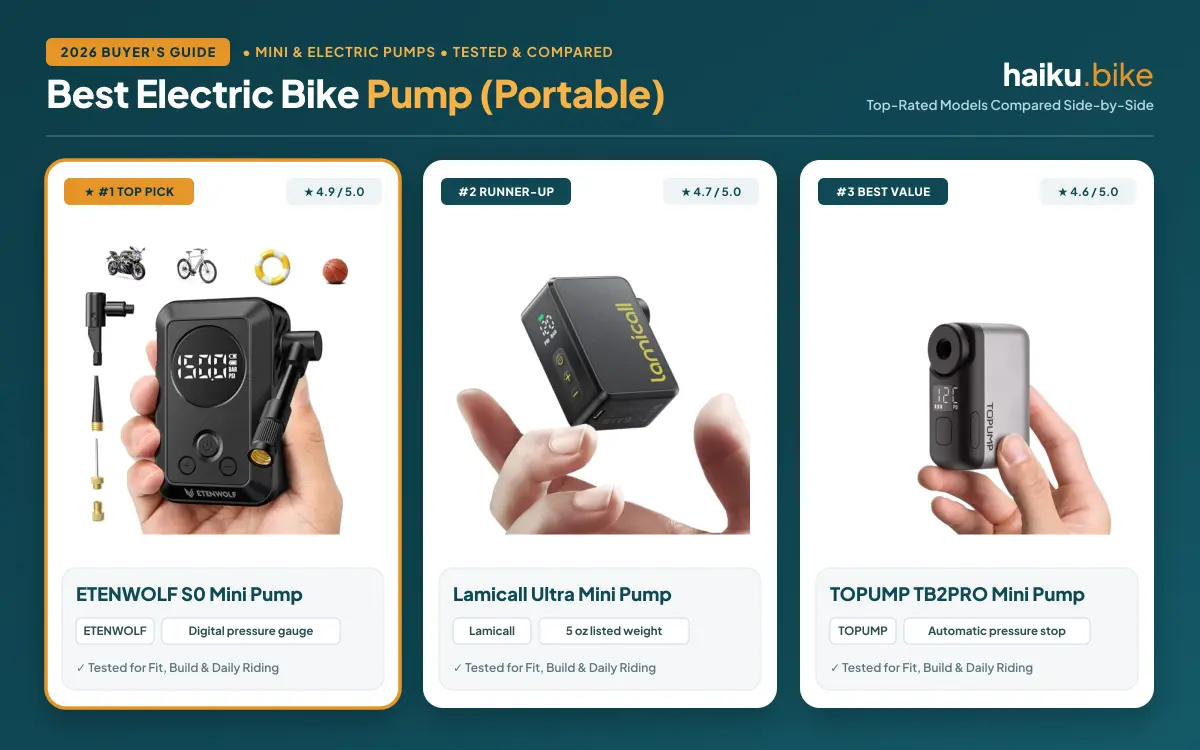
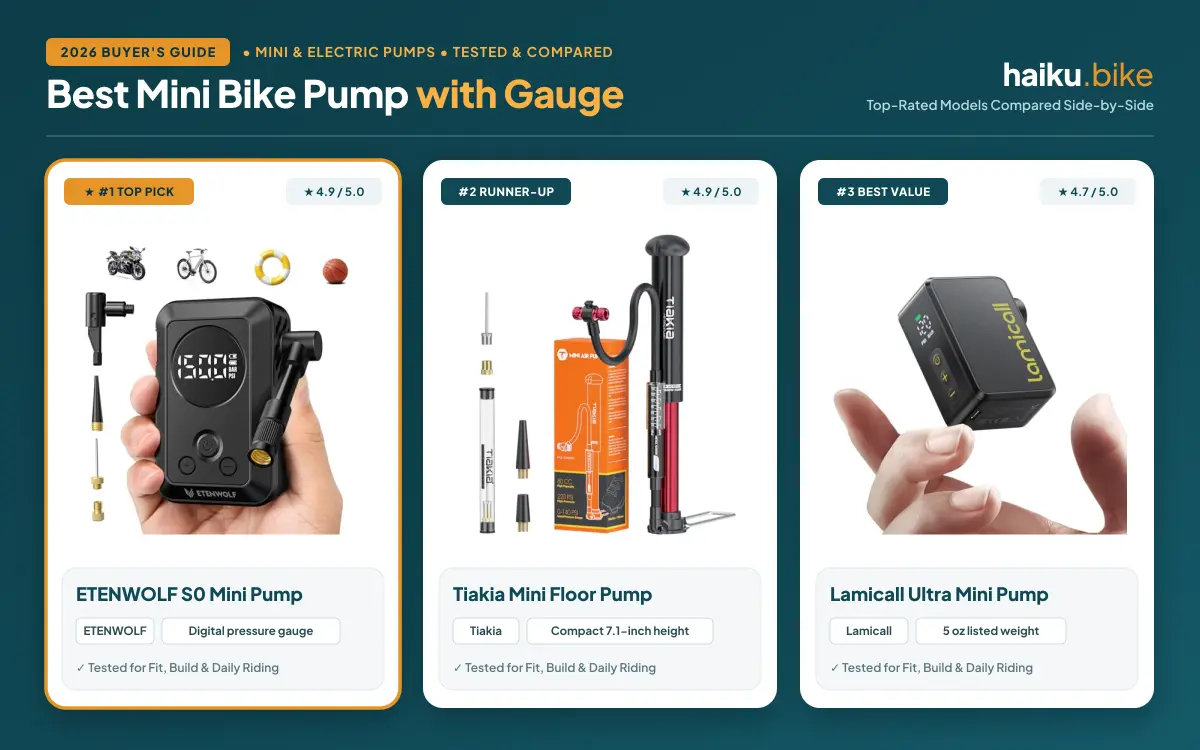
- Best overall: ETENWOLF S0 Mini Bike Pump earns this spot because it combines a 150 PSI maximum, automatic shutoff, and a listed 0.54 lb weight.
- Best value: BV Bike Pump out of durable Steel earns this spot because its manual design avoids battery charging and supports Presta and Schrader valves with a reversible head.
- Best for quick roadside inflation: DSUY Mini Bike Tire Pump earns this spot because its maker lists a 10-second inflation time for a 700x23C tire from 80 to 100 PSI.
- Best for all-in-one hose storage: Fanttik X9 Ace Mini Electric Bike Pump, 150PSI earns this spot because its integrated hose and valve design simplifies storage.

Pros
- Automatic pressure shutoff
- Digital pressure gauge
- Schrader and Presta adapters included
- Ball needle and balloon valve included
- Memory for last pressure setting
Cons
- Up to eight flat tires per charge
- Requires battery recharging
- No frame-mount hardware listed
Pros
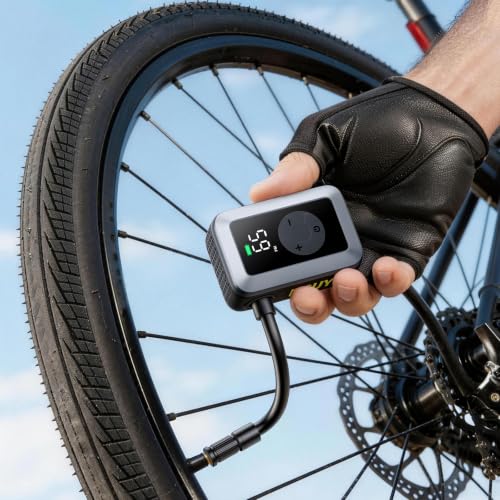
- Presta and Schrader adapters included
- Digital gauge with auto-stop
- About 0.3 lb
- USB-C charging
- 24-month warranty
Cons
- Motor may get noisy
- Motor may heat during use

Pros
- Presta and Schrader compatibility
- Built-in pressure gauge
- Steel construction
- 1 lb weight
- Inflates balls and bike tires
Cons
- Valve conversion requires reversing components
- Listed size details conflict

Pros
- Presta valve adapter included
- Automatic pressure shutoff
- Four pressure units
- USB device charging
- 0.98 lb weight
Cons
- No stated bike-specific inflation runtime
- Not recommended for large commercial truck tires
- No stated water resistance rating

Pros
- Presta and Schrader compatibility
- Automatic pressure shutoff
- 5,000 mAh battery
- Up to 8 inflations per charge
- About 0.85 lb
Cons
- 25-minute continuous-use limit
- Requires battery charging
Side-by-Side Comparison
| Model | Type | Maximum pressure | Stated inflation detail | Power or weight | Valve compatibility |
|---|---|---|---|---|---|
| ETENWOLF S0 Mini Bike Pump | Electric | 150 PSI | 700×23C, 80 to 100 PSI, in 20 seconds | 2400 mAh; 0.54 lb | Presta adapter and Schrader |
| DSUY Mini Bike Tire Pump | Electric | 120 PSI | 700x23C, 80 to 100 PSI, in 10 seconds | Up to 14 stated inflations per charge | Presta and Schrader adapters |
| BV Bike Pump out of durable Steel | Manual | 160 PSI | Not listed | 16.25 inches long | Reversible twin valve head |
| OlarHike Tire Inflator Portable Air Compressor | Electric | Not listed | Car tire figures listed; bicycle time not listed | 2000mAh × 2; 1 lb | Presta adapter included |
| Fanttik X9 Ace Mini Electric Bike Pump, 150PSI | Electric | 150 PSI | 700 x 23 C, 80 to 100 PSI, in 32 seconds | 5000 mAh; eight tires per charge | Presta and Schrader built in |
Power source is the clearest dividing line: electric pumps reduce hand effort but require charge, while the BV works without a battery. Inflation times only compare meaningfully when tire size and starting pressure match, so treat each maker figure as condition-specific.
Common Mistakes to Avoid
Valve mismatch can make a pump unusable during a flat, even when its pressure ceiling appears suitable. Check whether your bike uses Presta or Schrader valves, then confirm the pump includes the correct adapter or a compatible reversible head. ETENWOLF requires its separate Presta adapter for road-bike use, while BV changes formats by reversing parts in its twin valve head.
Battery dependence is easy to overlook when choosing a compact electric pump. Check the maker’s stated charge capacity and charging method, then recharge before a long ride; listed capacity varies with tire size and starting pressure. ETENWOLF states up to eight fully flat tires or eighteen low-pressure tires per charge, while DSUY gives separate estimates for top-ups and fully flat tires.
A maximum pressure rating does not tell you how quickly a pump will inflate your particular tire. Compare maker figures only when the tire size and pressure range match your needs, and do not treat a road-tire time as a prediction for a high-volume tire. OlarHike lists car-tire inflation figures, but does not list a bicycle inflation time.
Carry dimensions and setup can also undermine an otherwise suitable choice. The BV measures 16.25 inches, unlike palm-size electric options, so check your bag or mounting space before ordering. For any pump, learn how its hose or adapter connects to your valve before relying on it during a roadside stop.
Best Portable Bike Pump Buying Guide
Valve Compatibility and Connection
Valve compatibility determines whether a pump can connect to your tire without an extra part or awkward setup. Identify your valve type before comparing products, then check whether the pump uses a built-in head, separate adapters, or a reversible design.
ETENWOLF supports Presta and Schrader, but its Presta adapter is separate and must be attached for road-bike use. DSUY supplies adapters for both formats and a Schrader hose for angled or difficult-to-reach valves. BV reverses parts in its twin valve head, while Fanttik integrates both valve types with its hose.
Check how the connection seals and whether the included hose reaches your valve comfortably, especially with deep rims or crowded spokes. The bike pump guide for Presta valves can help if your main concern is that valve standard.
Pressure Rating and Tire Needs
A pump’s maximum pressure should cover your intended tire pressure, but the rating alone does not establish speed or suitability. Check your tire’s sidewall guidance and your riding setup, then compare those needs with the pump’s stated limit.
ETENWOLF and Fanttik list a 150 PSI maximum, DSUY lists 120 PSI, and BV lists 160 PSI. These figures describe ceilings, not a promise that each pump reaches every pressure at the same pace. A higher rating can matter to riders using high-pressure tires, but it should not replace checking inflation details.
Tire volume changes how much air a pump must move, so road-tire claims may not predict performance on mountain or fat tires. Look for a stated tire size and starting pressure that resemble your own setup. When a maker gives no bicycle-specific figure, treat speed as unknown rather than inferring it from maximum pressure.
Inflation Time and Airflow
Inflation time affects how long a roadside stop lasts, but published times only help when their conditions are clear. Compare the tire size, starting pressure, ending pressure, and stated time together instead of relying on broad claims about speed.
DSUY lists 10 seconds for a 700x23C tire from 80 to 100 PSI and 20 seconds for a 700x25C tire under that pressure range. ETENWOLF lists 20 seconds for a 700×23C tire from 80 to 100 PSI, while Fanttik lists 32 seconds for a 700 x 23 C tire under the same stated range.
Those figures do not establish how long inflation takes for a larger tire or a completely flat tire. ETENWOLF and Fanttik also provide separate claims for bringing a road tire from 0 to 100 PSI, which are different conditions from topping up. Choose a pump with published figures relevant to your likely roadside need.
Battery, Charging, and Controls
An electric pump trades hand effort for battery planning, making charge capacity and controls central buying criteria. Check whether the maker states inflations per charge, whether those estimates match your tire size, and how the pump displays remaining battery.
ETENWOLF lists up to eight fully flat tires or eighteen low-pressure tires per charge. DSUY lists up to fourteen 700x23C top-ups from 80 to 100 PSI, while Fanttik states eight tires per charge. These are maker estimates tied to particular conditions, not guarantees for every ride or tire.
Digital pressure displays and automatic shutoff can help riders reach a chosen target without watching a gauge continuously. ETENWOLF and DSUY list ±1 PSI accuracy and auto-stop, while Fanttik and OlarHike list automatic shutoff. Check the controls and charging cable details on the product page before choosing an electric unit.
Size, Weight, and Carrying Method
A pump only helps on the road when you can carry it, so match its shape and weight to your storage space. Decide whether it will ride in a jersey pocket, saddle bag, frame bag, or backpack before comparing compactness claims.
ETENWOLF lists a palm-size body weighing 0.54 lb, and OlarHike lists a 1 lb weight. Fanttik describes its pump as palm-size but does not list a weight. BV measures 16.25 inches long, which may suit a larger bag better than a jersey pocket.
Consider the complete carry setup, including hose, adapters, and storage bag, rather than the pump body alone. A small electric inflator may save space but brings charging needs; a manual pump avoids that dependency while requiring more room and physical effort. Check included accessories and dimensions before committing.
Manual Versus Electric Design
A manual pump uses arm effort instead of a battery, while an electric inflator powers inflation with a rechargeable motor. The right format depends on whether you prioritize charging-free readiness or reduced effort during an emergency.
The BV is the manual option here, with a steel build, reversible valve head, and stated 160 PSI maximum. Electric choices add features such as digital gauges and automatic shutoff, but their batteries need attention. Some electric models also specify motor noise or operating heat, as DSUY does.
Think through where you ride and how often you want to recharge gear. Riders who prefer not to depend on stored power may favor a hand pump, while riders prioritizing quick, low-effort inflation may prefer electric. Our Pumps & Tire Care category includes other pump styles for different routines.
How We Chose
We score options with the Haiku Ride Score: core performance counts for 30%, build and weather resistance for 20%, ease of use for 20%, compatibility and battery for 15%, and value for 15%. This framework helps us compare different pump formats without treating one specification as the whole buying decision.
Our evaluation draws on manufacturer specifications, compatibility information, and long-term owner feedback where available. We research and draft our guides with software tools, including AI, then run automated checks on product fit, sourcing, and our editorial rules. Our editor spot-checks guides rather than reading each one before publication. Read about how we review.
Price and Value: What Each Budget Gets You
Budget
At the entry end of this category, riders can find straightforward manual designs that avoid batteries and keep operation simple. The BV Bike Pump out of durable Steel offers a reversible valve head and a stated 160 PSI maximum, but it requires hand effort and measures 16.25 inches. Buyers give up compact electric convenience and must make sure its length suits their carry setup.
Mid-Range
Mid-range choices commonly add a rechargeable motor, pressure display, or automatic shutoff while remaining portable. The ETENWOLF S0 Mini Bike Pump lists a 0.54 lb weight, digital gauge, and automatic stop; the OlarHike Tire Inflator Portable Air Compressor adds a USB output. Buyers should compare bike-specific inflation details and remember that electric convenience depends on a charged battery.
Premium
At the upper end of this group, compact electric pumps may emphasize quick inflation, battery capacity, or an integrated hose. The DSUY Mini Bike Tire Pump lists a 10-second road-tire top-up under stated conditions, while Fanttik includes an all-in-one hose and valve design. These features can simplify roadside use, but their claims remain tied to specific tire sizes and pressure ranges.
Choosing Something Else
Riders who mostly inflate tires at home may prefer a floor pump with a larger handle and less emphasis on pocket-sized carrying. A floor pump is not a substitute for roadside gear, though, so commuters and distance riders may still want a compact backup. Compare the Floor Pumps category if portability is not your main priority.
Final Thoughts
The ETENWOLF S0 Mini Bike Pump suits riders who want a light electric inflator with a stated 150 PSI ceiling, digital gauge, and automatic shutoff. Its listed weight is 0.54 lb, but road-bike riders need to attach the separate Presta adapter. Battery charging is part of keeping it ready for a ride.
The DSUY Mini Bike Tire Pump fits riders who value a short stated inflation time and a display showing pressure and battery level. Its maker lists 10 seconds for a 700x23C tire from 80 to 100 PSI, but motor noise and heat are noted during operation. Riders who want to avoid charging can choose the manual BV Bike Pump out of durable Steel instead.
The Fanttik X9 Ace Mini Electric Bike Pump, 150PSI, may suit riders who want an integrated hose and valve arrangement, while the OlarHike Tire Inflator Portable Air Compressor adds USB output for other devices. OlarHike does not list a bicycle inflation time, and Fanttik’s inflation claims describe specific road-tire conditions. Compare those limits with your usual tires before choosing.
Skip these compact options if you need a workshop pump for frequent home inflation or need published bicycle figures for a tire size not covered here. A floor pump may better suit home use; riders focused on Presta setup can consult our Presta valve pump guide before deciding.
FAQs
Which portable bike pump inflates fastest?
The DSUY Mini Bike Tire Pump has the shortest listed time for the specified road-tire top-up among these options. Its maker states 10 seconds for a 700x23C tire from 80 to 100 PSI. ETENWOLF lists 20 seconds and Fanttik lists 32 seconds for similar stated conditions, but none of these figures predicts every tire size or starting pressure.
Do portable bike pumps fit Presta and Schrader valves?
Several pumps in this guide support both Presta and Schrader valves, but connection methods differ. ETENWOLF uses a separate Presta adapter, DSUY includes adapters for both formats, BV uses a reversible twin valve head, and Fanttik integrates both valve types. Check the included parts and instructions, then confirm the connection suits your bike before riding.
How many tires can an electric bike pump inflate per charge?
Electric pump capacity depends on the model, tire size, and amount of pressure being restored. ETENWOLF states up to eight fully flat tires or eighteen low-pressure tires per charge, while DSUY lists up to fourteen 700x23C top-ups from 80 to 100 PSI. Fanttik lists eight tires per charge. Treat these as maker estimates and recharge before longer rides.
Can a portable electric pump inflate a completely flat road tire?
Some makers provide separate figures for inflating a road tire from flat, but those claims apply to stated conditions. ETENWOLF says its pump can bring a full road-bike tire from 0 to 100 PSI in under one minute, while Fanttik lists 1 minute and 32 seconds. Check the maker’s starting pressure and tire description before comparing these claims.
Are mini electric bike pumps noisy?
Mini electric bike pumps use motors, and DSUY notes that its brushless motor may produce noise and heat during operation. Comparable sound measurements are not listed for these models, so buyers cannot rank them by a shared decibel figure. Riders who want to avoid motor noise can consider the manual BV Bike Pump out of durable Steel, which requires hand effort instead.
Does the Best Portable Bike Pump guide include a manual option?
Yes, the BV Bike Pump out of durable Steel is the manual option in this guide. It has a reversible twin valve head, a stated 160 PSI maximum, and a listed length of 16.25 inches. It avoids battery charging but requires physical pumping, so compare its length with your bag and browse other pump styles if you need a different format.
Can a portable bike pump inflate car tires?
The OlarHike Tire Inflator Portable Air Compressor lists passenger-car and bicycle use, with inflation figures for specific car tire sizes. Those car figures do not establish its bicycle inflation speed, which is not listed. Check a pump maker’s stated uses, fittings, and limits before using an inflator on a vehicle or item beyond its bicycle purpose.
Write Your Review
No reviews yet. Be the first to share your experience!