Parents who want to bring a young passenger on bike rides need a seat that matches the bicycle, supports the child, and leaves the rider able to steer and brake confidently. These options include rear rack-mounted seats and front-mounted designs, so their compatibility and seating positions differ substantially.
Safety note: Children’s bicycles sold in the United States must meet CPSC bicycle requirements under 16 CFR Part 1512, every rider should wear a helmet certified to the CPSC bicycle helmet standard under 16 CFR Part 1203, and an adult or bike shop should confirm fit, assembly, and brakes. Follow each manufacturer’s instructions and local laws, and check product listings for ASTM F1625 certification on rear-mounted child seats; that standard does not cover front-mounted or crossbar seats. For broader age-specific guidance, see our child bike seat guide for 2-year-olds.
We compare 6 child bike seats from brands including iBert, UrRider, KaZAM and more for November 2026. The guide focuses on mounting fit, passenger restraints, and the trade-offs that matter within the Best Child Bike Seat Under $100 category.
At a Glance: Which One Fits You
- Best overall: Rear Kids Bike Seat with Headrest offers sitting and sleeping positions, but requires a compatible rear rack.
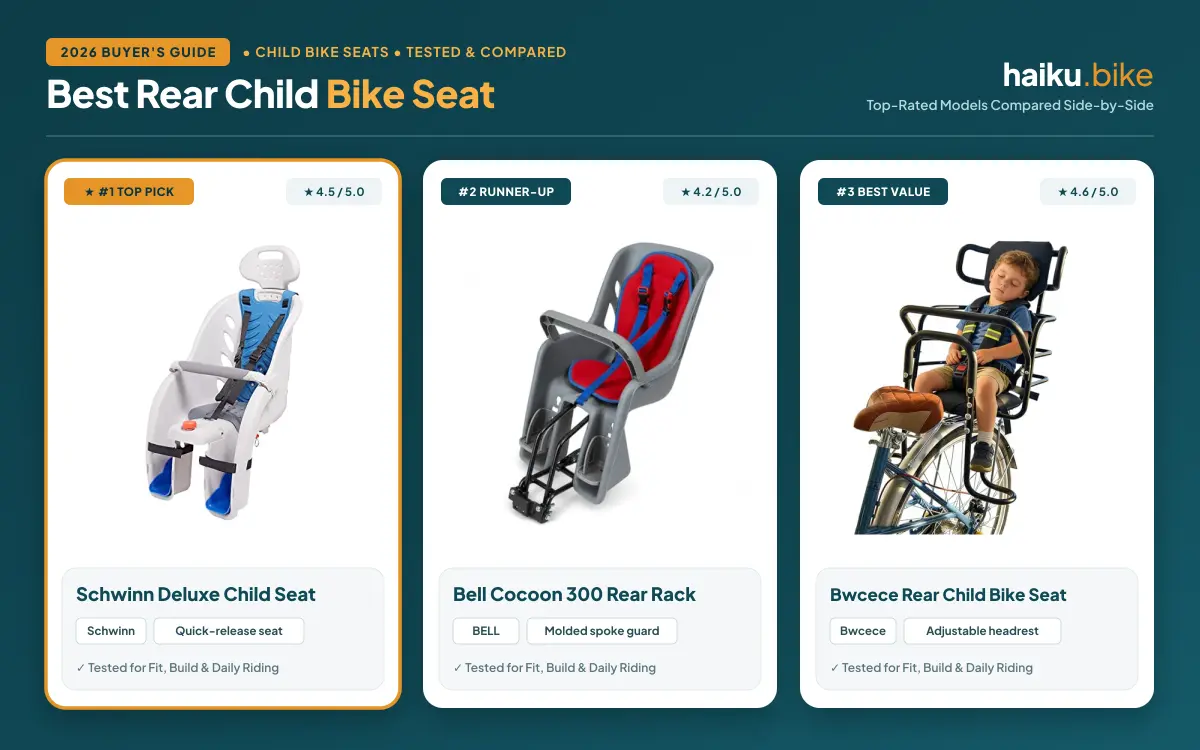
- Best value: Bwcece Kid’s Bike Seat Rear with Adjustable combines an adjustable headrest, handrail, and foot pedals in a rear-mounted design.
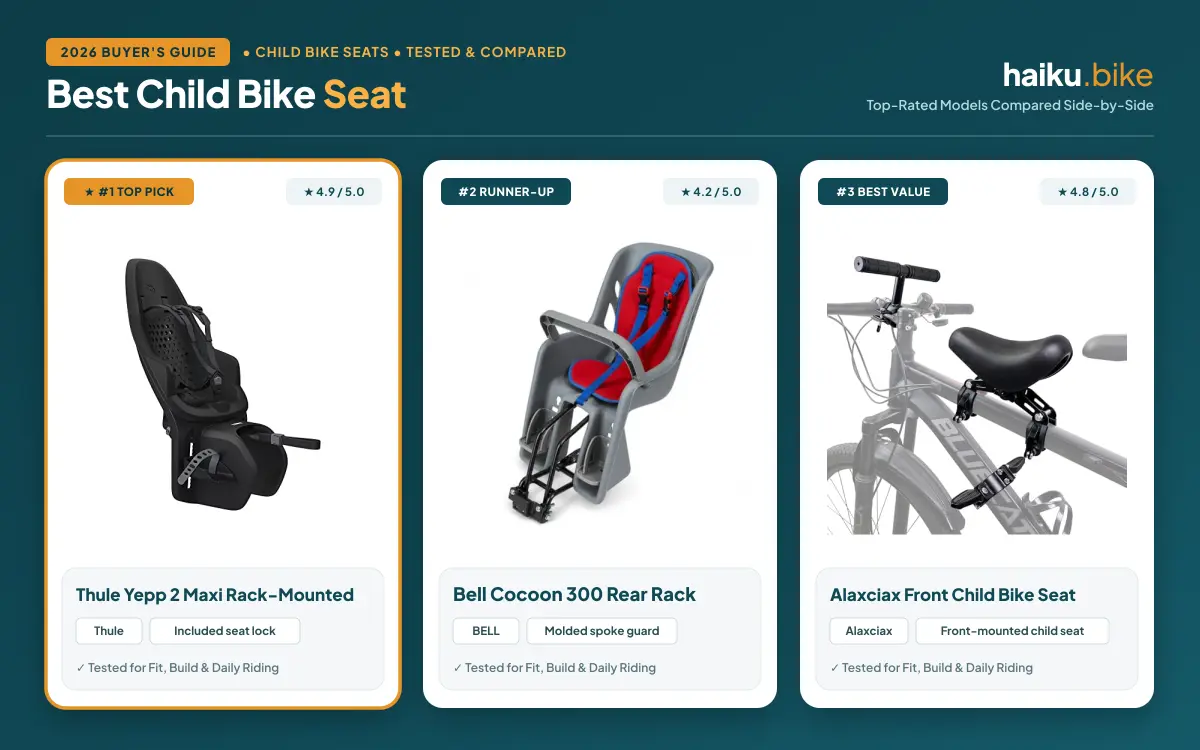
- Best for front-seat conversation: Kazam Wallaby Center-Mounted Child Bike Seat places a toddler in front with a 5-point harness, subject to frame fit.
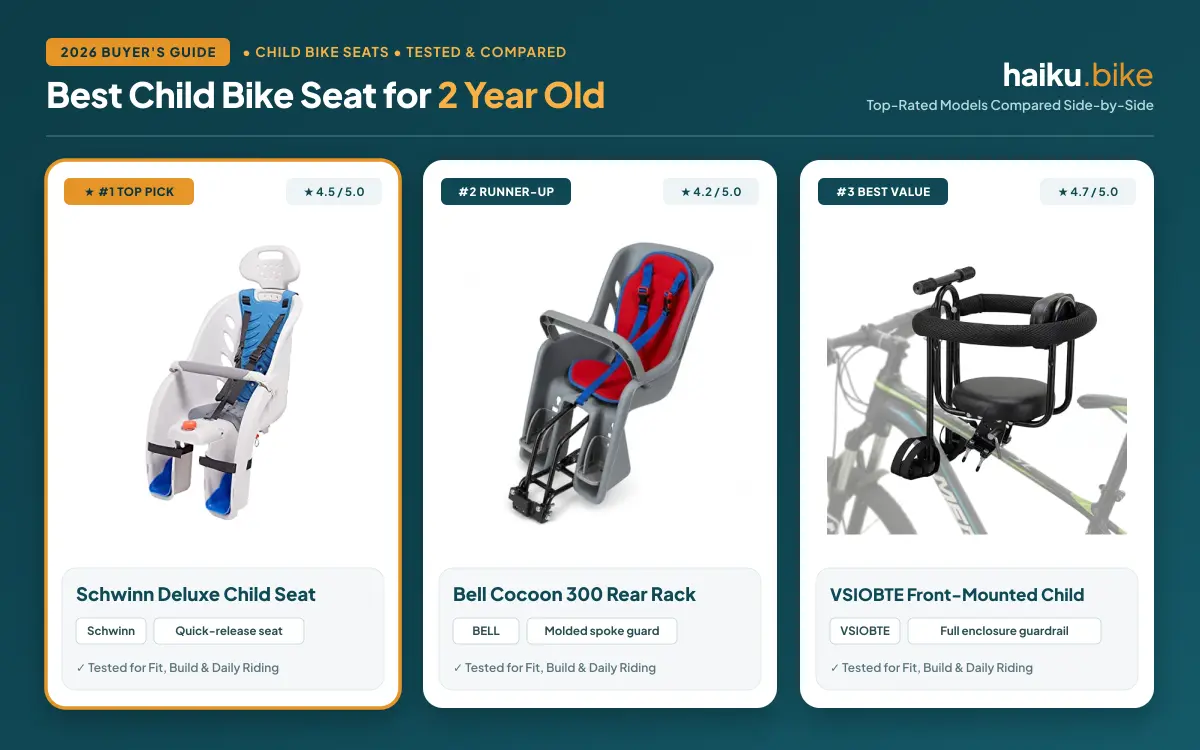
- Best for quick removal: UrRider Child Bike Seat, Front Mount Kids Bike folds and uses a tool-free quick-release mount, but excludes some frame types.

Pros
- Front-mounted position keeps child in view
- Tool-free quick release
- Foldable with included carry bag
- Adjustable footrests
- Fits some mountain and hybrid bikes
Cons
- Not for road bikes or carbon frames
- Requires specific frame and seat post measurements
- Who should skip it: riders without a compatible frame

Pros
- Adjustable headrest
- Sitting and reclining positions
- Full-perimeter fence
- Installation hardware included
- No special tools required
Cons
- Requires a compatible rear rack
- Rack dimensions must meet specified limits
- Who should skip it: Riders without a suitable rack

Pros
- Front-mounted child position
- Adjustable 3-point harness
- Adjustable foot cups
- Mounting hardware included
- Wipes clean
Cons
- Fits only stated stem bolt spacing
- Child limit: 38 lb
- Who should skip it: riders with incompatible bikes or children outside maker's range

Pros
- Adjustable headrest
- Thick padded cushion
- Removable handrail
- Foot pedals included
- Reflective tape on back
Cons
- Requires a rear rack
- Rack dimensions limit compatibility
- Maximum load capacity not specified
Pros
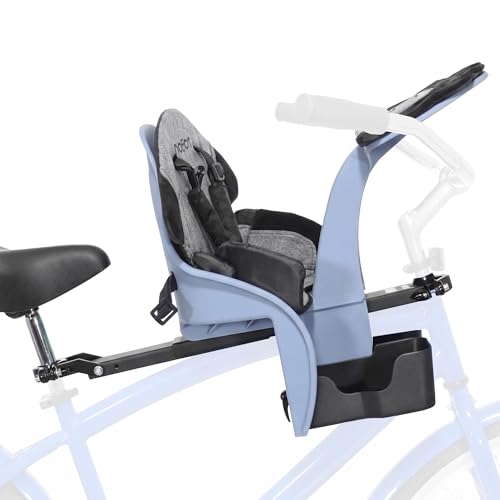
- Center-mounted, front-facing position
- Adjustable 5-point harness
- Adjustable foot cups
- Washable padded seat
- Weather-resistant plastic shell
Cons
- Limited to toddlers 27 to 37 inches tall
- Requires at least 7.5mm head tube clearance
- Bike fit depends on specified frame dimensions

Pros
- Guardrail and 3-point harness
- Reclining backrest
- Sun canopy
- Padded seat and high backrest
- Maker-listed 50 lb capacity
Cons
- Bike compatibility details are limited
- No safety certification listed
- Who should skip it: riders needing confirmed bike fit
Side-by-Side Comparison
| Seat | Mount | Listed fit or child guidance | Restraint and support | Notable trade-off |
|---|---|---|---|---|
| Rear Kids Bike Seat with Headrest | Rear rack | 12 months to 8 years; rack length over 11.81 inches and width under 6.69 inches | Perimeter fence; sitting and sleeping positions | Requires compatible rack and frame space |
| Bwcece Kid’s Bike Seat Rear with Adjustable | Rear rack | 18 months to 8 years; frame length over 11.81 inches and width under 7.48 inches | Safety belt, handrail, foot pedals | Maximum child weight not listed |
| iBert Front Mounted Child Seat with Patented | Front mount | Ages 1 to 3; 2 feet 5 inches to 3 feet 2 inches; up to 38 lb | Adjustable 3-point harness and foot cups | Requires 52mm to 62mm stem bolt spacing |
| Rear Child Bike Seat Toddlers Rear Mount Bike seat | Rear mount | Over 1 year; supports up to 50 lb | 3-point buckle, guardrail, canopy | Bike fit dimensions not listed |
| Kazam Wallaby Center-Mounted Child Bike Seat | Center mount | 27 to 37 inches tall; specified frame limits | 5-point harness and adjustable footrests | Requires careful frame measurement |
| UrRider Child Bike Seat, Front Mount Kids Bike | Front mount | Ages 2 to 6; up to 60 lb; specified frame limits | Handrail, saddle, adjustable footrests | Not for road bikes with horizontal top tubes or carbon frames |
Mounting compatibility matters most because a seat that does not attach to the bicycle as specified cannot serve its intended purpose. Rear rack models require suitable rack space, while front and center mounts depend on frame or stem dimensions. Measure first, then compare the child’s size and restraint needs with the maker’s guidance.
Common Mistakes to Avoid
Buying before measuring the mounting area can leave a rear seat incompatible with the bike. Rear Kids Bike Seat with Headrest specifies a rack length greater than 11.81 inches and width below 6.69 inches, while Bwcece gives different limits. Compare the exact requirements for your chosen seat with the bicycle and rack.
Assuming every front seat fits every bicycle is another costly mistake. iBert specifies stem bolt spacing, and KaZAM and UrRider list frame measurements and exclusions. Check cables, batteries, and available clearance where applicable, then confirm compatibility with the maker if your bike falls near a listed limit.
Choosing by age alone can overlook height, weight, posture, and restraint fit. The products give different passenger guidance, and some do not publish a maximum child weight. Read the manufacturer’s instructions and do not treat a broad age range as proof that a specific child fits securely.
Assuming safety features prove certification can create a false sense of certainty. Rear-mounted seats should have ASTM F1625 certification confirmed in the product listing or manufacturer documentation; front-mounted and center-mounted seats fall outside that standard. Also check that the adult bicycle and rack can support the intended combined load.
Best Child Bike Seat Under $100 Buying Guide
Mounting Style and Bicycle Compatibility
Mounting style determines whether a child seat can attach to your bicycle and where the passenger sits. Rear rack seats place the child behind the rider, while front and center-mounted seats place the child closer to the handlebars or top tube.
Rear Kids Bike Seat with Headrest and Bwcece both require a rear rack and specify different rack dimensions. iBert lists stem bolt spacing, KaZAM gives several frame limits, and UrRider excludes carbon frames and road bikes with horizontal top tubes. Check your bicycle measurements against the exact model requirements, not a general claim that it fits most bikes.
Child Size, Restraints, and Support
Child fit depends on the maker’s age, height, and weight guidance, plus the child’s ability to sit in the intended position. The listed limits differ: iBert specifies age, height, and weight, while UrRider lists an age range and a maximum weight.
Compare harness design and foot support as carefully as the seat shell. iBert has a 3-point harness and adjustable foot cups, KaZAM has a 5-point harness and adjustable footrests, and Bwcece lists a belt, handrail, and pedals. Confirm that restraints fit the child and can be secured as directed.
Seat Position and Passenger Interaction
Seat position affects how closely you can see and speak with your passenger during a ride. Front-mounted and center-mounted designs keep the child in front, while rear seats carry the passenger behind the rider.
UrRider and iBert offer front positioning, and KaZAM describes its seat as center-mounted. That arrangement may suit families who value conversation, but it also places the seat near the rider’s space and requires close attention to fit. Rear seats may suit riders who prefer an unobstructed front area, provided the rack and frame meet specifications.
Comfort, Adjustment, and Weather Features
Comfort features can help a child remain supported, but they do not replace correct fit or restraints. Rear Kids Bike Seat with Headrest offers sitting and sleeping positions, and Bwcece lists an adjustable headrest and thick cushion. SHIAOBYC describes a reclining backrest, cushion, and sun canopy.
KaZAM includes a padded dashboard and washable padded seat, while UrRider lists a cushioned ventilated saddle. Think about the child’s posture and the ride conditions, then check that adjustments work with the child’s helmet and the manufacturer’s instructions. Do not assume a canopy provides protection beyond the maker’s stated description.
Safety Information and Certification
Certification and clear manufacturer instructions help families evaluate child-carrying equipment before purchase. For rear-mounted child bike seats, check the listing for ASTM F1625 certification rather than inferring compliance from a harness, guardrail, or reflective material.
ASTM F1625 does not cover front-mounted or crossbar seats, so do not apply that standard to iBert, UrRider, or KaZAM based on seat position alone. Confirm applicable product information with the manufacturer, and check local rules. The product descriptions do not establish that any specific seat is certified.
Installation, Removal, and Ongoing Checks
Installation requirements matter because each seat depends on a secure attachment to a compatible bicycle. Rear Kids Bike Seat with Headrest includes hardware and instructions, and Bwcece describes assembly without special tools. UrRider advertises tool-free quick release, while other models have different mounting arrangements.
Follow the model-specific instructions and confirm fasteners and attachment points are secure before carrying a child. Inspect the harness, handrail, foot supports, and frame contact areas regularly for looseness or damage. If the seat shifts or a component is damaged, do not ride with a child until the manufacturer’s guidance resolves the concern.
How We Chose
We score products with the Haiku Ride Score: core performance 30%, build and weather resistance 20%, ease of use 20%, compatibility and fit 15%, and value 15%. For child bike seats, compatibility and fit means mounting dimensions, stated child fit guidance, restraints, and support features.
We evaluate manufacturer specifications, compatibility information, and long-term owner feedback when those details are available. We research and draft our guides with software tools, including AI, then run automated checks on product fit, sourcing, and our editorial rules. Our editor spot-checks guides rather than reading each one before publication. Read more about how we review.
Price and Value: What Each Budget Gets You
Budget
Within this guide’s under-$100 ceiling, the lower-cost end includes seats with core support features rather than extensive adjustment. Rear Kids Bike Seat with Headrest combines a perimeter fence and two seating positions, but requires a compatible rack. Buyers should prioritize a secure fit and clear child guidance over extra convenience features.
Mid-Range
Mid-budget choices add features that change passenger position or improve adjustment and support. Bwcece includes an adjustable headrest, handrail, and foot pedals, while iBert provides a front position, harness, and adjustable foot cups. These features can suit different families, but each design still has specific compatibility limits to confirm.
Premium
At the upper end of this guide’s budget, riders can find more specialized combinations of restraints, padding, or removal convenience. KaZAM lists a 5-point harness and adjustable footrests, while UrRider folds and uses a quick-release mount. These additions do not remove frame restrictions or guarantee a suitable fit for every child.
Choosing Something Else
A child bike trailer is an alternative for families whose bicycle cannot accept a seat or who prefer a separate passenger compartment. Check trailer compatibility and passenger guidance, and look for ASTM F1975 certification for bicycle trailers that carry children. A trailer adds a different setup and riding profile, so compare it with your routes and storage needs.
Final Thoughts
Families with a compatible rear rack can compare Rear Kids Bike Seat with Headrest for its two seating positions, or Bwcece Kid’s Bike Seat Rear with Adjustable for its headrest, handrail, and foot pedals. Both require careful measurement, and neither description gives a complete answer for every child’s fit.
Parents who want the child in front can consider iBert Front Mounted Child Seat with Patented, Kazam Wallaby Center-Mounted Child Bike Seat, or UrRider Child Bike Seat, Front Mount Kids Bike. Their harnesses and mounting requirements differ, so choose by measured bicycle compatibility and the child’s stated fit.
Riders seeking a canopy and reclining backrest can also compare Rear Child Bike Seat Toddlers Rear Mount Bike seat, but its bike fit dimensions are not listed. Skip these seats if your bicycle does not meet the maker’s requirements, the child cannot use the restraints as directed, or you cannot confirm safe load guidance. Browse the child bike seat category or our kids and family cycling guides for related options.
FAQs
Will a rear child bike seat fit any bicycle?
A rear child bike seat does not fit every bicycle because mounting systems and rack dimensions vary. Rear Kids Bike Seat with Headrest and Bwcece list different rack measurements, so compare the chosen seat’s requirements with your bicycle. Confirm that the rack is suitable for the intended load and follow the manufacturer’s installation instructions.
Which child bike seat fits a toddler?
A child bike seat fits a toddler only when the child meets the maker’s stated size guidance and can use its restraints correctly. The listed guidance varies by model, including age, height, and weight limits. Check the seat instructions and confirm the bicycle fit before purchase, rather than choosing by age alone.
Are front-mounted child bike seats safe?
Front-mounted child bike seats have different mounting requirements and are not covered by ASTM F1625, which applies to rear-mounted child bike seats. Check the specific seat’s instructions, fit limits, and product documentation. Do not assume a harness or front guardrail proves certification, and follow local laws and manufacturer guidance.
What does ASTM F1625 cover for child bike seats?
ASTM F1625 is the relevant standard named here for rear-mounted child bike seats; it does not cover front-mounted or crossbar seats. Check the product listing and manufacturer documents for certification before buying a rear seat. None of the product descriptions establishes that a specific seat in this guide holds that certification.
Can a child bike seat carry a child up to 60 lb?
UrRider lists a maximum child weight of 60 lb, while other seats give different limits or do not list a maximum weight. The bicycle and mounting system also need to support the intended load. Check both the seat and bicycle documentation, and do not use a stated seat limit as proof that your bike is suitable.
How do I install a child bike seat securely?
Install a child bike seat by following the exact instructions and using the supplied mounting hardware as directed. Check attachment points, fasteners, restraints, and foot supports before each ride. If the seat moves, a part is damaged, or the instructions do not resolve a fit question, do not carry a child until you get manufacturer guidance.
Should I choose a child bike seat or a trailer?
A child bike seat places the passenger on the bicycle, while a trailer provides a separate compartment behind it. A trailer may suit families whose bikes do not meet seat mounting requirements or who prefer that arrangement. Check trailer fit and ASTM F1975 certification, and compare family needs with our guide to seats for 2-year-olds.
Write Your Review
No reviews yet. Be the first to share your experience!