E-bike commuters riding after dark need a headlight that helps reveal road hazards and makes their bike easier to see. The options here range from simple rechargeable sets to lights with mode-specific runtime claims, battery indicators, and wider-angle visibility features.
This guide compares 7 lights from brands including Ascher, Victoper, Suruid and more for beam output, runtime, mounting, charging, and weather resistance. Follow the manufacturer’s instructions and local laws, and check your e-bike manual before attaching accessories. Riders comparing other add-ons can browse our E-Bike Accessories guide.
At a Glance: Which One Fits You
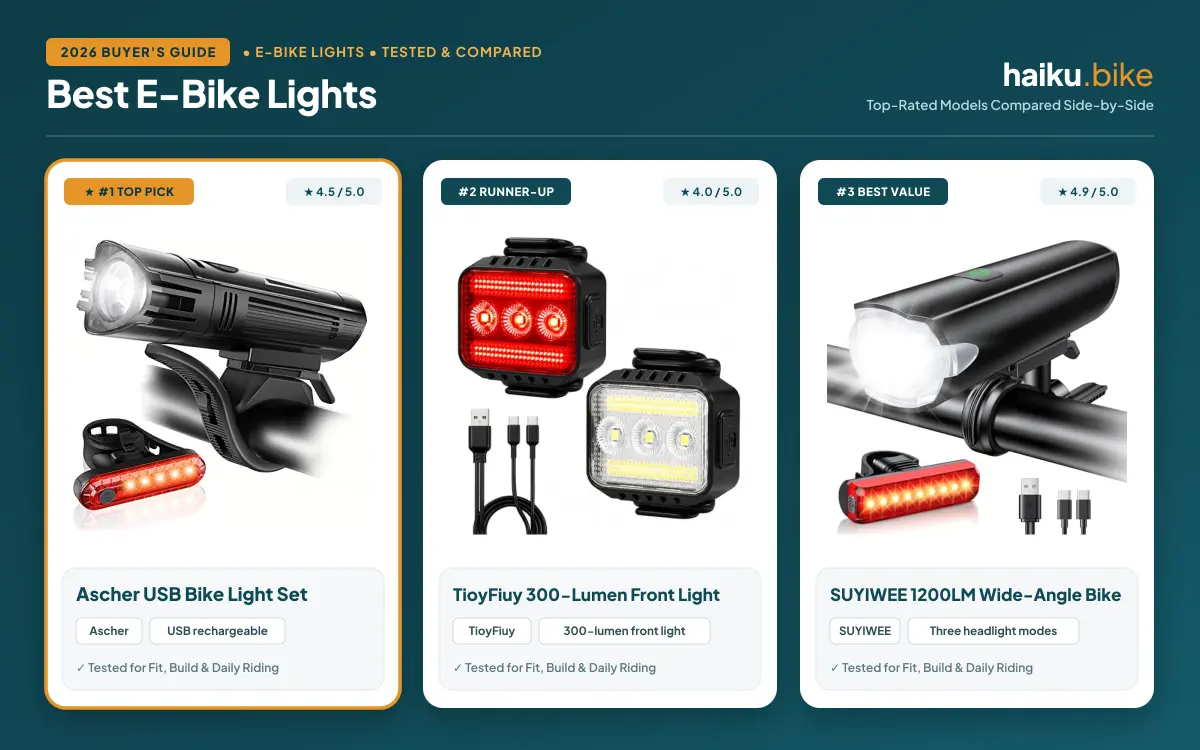
- Best overall: Zewdov 1000 Lumens Super Bright Bike Lights combines eight headlight modes, seven taillight modes, and an IP65 rating stated by its maker.
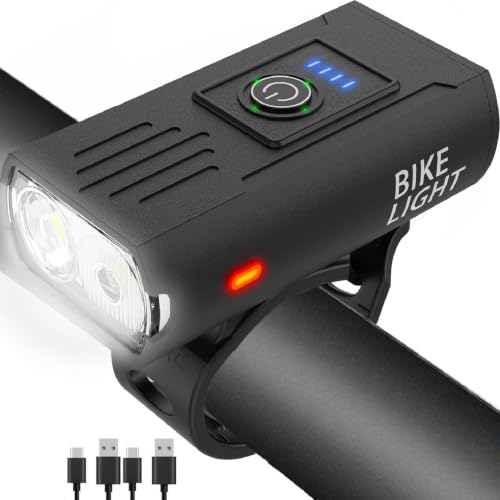
- Best value: Victoper Bike Light, High Lumens Super Bright offers six front-light modes and an IPX4 rating, though its maker does not list a lumen figure.
- Best for side visibility: SUYIWEE 2026 New 1200LM Wide Angle Bike Lights has side-emission lenses and a maker-described 270-degree beam.
- Best for battery information: Vastfire 17 LED Bike Lights 5000 Lumen includes an LCD power display and a maker-stated runtime of up to 16 hours.

Pros
- Front and rear lights included
- Multiple steady and flash modes
- USB-C charging cable included
- Tool-free installation
- Aluminum alloy casing
Cons
- Four-hour runtime at highest headlight brightness
- Mode controls use single-click, double-click, and long-press
Pros
- Six front-light modes
- Two front LEDs
- USB rechargeable
- IPX4 water resistance
- Lightweight, portable design
Cons
- No battery runtime listed
- No lumen output listed
- Mount compatibility details absent

Pros
- Front and rear lights included
- Four headlight modes
- USB-C charging and output
- Battery-level display
- IPX7 water-resistance rating
Cons
- Runtime by lighting mode not specified
- Handlebar fit range not specified

Pros
- 270° wide-angle front beam
- Three headlight modes
- Five rear-light modes
- IP65 water resistance
- Quick-release brackets
Cons
- Handlebar fit range not listed
- Rear-light runtime conditions not specified
- Light output not stated for rear light

Pros
- Headlight and taillight included
- Five lighting modes
- Up to 1,200 lumens, maker-rated
- IPX5 water-resistance rating
- Tool-free mounting
Cons
- Built-in battery is non-detachable
- Runtime rated for 1.5 to 3 hours
- No charging-port type listed

Pros
- Front and rear lights included
- USB rechargeable
- Four lighting modes
- Tool-free silicone strap mounts
- 3.5 oz combined weight
Cons
- No lumen rating listed
- Runtime varies by mode
- No charging port type listed

Pros
- Low- and high-beam setup
- USB-C charging
- Quick-release mount
- Five lighting modes
- Aluminum-alloy shell
Cons
- Runtime not specified
- Handlebar compatibility range not specified
- IPX4 rating does not indicate immersion protection
Side-by-Side Comparison
| Light | Stated headlight output | Stated front runtime | Water resistance | Charging |
|---|---|---|---|---|
| SUYIWEE 1200LM Wide Angle Bike Lights | 1200 lumens | Up to 6 hours high, 7 hours low | IP65 | USB-C |
| Super Bright Bike Light for Night Riding | Up to 1200 lumens | 1.5 to 3 hours | IPX5 | USB |
| Ascher Ultra Bright USB Rechargeable Bike Light | Not listed | 5 to 12 hours | IPX4 | USB |
| Zewdov 1000 Lumens Super Bright Bike Lights | 1000 lumens | Up to 4 hours high, 19 hours low | IP65 | USB-C |
| Victoper Bike Light, High Lumens Super Bright | Not listed | Not listed | IPX4 | USB rechargeable |
| Vastfire 17 LED Bike Lights 5000 Lumen | 5000 lumens | Up to 16 hours | IPX7 | USB-C |
| Suruid Super Bright LED Bike Light | 1800 lumens | Not listed | IPX4 | USB Type-C |
Runtime at the brightness you plan to use matters more than the largest advertised maximum. Zewdov and SUYIWEE publish separate high- and low-mode figures, while several other makers provide less detail. Riders with long commutes should compare the intended mode and keep charging time in their routine.
Common Mistakes to Avoid
Choosing a headlight by lumen claims alone can leave riders with a beam that does not suit their route. Lumens describe output, not beam placement or pavement coverage. Compare the maker’s beam description, consider side visibility, and aim the light according to its instructions to avoid directing unnecessary glare toward other road users.
Planning around a maximum runtime can leave a commuter short of charge on the return trip. Some maximum figures apply only to low mode, so match the published figure to the brightness you expect to use. Leave a practical reserve for delays, and recharge before a longer ride rather than relying on a warning indicator.
Assuming every mount fits every e-bike can produce an unstable setup or block cockpit controls. Compare the strap or bracket with available handlebar space, display placement, buttons, and cables. After installation, confirm that the mount holds its position and the beam points where you need it.
Relying on a headlight alone can leave a bike difficult to see from behind or from the side. Confirm whether the package includes a taillight and check its modes and mounting position. Reflective clothing can add visibility without depending on a charged battery, especially when traffic approaches from several directions.
Best E-Bike Headlight Buying Guide
Beam Output and Pattern
Beam output and pattern determine how a headlight illuminates the route and how its light reaches other road users. A lumen figure describes stated output, but it cannot show where the beam lands or how evenly it covers pavement. Check for useful maker details about beam width, near-field coverage, and side-facing elements.
Suruid lists 1800 lumens, while Vastfire lists 5000 lumens; those claims alone do not prove which beam suits your streets. SUYIWEE describes side-emission lenses and a 270-degree beam for visibility at oblique angles. On shared roads, consider beam aim and distribution alongside output, and follow the product instructions when positioning the light.
Runtime and Battery Information
Runtime matters because your headlight needs to stay illuminated for the full trip in the mode you plan to use. Compare the maker’s claim for that specific mode, rather than treating a low-setting maximum as a full-output estimate. If the listing gives only one runtime figure, look for an explanation of its conditions before relying on it.
Vastfire lists up to 16 hours, while Zewdov lists up to 4 hours at highest brightness and 19 hours at lowest brightness. SUYIWEE lists up to 6 hours on high and 7 on low. These claims use different levels of detail, so compare like with like and leave reserve for delays or colder conditions.
Battery indicators can help riders decide when to recharge before a commute. Vastfire includes an LCD power display, and SUYIWEE describes an indicator that flashes below 20 percent. Check charging instructions and port access before buying, then recharge ahead of a long ride instead of depending on a warning to appear at a convenient time.
Front and Rear Visibility
A front light helps you see ahead, while a rear light helps traffic approaching from behind notice your bike. Several products in this guide include both lights, but package contents, rear modes, and runtime differ. Confirm that a taillight is included if you need one instead of assuming every product name describes the full package.
More modes do not automatically mean better visibility, but they can give riders options for different conditions. Zewdov lists seven taillight modes, while SUYIWEE lists five. Read the instructions so you can select a suitable mode while stopped, and check local laws for rules that apply to bicycle lighting and flash patterns.
Side-emission lenses address viewing angles that a forward-facing beam may not cover. SUYIWEE describes those lenses, while a rear light targets traffic coming from behind. Reflective clothing can supplement both lights on routes with intersections or mixed traffic, where drivers may approach from several directions.
Mounting and E-Bike Fit
A secure mount helps keep a headlight aimed at the road and reduces movement over rough pavement. The options include silicone straps, quick-release brackets, and aluminum brackets. Compare each design with your handlebar layout, particularly when an e-bike display, control buttons, or other accessories occupy space near the stem.
Ascher uses a silicone mount strap that its maker says fits most handlebar sizes. Vastfire describes an aluminum bracket with a dual-nut structure and silicone pads. Those designs attach differently, so review product fit information and check that the mount does not obstruct controls, cables, or your view of the display.
Quick removal can make charging and storage easier, but the mount still needs to hold its position while riding. Install the light according to the maker’s instructions and check its aim before setting off. If your handlebar shape or accessory layout is unusual, confirm compatibility before ordering rather than assuming a universal fit.
Water Resistance and Construction
Water-resistance ratings describe a product’s stated protection, but they do not make every light suitable for every exposure. These products list ratings from IPX4 to IPX7, as well as IP65. Compare the stated rating with your typical riding conditions and follow the maker’s instructions for wet or muddy rides.
Zewdov and SUYIWEE list IP65 protection, Vastfire lists IPX7, and Ascher and Victoper list IPX4. Treat each rating as a manufacturer specification, not a guarantee for every situation. Follow charging-port care instructions, and check whether the maker gives guidance about drying the light after wet rides.
Housing and bracket construction both matter when a light faces vibration and regular handling. Victoper and Suruid identify aluminum alloy housings, while other products describe aluminum components. A sturdy light body cannot compensate for a bracket that shifts, so consider the attachment and housing together when comparing options.
Charging and Controls
Charging connections and controls affect how easily a light stays ready and changes modes. SUYIWEE, Zewdov, Vastfire, and Suruid describe USB-C or Type-C charging, while other products describe USB charging. Check the product instructions and included cable information, then decide whether the charging setup fits your routine.
Mode counts matter less if selecting a setting is confusing while you are stopped beside the bike. Zewdov describes single-click, double-click, and long-press controls, while Ascher describes a one-touch sequence across four modes. Read the instructions before relying on a particular brightness or flash setting during a commute.
Extra charging functions may help, but they should not replace a realistic runtime comparison. Vastfire lists USB-C output for emergency device charging, and SUYIWEE describes charging both lights through dual Type-C ports. Riders comparing related equipment can also browse our E-Bike Helmets guide.
How We Chose
We assess these lights with the Haiku Ride Score: core performance counts for 30%, build and weather resistance for 20%, ease of use for 20%, compatibility and fit for 15%, and value for 15%. For this category, compatibility and fit include mounting space, charging, and published battery information.
We compare manufacturer specifications, compatibility information, and long-term owner feedback to assess how each light may suit different riders. We research and draft our guides with software tools, including AI, then run automated checks on product fit, sourcing, and our editorial rules. Our editor spot-checks guides rather than reading each one before publication. Our how we review page explains our editorial approach.
Price and Value: What Each Budget Gets You
Budget
At the lower end, riders can find rechargeable lights with straightforward controls and basic weather resistance. Victoper offers six front-light modes and an IPX4 rating, while Ascher includes front and rear lights with stated runtime ranges by mode. These options suit riders who value a simple setup, but their maker information gives less detail about beam output than some alternatives.
Mid-Range
Options in the middle of this selection add features such as more detailed mode choices, side visibility, or charging conveniences. Zewdov publishes separate runtime claims for high and low modes, and SUYIWEE describes side-emission lenses and dual USB-C charging. Those details can help match a light to a commute, although riders should still assess beam suitability and runtime at their intended setting.
Premium
At the upper end, Vastfire lists a digital battery display, multiple beam modes, an IPX7 rating, and a maker-stated runtime of up to 16 hours. These features may appeal to riders who value battery information and a range of lighting settings. The trade-off is that a high output claim and extra functions do not guarantee the right beam for every street.
Choosing Something Else
Riders whose e-bikes already have working lights can first check whether those lights illuminate the route and remain visible from behind. Reflective clothing can supplement built-in lighting without adding another battery to charge. A separate rechargeable light makes more sense when the factory beam is inadequate, a light is missing, or a removable setup suits storage and charging needs.
Final Thoughts
Commuters who want multiple modes and a front-and-rear set can consider Zewdov 1000 Lumens Super Bright Bike Lights. Its maker lists eight headlight modes, seven taillight modes, and IP65 protection, but its multiple control actions may take time to learn. Riders who prefer fewer settings should compare simpler options before choosing.
Riders who value a battery display can compare Vastfire 17 LED Bike Lights 5000 Lumen, which has an LCD power display and a maker-stated runtime of up to 16 hours. Those who prioritize visibility from oblique angles can consider SUYIWEE 2026 New 1200LM Wide Angle Bike Lights. Their specialized features may be unnecessary for short rides on well-lit streets.
Budget-conscious riders who want several front-light modes can compare Victoper Bike Light, High Lumens Super Bright, though its maker does not state a lumen figure. Riders seeking a lightweight front-and-rear set can consider Ascher Ultra Bright USB Rechargeable Bike Light, with front-light runtime stated from 5 to 12 hours by mode. Check fit and package details before ordering either option.
Riders who need a light wired into an e-bike electrical system should choose a product designed for that system, not assume a USB-rechargeable lamp connects to the bike battery. Riders with adequate built-in lighting may not need a separate headlight. For related gear, browse our E-Bike Locks guide and the broader E-Bike Accessories category.
FAQs
What should I look for in an e-bike headlight?
An e-bike headlight should match your route, ride duration, and handlebar setup. Compare beam pattern, runtime at the mode you expect to use, water-resistance rating, and whether a taillight comes in the package. A lumen claim describes output, not beam distribution. Follow the maker’s instructions and consult your e-bike manual before attaching accessories.
How many lumens does an e-bike headlight need?
An e-bike headlight does not have one lumen level that suits every route. Unlit roads may call for more illumination than regularly lit streets, but beam shape and aim also affect what you can see. Compare the maker’s output claim with your conditions, and avoid pointing a bright beam toward drivers or other riders.
How long should an e-bike headlight battery last?
An e-bike headlight battery should cover your full ride in the mode you plan to use, with reserve for delays. Runtime claims can vary by brightness setting, so compare the maker’s figure for that specific mode. Recharge before longer rides, and treat a battery indicator as a reminder rather than a reason to wait until power runs low.
Do USB-rechargeable bike lights work on e-bikes?
USB-rechargeable bike lights can work on an e-bike when their mounts fit and they do not interfere with displays, controls, or cables. Rechargeable does not mean that a light connects to the e-bike’s electrical system. Check the light and bike instructions, and confirm that the charging method and mounting arrangement suit your specific setup.
Can I ride with an e-bike headlight in the rain?
An e-bike headlight with a stated water-resistance rating may suit some wet-weather riding, but the maker’s care instructions still apply. Options here list ratings from IPX4 to IPX7 and IP65. Protect charging ports as directed, inspect the light after wet rides, and follow instructions about drying it before charging.
Do I need a separate taillight for my e-bike?
A separate taillight can help when an e-bike’s built-in rear light is absent, difficult to see, or not working. Several products in this guide include a rear light, but package contents and modes vary. Confirm what comes in the box, check local lighting rules, and consider reflective clothing as another visibility aid.
How do I mount a bike headlight securely?
A bike headlight should attach firmly without blocking brake levers, displays, cables, or other controls. Compare its strap or bracket with your handlebar layout, then follow the maker’s installation instructions. Before riding, check that the light points where intended and its mount stays stable. Browse our E-Bike Lights category for related options.
Write Your Review
No reviews yet. Be the first to share your experience!