

Commuters and weekend riders need a dependable way to reinflate a tire after a flat or pressure loss. A compact electric bike pump can reduce hand effort, but its pressure limit, battery capacity, valve setup, and carry size determine whether it suits your ride.
Our guide to the best electric bike pump under $50 compares 5 compact options from Fanttik, TOPUMP, Lamicall and more for riders in November 2026. Follow each manufacturer’s instructions and local laws, and see our guide to portable electric bike pumps for a broader comparison.
At a Glance: Which One Fits You
- Best overall: Fanttik X9 Ace Mini Electric Bike Pump, 150PSI offers the highest listed pressure ceiling here and maker-stated capacity for eight tires per charge, though its listed specifications do not give its weight.
- Best value: Lamicall Ultra Mini Electric Bike Pump, 120 PSI combines a 5 oz listed weight, automatic shutoff, and a 30-minute full charge, but its stated safe operating range ends at 120 PSI.
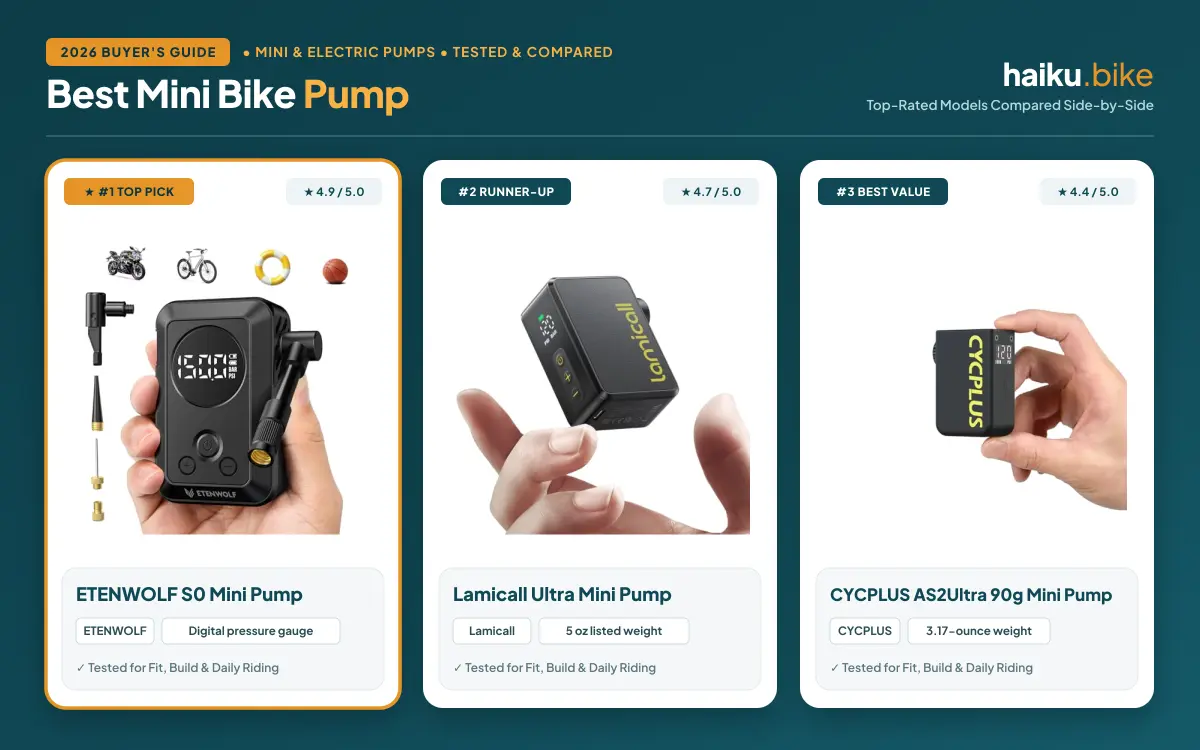
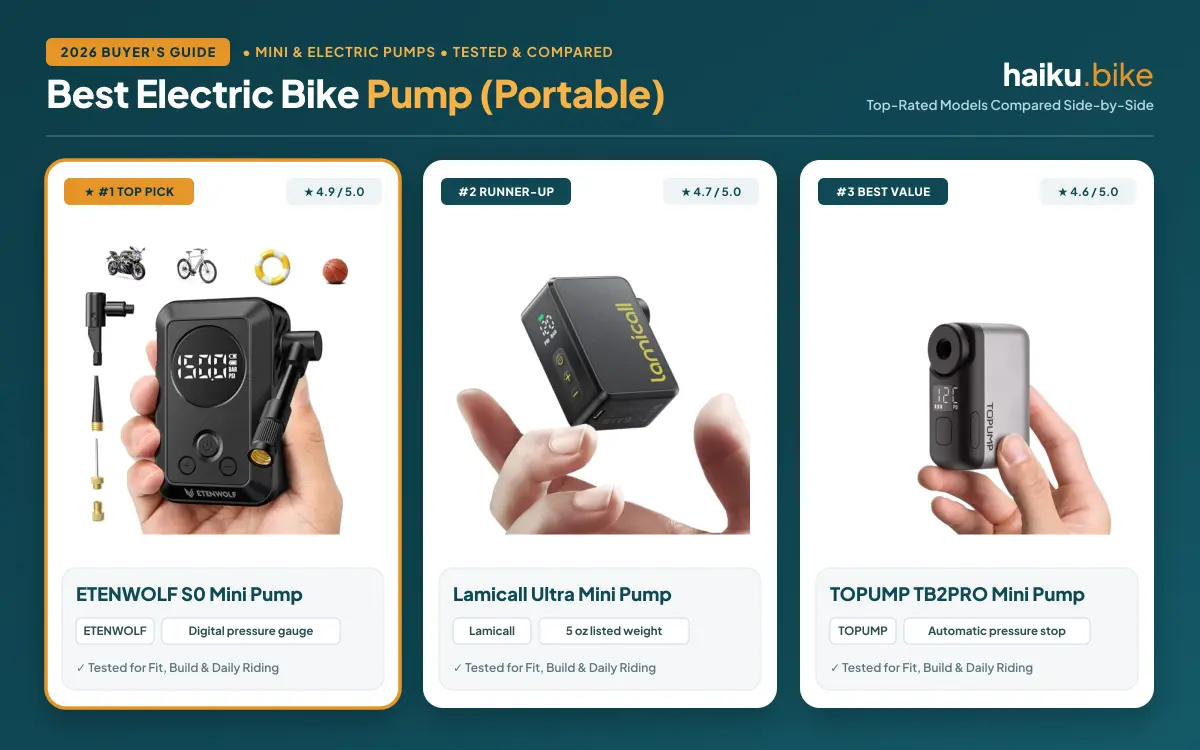
- Best for small carry: TOPUMP TB2PRO Mini Electric Bike Pump has listed dimensions of 2.09 x 1.26 x 3.03 inches and weighs 0.29 lb, though its stated maximum is 120 PSI.
- Best for a digital gauge: vorproform-x Electric Bike Pump includes a digital display, preset-pressure shutoff, and ball needle, but its maker says it is not suited to high-volume tires inflated from flat.

Pros
- Presta and Schrader compatibility
- Digital gauge with auto-stop
- Compact 4.23-ounce design
- USB-C charging
- Includes sports ball needle
Cons
- Not recommended for high-volume tires from flat
- No battery runtime stated
- Who should skip it: riders needing a full-size pump for flat, high-volume tires

Pros
- Presta and Schrader compatibility
- Automatic pressure stop
- Compact 0.29 lb body
- USB-C charging
- Included air hose
Cons
- Use hose above 100 PSI
- Resin TPU valves require hose
- Maker specifies two-tire minimum per charge

Pros
- Presta and Schrader compatibility
- Automatic pressure shutoff
- 5,000 mAh battery
- Up to 8 inflations per charge
- About 0.85 lb
Cons
- 25-minute continuous-use limit
- Requires battery charging

Pros
- Compact 0.29 lb design
- Presta and Schrader compatibility
- Preset-pressure auto-stop
- Digital gauge rated accurate to ±1 PSI
- USB-C charging
Cons
- No water-resistance rating listed
- Inflation estimates vary across listing
- Who should skip it: riders needing documented weather protection

Pros
- 5 oz listed weight
- Presta and Schrader compatibility
- Automatic pressure shutoff
- Real-time pressure display
- Type-C charging
Cons
- No water resistance rating listed
- Requires cooling after overheat shutdown
- Battery capacity not specified
Side-by-Side Comparison
| Product | Maximum pressure | Listed weight | Charging and capacity | Valve support |
|---|---|---|---|---|
| vorproform-x Electric Bike Pump | 120 PSI | 4.23 oz | About 30 minutes to charge; capacity not listed | Presta, Schrader |
| TOPUMP TB2PRO Mini Electric Bike Pump | 120 PSI | 0.29 lb | 30 minutes; at least two 700 x 25C tires from 0 to 120 PSI | Presta, Schrader |
| Fanttik X9 Ace Mini Electric Bike Pump, 150PSI | 150 PSI | Not listed | Capacity for eight tires per charge, according to Fanttik; charge time not listed | Presta, Schrader |
| Hydencamm Mini Bike Tire Pump | 120 PSI | Not listed | Full charge in one hour; capacity varies by tire and pressure | Presta, Schrader |
| Lamicall Ultra Mini Electric Bike Pump, 120 PSI | 120 PSI | 5 oz | 30 minutes; at least two 700 x 25C tires from 0 to 110 PSI | Presta, Schrader |
Pressure ceiling and battery claims distinguish these pumps most clearly. Fanttik lists a 150 PSI maximum, while the other models list 120 PSI; battery capacity claims use different tire conditions, so riders should compare them cautiously.
Common Mistakes to Avoid
Choosing by maximum pressure alone can lead to a poor match because tire volume and starting pressure affect battery demand and inflation time. Check the pressure guidance printed on your tire and provided by the bicycle or tire maker, then choose a pump with a suitable ceiling rather than treating maximum pressure as your target.
Assuming every valve connection works the same can create trouble at the roadside. All five products list Presta and Schrader support, but adapters and hose arrangements differ; TOPUMP specifically advises using its hose above 100 PSI and an extension hose with TPU tubes that have resin valves.
Ignoring battery limits and heat instructions can interrupt inflation or risk damage to delicate valve materials. Check the maker’s capacity conditions, charge before leaving, and follow any cooling or hose guidance; TOPUMP warns that direct connection can overheat resin valves on certain TPU tubes.
Expecting a mini electric pump to replace every workshop tool is another poor assumption. The vorproform-x maker says the pump is intended for top-offs or emergency refills, not high-volume tires inflated from completely flat, while a floor pump is better suited to regular home inflation.
Best Electric Bike Pump Under $50: Buying Guide
Pressure Range and Tire Needs
Pressure range matters because a pump must reach the pressure appropriate for your tire without exceeding its safe operating limit. Fanttik lists a 150 PSI maximum, while Lamicall, TOPUMP, Hydencamm, and vorproform-x each list 120 PSI.
Those maximums describe pump ceilings, not recommended tire settings. Read the tire sidewall and follow the bicycle and tire makers’ guidance, since tire width, rider load, surface, and riding style affect suitable pressure. Do not inflate beyond the tire’s stated limit.
Compare the stated operating range as well as maximum pressure. Lamicall describes a safe operational range of 0 to 120 PSI, while TOPUMP advises using its hose above 100 PSI. Riders who need a higher pressure ceiling may prefer Fanttik, but should still verify their tire’s requirements.
Battery Capacity and Charging
Battery capacity determines how many inflation jobs a rechargeable pump may handle before it needs power. Fanttik says its pump can inflate eight tires per charge, while TOPUMP and Lamicall each state capacity for at least two 700 x 25C tires under specified conditions.
These maker claims do not use identical tire sizes and pressure conditions, so they are not direct comparisons. Hydencamm gives different capacity claims for 700 x 23C and 700 x 25C tires, while vorproform-x does not list a per-charge tire count.
Charging time can matter when you use a pump for commuting or keep it in a travel bag. Lamicall and TOPUMP list a 30-minute full charge, vorproform-x says about 30 minutes, and Hydencamm lists one hour; Fanttik does not publish a charge time here.
Valve Connection and Hose Design
Valve compatibility determines whether the pump can connect to your inner tube using its supplied parts. All five products list Presta and Schrader support, but the connection method, hose arrangement, and included accessories differ.
TOPUMP includes an air hose and Presta converter, and its instructions call for hose use above 100 PSI. Fanttik describes an integrated hose with a rotating connection, while Hydencamm lists separate hose and valve connectors among its included accessories.
Check the exact connection procedure before purchase, especially if your setup uses a delicate valve. TOPUMP specifically instructs riders with TPU inner tubes and resin valves to use an extension hose to reduce overheating risk. For more valve guidance, read how to pump a presta valve without losing air.
Size, Weight, and Carrying
Carry size matters when a pump needs to fit in a jersey pocket, saddle bag, or commuter pack. Lamicall lists a 5 oz weight, vorproform-x lists 4.23 oz, and TOPUMP lists 0.29 lb plus dimensions of 2.09 x 1.26 x 3.03 inches.
Hydencamm describes its pump as smaller than most smartphones but does not list weight or dimensions. Fanttik calls the X9 Ace palm-size, but its listed specifications do not provide exact measurements, so riders with tight storage limits should check current product details.
Plan space for accessories as well as the pump body. A hose, valve converter, cable, or storage bag can change how neatly a pump packs, and those items may be useful during roadside inflation. Compare the included parts with your existing repair kit before choosing a carry setup.
Inflation Speed and Heat Management
Inflation speed affects the length of a roadside stop, but maker figures apply only to the stated tire and pressure conditions. TOPUMP lists 15 L/min airflow and about 50 seconds to reach 80 PSI; Fanttik lists 10 L/min and 32 seconds for a 700 x 23C tire from 80 to 100 PSI.
Lamicall says its pump can inflate a tire to 100 PSI in 50 seconds and lists airflow up to 32 L/min. The different figures do not establish a uniform comparison because tire volume, starting pressure, and operating conditions vary.
Heat management matters when a compact motor runs during inflation. Lamicall describes an overheat alert and automatic shutdown, while Fanttik says its cooling system supports continuous operation for 25 minutes. Follow the instructions for any pump, allow it to cool as directed, and stop if the valve or pump behaves unexpectedly.
Display, Controls, and Intended Use
Display and control features affect how easily you can set pressure and monitor inflation. Lamicall, TOPUMP, Hydencamm, and vorproform-x describe digital pressure displays, preset targets, or automatic stopping; Fanttik also lists automatic shutoff at the selected pressure.
Automatic shutoff can reduce the need to watch the gauge continuously, but you still need to enter a suitable target and confirm the reading. Lamicall lists pressure memory, and vorproform-x says it remembers the last pressure setting. Check whether the controls and display suit your eyesight and roadside routine.
Intended use can rule out a pump even when pressure and valve support appear suitable. Vorproform-x is described for top-offs and emergency refills, not high-volume tires inflated from flat; riders with large-volume tires should consider a pump designed for that job or carry another inflation option.
How We Chose
We assess compact electric bike pumps with the Haiku Ride Score: core performance 30%, build and weather resistance 20%, ease of use 20%, compatibility and fit 15%, and value 15%. For these pumps, compatibility and fit cover valve support, hose arrangements, charging, carry details, and maker-stated battery capacity.
Our evaluation compares manufacturer specifications, compatibility information, and long-term owner feedback when available. We research and draft our guides with software tools, including AI, then run automated checks on product fit, sourcing, and our editorial rules. Our editor spot-checks guides rather than reading each one before publication. Our how we review page explains the method.
Price and Value: What Each Budget Gets You
Budget
At the lower end of this guide’s budget, riders can find a compact pump with automatic shutoff, a digital display, and support for common bicycle valves. Lamicall lists a 5 oz weight and a 30-minute charge, making its feature set useful for riders who value low carry weight. The trade-off is a 120 PSI ceiling and limited stated capacity compared with Fanttik’s claim.
Mid-Range
Mid-range options add a balance of portable design, preset pressure controls, and charging convenience. TOPUMP publishes exact dimensions and a two-tire capacity claim under stated conditions, while Hydencamm describes multiple included connectors and capacity claims for different tire sizes. Buyers give up some certainty where dimensions or weight are not listed, so check packing needs and supplied accessories before choosing.
Premium
At the upper end of this budget, the vorproform-x emphasizes a digital gauge, memory for the last setting, and a compact listed size; Fanttik adds a 150 PSI ceiling and a maker-stated eight-tire capacity. Those features suit riders prioritizing control or pressure range. Trade-offs remain: vorproform-x is not intended for high-volume tires from flat, and Fanttik does not list exact weight.
Choosing Something Else
A manual mini pump suits riders who want inflation without charging or battery management. It requires repeated hand strokes and can take more effort, but works as a simple backup when a rechargeable pump runs low. A floor pump is a practical choice for home inflation, especially for riders who rarely need powered inflation away from their bike storage.
Final Thoughts
Riders who prioritize a higher listed pressure ceiling and Fanttik’s stated tire capacity should consider the Fanttik X9 Ace Mini Electric Bike Pump, 150PSI. Its 150 PSI maximum separates it from the 120 PSI models in this guide, but exact weight is not listed. Riders who need confirmed pack dimensions should compare other options.
The TOPUMP TB2PRO Mini Electric Bike Pump suits riders who want published dimensions, a listed weight, and a stated 30-minute charge. Its capacity claim applies to specified 700 x 25C tires, and its hose guidance matters above 100 PSI. The Lamicall Ultra Mini Electric Bike Pump, 120 PSI is another compact choice, with a 5 oz listed weight and overheat protection.
Riders who value a display and remembered pressure setting can consider the vorproform-x Electric Bike Pump, while Hydencamm Mini Bike Tire Pump includes multiple listed connectors and a storage bag. Both have a 120 PSI maximum. Compare their stated limits and accessories with your tire and packing needs before deciding.
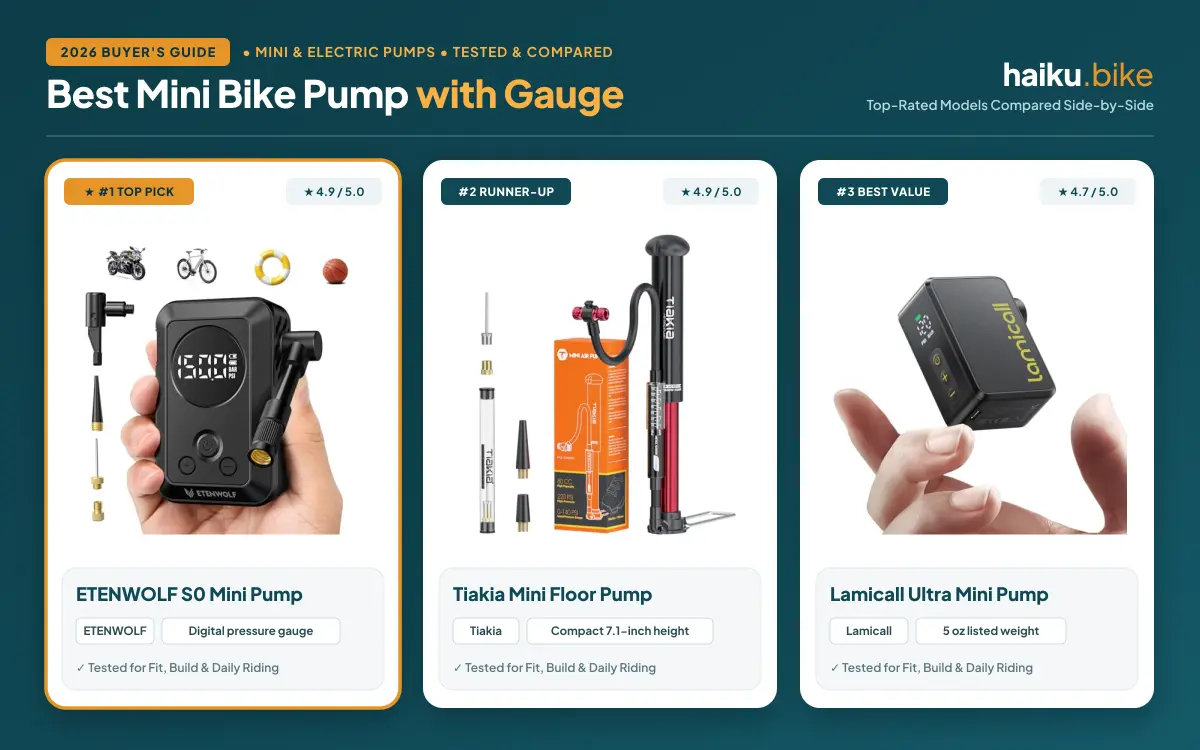
Riders who need frequent high-volume inflation, dislike charging, or mostly inflate tires at home should skip these portable electric pumps and choose a floor pump. Our floor pump category covers that alternative, while our mini bike pumps with gauges guide compares another portable format.
FAQs
Do electric bike pumps work with Presta valves?
Electric bike pumps in this guide list support for Presta and Schrader valves. Their adapters and hose arrangements differ, so check the instructions before connecting one to your tube. TOPUMP includes a Presta converter and advises using its hose above 100 PSI. Riders with resin valves on TPU tubes should follow its extension-hose guidance.
Can a mini electric pump inflate a tire from flat?
A mini electric pump may inflate a bicycle tire from flat, but capacity and suitability depend on the pump and tire volume. Vorproform-x is described for top-offs and emergency refills, not high-volume tires inflated from completely flat. Check the maker’s intended use and capacity conditions, then carry an alternative if your tire needs more air than the pump can provide.
How long do electric bike pumps take to charge?
Charging time varies by pump: TOPUMP and Lamicall list 30 minutes, vorproform-x says about 30 minutes, and Hydencamm lists one hour. Fanttik does not publish a charge time in its listed specifications. Charge the pump before a ride and follow its storage instructions, since a displayed charge time does not show how many inflations every tire will receive.
How many tires can an electric bike pump inflate per charge?
Per-charge capacity depends on tire size, starting pressure, and the target pressure. Fanttik says its pump can inflate eight tires per charge, while TOPUMP and Lamicall state capacity for at least two specified 700 x 25C tires under their stated conditions. The claims use different conditions, so riders should not treat them as a direct comparison.
Can I use an electric bike pump on a mountain bike?
An electric bike pump can suit a mountain bike if its valve connection, pressure range, and intended use match the tire. All five products list Presta and Schrader support, but a pressure ceiling alone does not confirm suitability for every tire volume. Check the tire maker’s pressure guidance and the pump’s instructions before inflating.
Are electric bike pumps safe for TPU tubes?
Electric pump use with TPU tubes depends on the tube’s valve material and the pump maker’s instructions. TOPUMP specifically says riders using TPU inner tubes with resin valves should connect an extension hose because direct connection may overheat the valve. Confirm your tube and valve materials, follow the pump instructions, and stop if the connection heats or behaves unexpectedly.
Should I carry an electric pump or a floor pump?
An electric pump suits riders who want powered inflation away from home and can keep its battery charged. A floor pump suits regular home or garage inflation and avoids battery management, but is not designed for pocket carry. Some riders may prefer a floor pump at home and a manual mini pump as a simple ride backup.
Where can I compare other compact bike pumps?
Riders comparing other compact options can use our guide to mini bike pumps with gauges. Before choosing, compare valve compatibility, stated pressure limits, carry dimensions, and included adapters. A gauge can help you set pressure, but you still need to follow the tire maker’s recommended range and the pump instructions.
Write Your Review
No reviews yet. Be the first to share your experience!