Parents carrying a young child by bicycle need a seat that fits the child, attaches securely to the bike, and leaves the rider able to pedal and steer comfortably. Rear seats position the child behind the rider, while front-mounted designs place the child between the rider and handlebar area.
Our guide compares 10 child bike seat options from brands including BELL, Schwinn, Auwey and more in November 2026. Follow the seat and bicycle manufacturers’ instructions and local laws, and check the product listing for ASTM F1625 certification (the standard for rear-mounted seats; front-mounted seats are not covered). Our Kids & Family Cycling category covers more equipment for riding with children.
At a Glance: Which One Fits You
- Best overall: Thule Yepp 2 Maxi Rack-Mounted Child Bike Seat earns this spot because it combines a padded 5-point harness, adjustable footrests, and a universal rack mount system.
- Best value: Bell Cocoon 300 Rear Mount Child Bike Seat earns this spot because its wrap-around seat includes a 5-point harness, spoke guard, and reflector.
- Best for front mounting: Alaxciax Front Mounted Bicycle Seats for Children earns this spot because its set includes a child seat, handlebars, and folding foot pedals.
- Best for MIK HD racks: Thule Yepp 2 Maxi Child Bike Seat Compatible earns this spot because its click-in mount is designed for MIK HD bike racks.

Pros
- Adjustable 5-point harness
- Shock-absorbing foam seat
- Adjustable footrests and footstraps
- Included seat lock
- Water-repellent materials
Cons
- Rack-mount version only
- Pediatrician guidance advised under age 1

Pros
- Quick-release seat
- 3-point harness and leg restraints
- Adjustable footwells
- Removable headrest
- Converts to rear rack carrier
Cons
- 40 lb maximum child weight
- Designed for most, not all, adult bikes
- Carries one child only

Pros
- Adjustable five-point harness
- Molded spoke guard
- Rear reflector included
- Mounting hardware and instructions included
- Fits most 26- and 27-inch bikes
Cons
- Requires compatible rear rack
- Not designed for rear-suspension bikes
- Maximum child weight: 40 lb

Pros
- Full enclosure guardrail
- Foot straps included
- Four pedal height settings
- Foam cushion and backrest
- Installation tools included
Cons
- Crossbars limited to 2 inches in diameter
- Designed for children ages 1 to 4
- Maximum load listed as 55 lb

Pros
- Sitting and sleeping backrest positions
- Three-point buckle harness
- Padded seat and armrests
- Disassembles for storage
Cons
- Requires a flat bike rack
- Rack must meet specific size limits
- Limited to children under 36 inches and 33 lb

Pros
- Safety harness
- Foot pedals included
- Fits flat or sloping top tubes
- Tool-free installation and removal
- Rated for children up to 48 lb
Cons
- Not suitable for e-bikes
- Not suitable for road bikes
- Top-tube cables can prevent compatibility

Pros
- Adjustable headrest
- Thick padded cushion
- Removable handrail
- Foot pedals included
- Reflective tape on back
Cons
- Requires a rear rack
- Rack dimensions limit compatibility
- Maximum load capacity not specified

Pros
- Front-mounted child seat
- Included handlebars and folding pedals
- Leather saddle
- Quick-release attachment
- Installation kit and Allen key included
Cons
- Listed for mountain bikes only
- Requires flat or slightly sloping top tube
- No child height or inseam range listed

Pros
- Dedicated MIK HD click-in mount
- Adjustable five-point harness
- Adjustable footrests and footstraps
- Included metal seat lock
- Water-repellent, easy-clean materials
Cons
- Fits MIK HD racks only
- Maximum child weight: 40 lb

Pros
- Gel and memory foam padding
- Silicone grip dots
- Drawstring and two extra straps
- Reflective rear strip
- Breathable Lycra surface
Cons
- Fit depends on seat dimensions
- Black cover only
Side-by-Side Comparison
| Product | Mount or type | Child fit stated by maker | Restraint | Bike fit details |
|---|---|---|---|---|
| Thule Yepp 2 Maxi Rack-Mounted Child Bike Seat | Rear rack | 9 months to 5 years; up to 40 lb | Padded 5-point harness | Universal rack mount system |
| Alaxciax Front Mounted Bicycle Seats for Children | Front mount | 2 to 5 years; up to 120 lb | Not listed | Adult mountain bikes with flat or slightly sloping top tubes |
| Toddler Bike Seat Front Mounted,Child Bicycle | Front mount | 1 to 4 years; up to 55 lb | Guardrail and foot straps | Crossbars up to 2 inches in diameter |
| Bwcece Kid’s Bike Seat Rear with Adjustable | Rear rack | 18 months to 8 years; capacity depends on bike | Safety belt | Rack longer than 11.81 inches and narrower than 7.48 inches |
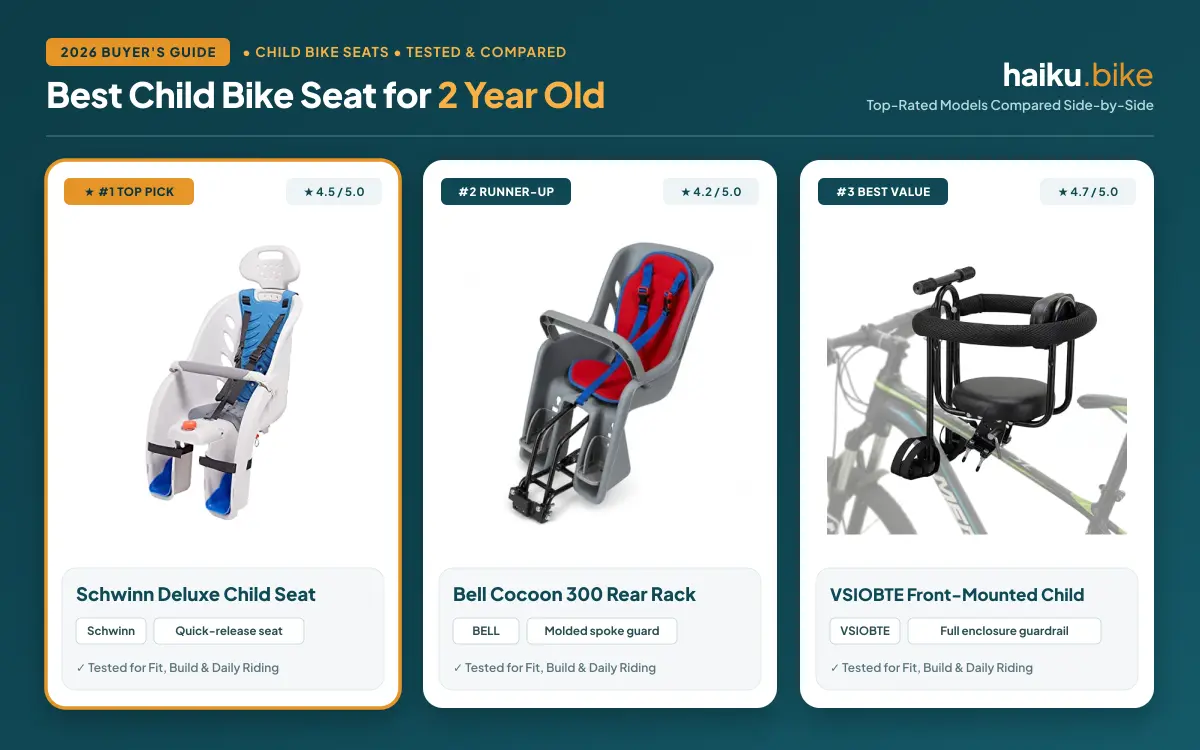
| Schwinn Deluxe Child Bike Carrier | Rear frame mount | Age 1 and older; up to 40 lb | 3-point harness and leg restraints | Most adult bikes |
| Auwey Kids Bike Seat Child Bike Seat Front Mount | Front mount | 2 to 5 years; up to 48 lb | Safety harness | Mountain bikes; not suitable for e-bikes or road bikes |
| XIEEIX Rear Child Bike Seat | Rear rack | 1 to 3 years; under 36 inches and 33 lb | 3-point buckle belt | Flat rack with stated size limits |
| Thule Yepp 2 Maxi Child Bike Seat Compatible | Rear MIK HD rack | 9 months to 5 years; up to 40 lb | Padded 5-point harness | MIK HD rack system |
| Bell Cocoon 300 Rear Mount Child Bike Seat | Rear rack | Age 1 and older; up to 40 lb | 5-point harness | Most standard 26-inch and 27-inch bikes without rear suspension |
| Zacro Gel Kids Bike Seat Cushion Cover for Boys | Saddle cushion cover | Not listed | Not applicable | Most child seats measuring 9 by 6 inches |
Mount compatibility matters most because a rack-mounted seat, frame-mounted carrier, and front seat attach in different ways. Compare your rack or frame with the maker’s requirements first, then check the child’s age, height, and weight against stated limits.
Common Mistakes to Avoid
Choosing a seat before identifying its attachment system can leave you with a carrier that cannot fit your bicycle. The MIK HD Thule seat requires that rack type, while the rack-mounted Thule Yepp 2 Maxi uses a universal rack mount system; neither description guarantees fit on every bike.
Assuming every rear rack has the right dimensions is another common error. The Bwcece seat specifies minimum rack length and maximum width, and the XIEEIX seat gives rack length, width, and thickness limits. Measure the rack and compare those figures with the maker’s requirements before ordering.
Parents can also overlook child fit limits or misunderstand what a product does. The XIEEIX seat states age, height, and weight limits, while the Zacro cushion cover is an accessory for an existing child saddle, not a carrier for an adult bike.
Finally, do not infer certification from a harness, reflector, or spoke guard. Check the product listing for ASTM F1625 certification, follow the installation instructions, and contact the maker if compatibility or certification details remain unclear.
Best Child Bike Seat: Buying Guide
Mounting system and bicycle compatibility
The mounting system determines whether a child bike seat can attach to your bicycle as intended. Rear options may attach to a rack or frame, while front-mounted seats use a position near the rider and require suitable frame space.
Match the exact mount to your bicycle instead of relying on broad wording such as “fits most bikes.” The Bell Cocoon 300 uses a rear rack and is described for standard 26-inch and 27-inch bikes without rear suspension, while the Schwinn carrier is a frame-mounted design.
Rack dimensions and rack type can both affect fit. Bwcece and XIEEIX state specific rack measurements, and the MIK HD Thule requires a MIK HD rack. If your bicycle’s setup does not match the stated requirements, ask the seat maker before purchasing.
Child age, height, and weight limits
Age, height, and weight limits define which children a maker says a seat can carry. Compare all stated limits with your child’s current size, and consider whether the seat offers enough room for expected growth.
Thule lists the Yepp 2 Maxi seats for children from 9 months to 5 years and up to 40 lb. The maker advises consulting a pediatrician for children under 1 year old, so an age range should not replace that guidance.
Descriptions do not always provide the same fit information. XIEEIX lists age, height, and weight limits, while Bwcece says carrying capacity depends on the bicycle. Check both the child’s fit and the bike’s load requirements before riding.
Harness, foot support, and side protection
Harnesses and foot supports help keep a child positioned in the seat during a ride. Compare restraint type, adjustment, side protection, and foot coverage rather than assuming every child carrier includes the same features.
The Thule Yepp 2 Maxi seats and Bell Cocoon 300 list 5-point harnesses, while the Schwinn carrier has a 3-point harness and leg restraints. XIEEIX also specifies a 3-point belt, so consider which restraint details suit your child and the intended fit.
Front-mounted designs have different listed features. The Toddler Bike Seat Front Mounted,Child Bicycle includes a full enclosure guardrail and foot straps, while Alaxciax supplies handlebars and folding foot pedals. Check that the child’s feet remain clear of moving bicycle parts.
Front versus rear seating position
Seat position changes where the child sits in relation to the rider and bicycle. A front seat places the child ahead of the rider, while a rear seat positions the child behind; bike fit and rider comfort help determine which arrangement suits your family.
Auwey describes its front seat for adult mountain bikes and says it is not suitable for e-bikes or road bikes. Alaxciax specifies adult mountain bikes with flat or slightly sloping top tubes, so check frame shape and bicycle type carefully.
Rear seats also differ in how they attach. Bell uses a rack mount, while Schwinn uses a frame mount. Confirm that the required rack or frame space is available and consider whether the installed seat leaves you room to mount and ride comfortably.
Safety information and certification
Safety information should let you confirm a seat’s intended use, installation requirements, and relevant certification. Check the product listing for ASTM F1625 certification rather than inferring it from a brand name or safety feature.
Follow the maker’s installation instructions and inspect the attachment before each ride. Harnesses, foot straps, spoke guards, reflectors, and locking hardware are useful listed features, but they do not replace correct installation or establish certification.
Make sure the instructions address your bicycle and child before carrying a passenger. If a fit detail is unclear, contact the manufacturer. The Child Bike Seats category provides more options to compare, but each model still has its own requirements.
Comfort, adjustment, and everyday care
Comfort and adjustment features matter when a child grows or family rides last longer. Compare cushioning, footrest adjustment, back support, and materials, then decide whether the listed features suit your child and usual routes.
The Thule Yepp 2 Maxi seats list shock-absorbing foam, adjustable footrests, footstraps, and water-repellent materials. Bwcece describes an adjustable headrest and thick cushion, while XIEEIX offers sitting and sleeping positions.
Removable components may help with storage, but use the maker’s instructions for removal and care. Schwinn lists a quick-release system, and the Zacro cover uses a drawstring and extra straps. Check that every component is secured before riding.
How We Chose
We score child bike seats with the Haiku Ride Score: core performance 30%, build and weather resistance 20%, ease of use 20%, compatibility and battery 15%, and value 15%. Battery does not apply to these non-powered products, but we retain consistent scoring criteria across Haiku Bike guides.
We compare manufacturer specifications, compatibility information, and long-term owner feedback where available. We research and draft our guides with software tools, including AI, then run automated checks on product fit, sourcing, and our editorial rules. Our editor spot-checks guides rather than reading each one before publication. Our how we review page explains our approach.
Price and Value: What Each Budget Gets You
Budget
At the budget end, families can find basic rack-mounted seats and front-mounted child seat sets with useful core features. The Bell Cocoon 300 lists a 5-point harness, spoke guard, and reflector, while the Alaxciax set includes handlebars and folding foot pedals. These options may provide fewer adjustment or comfort details than more feature-rich carriers, so confirm fit before comparing extras.
Mid-Range
Mid-range choices add features such as padded restraints, adjustable support, or a more substantial frame, depending on design. The XIEEIX seat offers sitting and sleeping positions, and the Schwinn carrier lists adjustable footwells and removable headrest. Buyers still need to verify mounting requirements and child limits; added padding or adjustment cannot make an incompatible bicycle suitable.
Premium
Premium seats may add refined mounting systems, adjustable footrests, locks, and water-repellent materials. The rack-mounted Thule Yepp 2 Maxi lists a universal rack mount, while its MIK HD version has a dedicated click-in system. These features suit riders whose bikes match the mount, but costlier equipment is not automatically a better fit for every child or bicycle.
Choosing Something Else
A child trailer can suit families whose bicycles do not meet a seat’s mounting requirements or who prefer a separate passenger compartment. A trailer has different attachment and use requirements, so check its instructions, compatibility, and applicable local rules. Families with an older child who can ride independently may instead consider a child-sized bicycle and appropriate protective gear.
Final Thoughts
Families with a compatible rear rack and a child within its stated limits should consider the Thule Yepp 2 Maxi Rack-Mounted Child Bike Seat. Its padded 5-point harness, adjustable footrests, water-repellent materials, and included lock make it a feature-rich option. Its universal rack mount still requires a compatible bicycle setup.
For a simpler rear rack choice, the Bell Cocoon 300 Rear Mount Child Bike Seat lists a 5-point harness, spoke guard, and reflector. Riders with a MIK HD rack can compare the Thule Yepp 2 Maxi Child Bike Seat Compatible, which uses a dedicated click-in mount instead of a general rack interface.
Families seeking a front-mounted arrangement can compare the Alaxciax Front Mounted Bicycle Seats for Children and Auwey Kids Bike Seat Child Bike Seat Front Mount. Their stated bike compatibility differs, so review top-tube shape and bicycle type. The adult tricycle guide may also help families comparing other ways to carry everyday gear.
Skip these seats if your bicycle does not meet the mount requirements, your child falls outside stated limits, or you cannot confirm a secure installation. A trailer may suit your family better, and a saddle cushion cover is not a passenger carrier. Compare the family cycling category when considering other equipment.
FAQs
How do I know if a child bike seat fits my bicycle?
A child bike seat fits only when its mount and stated dimensions match your bicycle. Identify whether it requires a rear rack, frame attachment, or MIK HD rack, then compare your bike with the maker’s instructions. Check rack measurements and frame shape where specified. Contact the manufacturer before buying if any compatibility detail is uncertain.
What age can a child ride in a child bike seat?
The appropriate age depends on the specific child bike seat and its maker’s stated limits. Thule lists its Yepp 2 Maxi seats for children from 9 months to 5 years, up to 40 lb, and advises consulting a pediatrician for children under 1 year old. Check age, height, and weight together rather than relying on age alone.
Are front-mounted child bike seats compatible with all bikes?
Front-mounted child bike seats do not fit every bicycle because frame shape and bike type affect compatibility. Auwey says its seat is unsuitable for e-bikes and road bikes, while Alaxciax specifies adult mountain bikes with flat or slightly sloping top tubes. Compare your bicycle with the seat instructions and ask the maker about unclear fit requirements.
Which safety features should I compare on child bike seats?
Compare each child bike seat’s harness, foot restraints, side protection, and installation guidance. Products in this guide list 3-point or 5-point harnesses, foot straps, spoke guards, and reflectors, but features vary. Check the product listing for ASTM F1625 certification and follow the maker’s instructions. Do not assume a seat is certified unless its listing says so.
Can I use a child bike seat on an e-bike?
A child bike seat should go on an e-bike only when both bicycle and seat makers confirm compatibility. Auwey specifically says its front-mounted seat is unsuitable for e-bikes, and other descriptions here do not establish e-bike fit. Check the bike instructions, seat mounting requirements, and local laws before carrying a child.
How should I maintain a child bike seat?
Maintain a child bike seat by following its maker’s care and installation instructions. Before each ride, check that the seat and mount remain secure and that buckles, harnesses, foot straps, and guards are in place. Clean materials as directed. Water-repellent materials do not remove the need for routine inspection or correct storage.
Which Best Child Bike Seat option in 2026 fits a MIK HD rack?
The Thule Yepp 2 Maxi Child Bike Seat Compatible is the option in this guide described for MIK HD racks. Its maker specifies a dedicated click-in mounting system, so confirm your rack is MIK HD rather than assuming any rear rack will work. Compare other attachment styles in the Child Bike Seats category.
Write Your Review
No reviews yet. Be the first to share your experience!