

When rain, winter darkness, or busy roads cut into your riding time, a magnetic bike trainer lets you exercise indoors on your own bicycle. These wheel-on stands hold the rear tire against a resistance roller, so you can keep your familiar bike and riding position.
We compared 7 models in November 2026, including options from FDW, Sportneer, CXWXC and more, for wheel and axle compatibility, resistance control, stability, and storage. Start by checking your rear axle and tire type, then browse our indoor training guides for other home-riding setups.
At a Glance: Which One Fits You
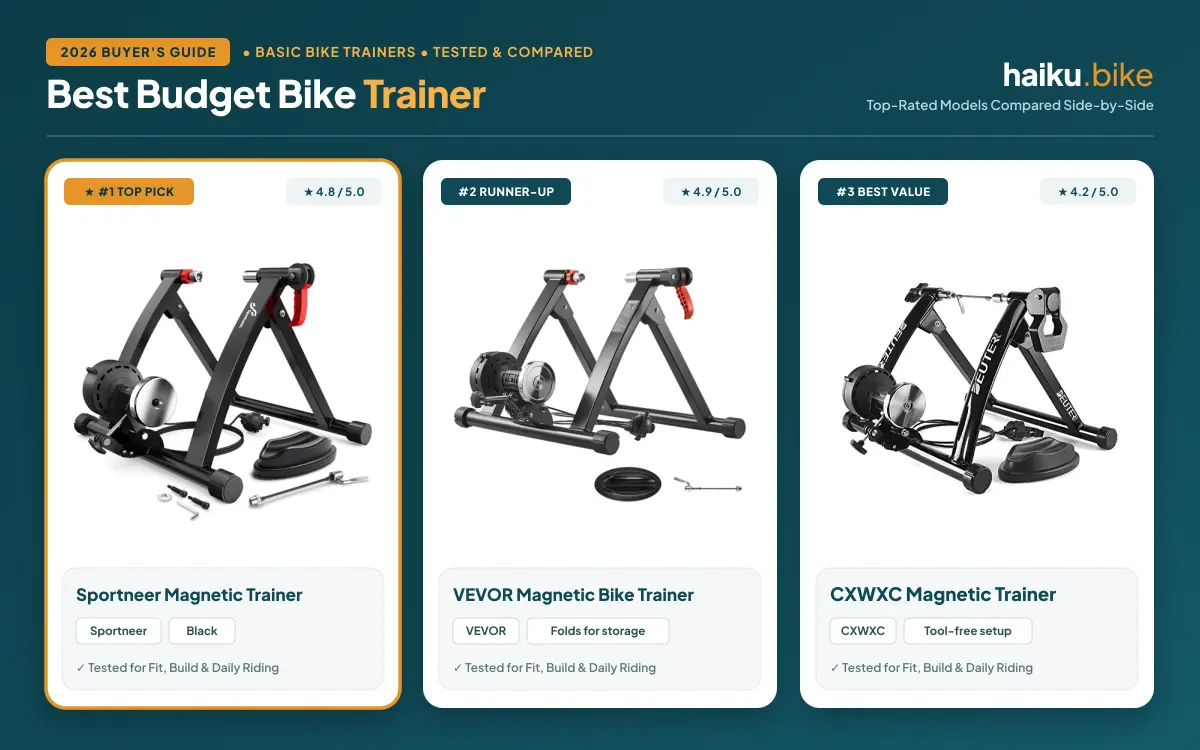
- Best overall: VEVOR Bike Trainer, 6 Level Resistance earns this spot because it fits 26 to 29 inch and 700c wheels, folds for storage, and lists a 330 lb capacity.
- Best value: FDW Magnetic Bike Trainer Stand for Indoor Riding suits budget-minded riders with five resistance settings and a foldable frame.
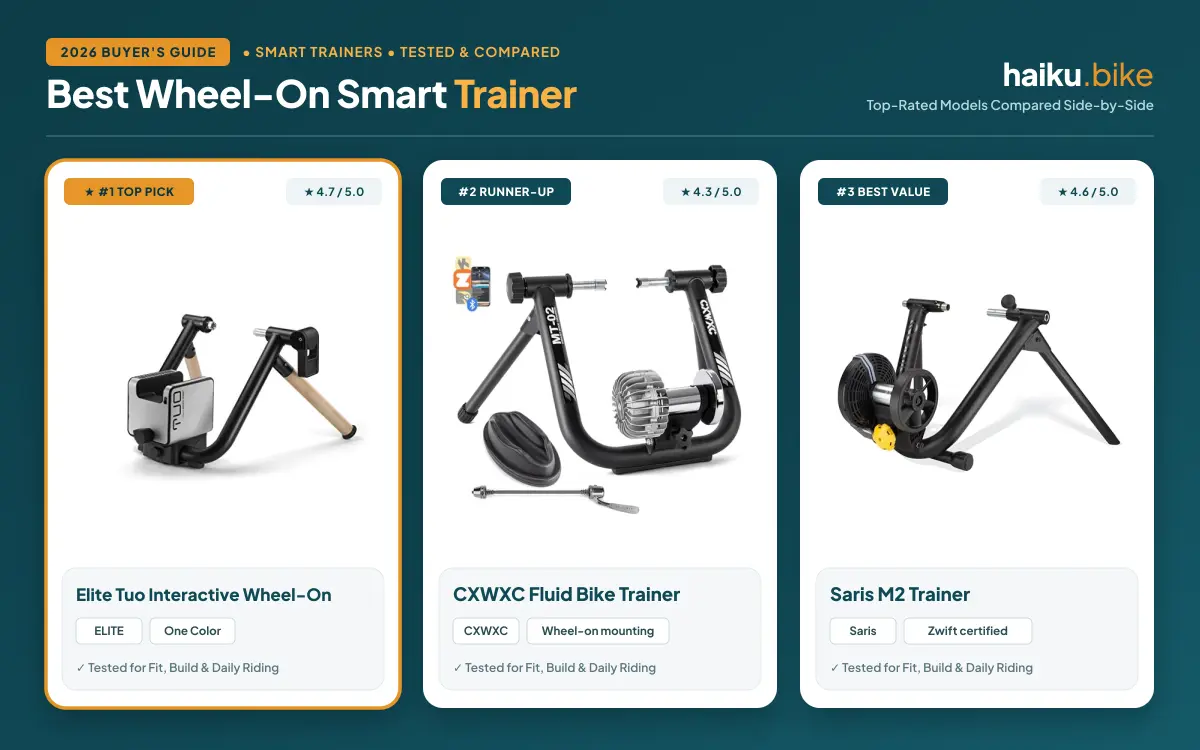
- Best for app-connected training: Saris M2 Smart Indoor Bike Trainer connects to cycling apps through ANT+ FE-C and Bluetooth.
- Best for more resistance steps: BalanceFrom Bike Trainer Stand Steel Bicycle offers eight magnetic resistance settings and handlebar control.
Pros
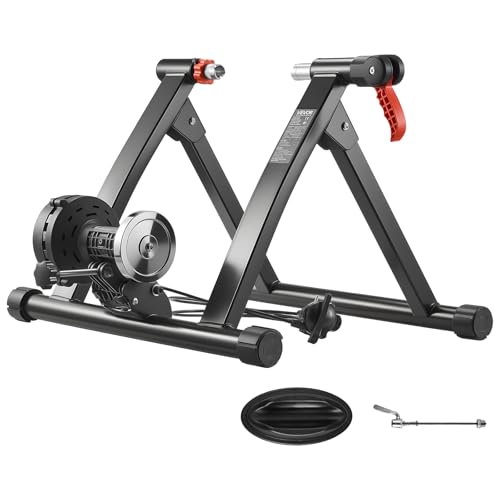
- Six magnetic resistance levels
- Fits 26 to 29-inch and 700c wheels
- Folds for storage
- Quick-release lever included
- Front wheel riser block included
Cons
- No app connectivity listed
- Limited to listed wheel sizes
- 17.31 lb
Pros
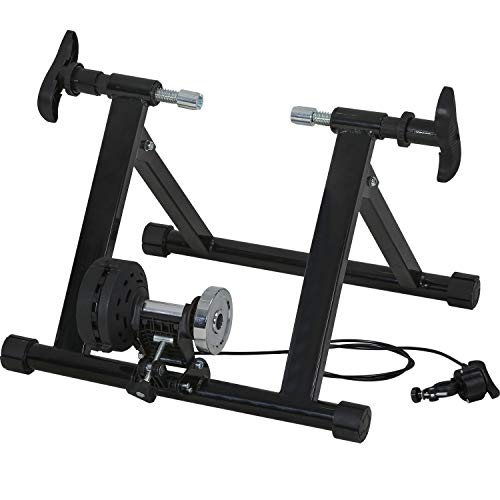
- Five resistance settings
- Foldable for storage
- Steel frame
- Rated for up to 300 lb
- 17.6 lb
Cons
- No app connectivity listed
- Wheel-size compatibility details unclear
- Noise claim applies only to level one

Pros
- Eight magnetic resistance settings
- Handlebar-mounted resistance controller
- Quick-release rear-wheel clamp
- Rubber feet protect wood floors
- Fits 26- to 28-inch or 700c wheels
Cons
- Rough tires can make noticeable noise
- No app or wireless connectivity listed

Pros
- Zwift certified
- ANT+ FE-C and Bluetooth
- Wheel-on setup
- Electromagnetic resistance
- Steel quick-release skewer included
Cons
- Power accuracy rated at ±5%
- Noise rated at 69 dB at 20 mph

Pros
- Six handlebar-controlled resistance levels
- Quick-release skewer included
- Front wheel riser block included
- Five adjustable anti-slip feet
Cons
- Standard version is for quick-release axles
- Noise varies with tire material and tread
- Thru-axle adapter requires non-standard version
Pros
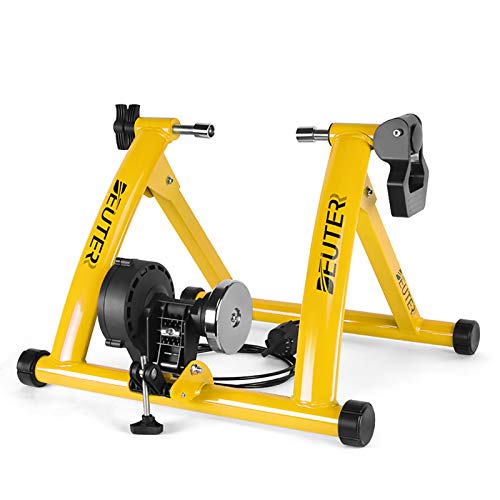
- Six handlebar-adjustable resistance levels
- Folding frame
- Quick-release skewer included
- Front-wheel riser block included
- Fits 26 to 29-inch and 700c wheels
Cons
- Knobby MTB tires can be loud
- Roller contact may cause indoor vibration
- No app or connectivity details provided
Pros
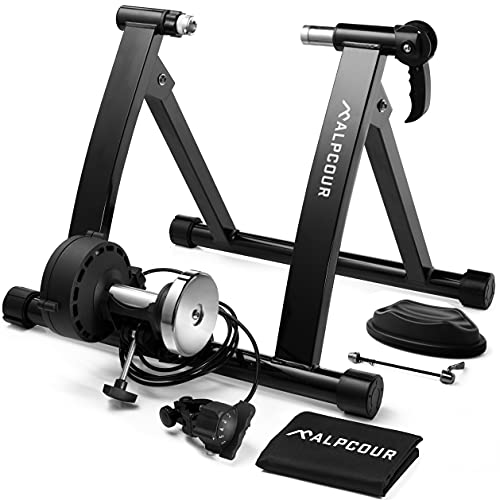
- Six fixed resistance settings
- Handlebar-mounted resistance control
- Foldable frame
- Carry bag included
- Quick, tool-free connection
Cons
- No app connectivity listed
- Compatibility listed for select wheel sizes
- Tire-driven design contacts rear tire
Side-by-Side Comparison
| Model | Wheel compatibility | Resistance | Connectivity | Capacity | Storage or setup |
|---|---|---|---|---|---|
| VEVOR Bike Trainer, 6 Level Resistance | 26 to 29 inch and 700c | 6 levels | Not listed | 330 lb | Foldable; quick-release lever |
| Sportneer Bike Trainer – Magnetic Indoor Cycling | 26 to 28 inch and 700c | 6 levels | Not listed | Not listed | Quick-release lever; riser block |
| Bike Trainer, Magnetic Bicycle Stationary Stand | 26 to 29 inch and 700c | 6 levels | Not listed | 330 lb | Foldable; quick clamp |
| Alpcour Bike Trainer Stand for Indoor Riding | 26 to 28 inch and 700c | 6 levels | Not listed | Not listed | Foldable; carrying bag |
| BalanceFrom Bike Trainer Stand Steel Bicycle | 26 to 28 inch and 700c | 8 levels | Not listed | 330 lb | Quick-release clamp; riser block |
| Saris M2 Smart Indoor Bike Trainer | Steel quick-release skewer for common road and mountain bike frames | Electromagnetic | ANT+ FE-C and Bluetooth | Not listed | Wheel-on setup |
| FDW Magnetic Bike Trainer Stand for Indoor Riding | 66 cm to 700c | 5 levels | Not listed | 300 lb | Foldable frame |
Wheel and axle fit matter most because an incompatible rear end can prevent secure mounting, regardless of resistance options. Once you confirm fit, choose between manual controls for straightforward exercise and Saris M2 connectivity for app-linked sessions.
Common Mistakes to Avoid
Axle mismatch can make an otherwise suitable trainer incompatible with your bike. Sportneer says its standard version includes a quick-release skewer and directs thru-axle riders to choose its non-standard version with an adapter. Check the exact version and your bike’s rear axle before ordering, rather than assuming every wheel-on stand fits every frame.
Tire tread can affect noise and vibration indoors. Sportneer recommends slick or road tires, while CXWXC cautions that rough mountain-bike tread can be loud on trainers. If you plan to use knobby tires, consider where the stand will sit and whether a mat or carpet may reduce floor resonance.
Manual resistance settings do not make a trainer smart or app-connected. The VEVOR, FDW, and other basic magnetic stands list selectable resistance, while Saris M2 lists ANT+ FE-C and Bluetooth. Choose a connected trainer if app communication matters, and confirm its axle hardware matches your bike.
Best Magnetic Bike Trainer Buying Guide
Wheel and Axle Compatibility
Wheel and axle compatibility determine whether a trainer can hold your bicycle securely. Compare your wheel marking with the trainer’s stated range, then check whether it includes a quick-release skewer or needs an adapter for your axle.
The VEVOR trainer lists compatibility with 26 to 29 inch and 700c wheels, while Sportneer lists 26 to 28 inch and 700c wheels. Sportneer also states a rear axle range and describes a separate thru-axle version. Confirm your frame and axle details against the exact version before buying.
A matching wheel size alone does not establish complete fit. Check the product page for included hardware, axle requirements, and any version-specific adapter details, especially if your bike has a thru axle or an unusual rear end.
Resistance Range and Control
Resistance settings determine how many manual adjustment steps you can select during an indoor ride. Most stands here list six levels, while BalanceFrom lists eight and FDW lists five.
A handlebar remote lets you change resistance without dismounting. Sportneer, CXWXC, Alpcour, and BalanceFrom describe handlebar controls, which can be useful when you want to adjust effort mid-ride. More settings give you more steps, but they do not establish a measured power range.
Magnetic resistance works with your gearing and pedaling effort to shape the ride. Consider whether you want a few straightforward levels or more adjustment steps, and avoid assuming a basic wheel-on stand will reproduce every climb or structured workout.
Smart Connectivity and Training Data
Smart connectivity matters when you want a trainer to communicate with cycling apps. Saris M2 lists ANT+ FE-C, Bluetooth, app support, and Zwift certification; the other models here do not list app connections.
Basic resistance controls can support indoor exercise without providing the app-linked functions listed for Saris M2. If virtual routes or connected workouts matter to you, verify the trainer’s communication protocols and app compatibility before choosing a model.
Adjustable magnetic resistance differs from electronically controlled resistance. Saris describes electromagnetic resistance and app connections, while the other listed stands use manual resistance levels. Riders who want uncomplicated indoor pedaling may prefer a basic stand and avoid paying for connectivity they will not use.
Noise, Tires, and Floor Vibration
Tire tread and floor vibration both affect how much noise reaches your household. Sportneer recommends slick or road tires, and CXWXC cautions that rough mountain-bike tires can be loud on a trainer.
Manufacturer descriptions of quiet operation do not guarantee silence in an apartment. Consider your tire type, riding location, and whether a mat could reduce floor resonance. Saris lists a noise figure of 69 decibels at 20 mph, giving shoppers a stated reference point.
A smooth-tread tire and stable floor can help limit noise when you ride late or share walls. A trainer cannot eliminate tire noise, drivetrain sound, or vibration transmitted through a building, so account for household conditions as well as the stand.
Stability and Weight Capacity
Frame stability matters because the trainer supports the bicycle and rider while the rear wheel spins. VEVOR describes a triangular carbon-steel frame, non-slip feet, and a stated 330 lb capacity; CXWXC and BalanceFrom also list 330 lb capacities.
Compare a published capacity with your complete riding setup and follow the maker’s assembly instructions. Sportneer describes a wide base, low center of gravity, and adjustable anti-slip feet, while FDW lists support up to 300 lb. Do not assume a capacity when a maker does not list one.
Frame construction and floor contact points matter if you move the trainer often or use it on a smooth floor. Compare the stated stability features and make sure the stand sits flat before mounting your bike.
Setup, Folding, and Storage
Setup and storage determine how easily a trainer fits into your home routine. VEVOR, CXWXC, Alpcour, and FDW describe foldable frames, while Alpcour includes a carrying bag and VEVOR lists a quick-release lever.
Check the included hardware and whether your bike needs a compatible skewer or adapter. A front-wheel riser block can help level the bicycle, while a quick-release mechanism can simplify mounting; neither feature resolves an axle mismatch.
Measure the space where you plan to ride and store the trainer, especially if you need to fold it between sessions. Our basic bike trainer guide covers more options for riders comparing indoor setups.
How We Chose
We score products with the Haiku Ride Score: core performance 30%, build and weather resistance 20%, ease of use 20%, compatibility and battery 15%, and value 15%. For magnetic trainers, we assess resistance operation, frame details, setup features, wheel and axle fit, and any listed connectivity.
Our evaluation draws on manufacturer specifications, compatibility information, and long-term owner feedback where available. We research and draft our guides with software tools, including AI, then run automated checks on product fit, sourcing, and our editorial rules. Our editor spot-checks guides rather than reading each one before publication. Our how we review page explains the editorial method.
Price and Value: What Each Budget Gets You
Budget
At the lower end, a magnetic stand can provide basic wheel-on indoor riding, foldable storage, and manual resistance without app connectivity. FDW Magnetic Bike Trainer Stand for Indoor Riding offers five resistance settings and a foldable frame. The trade-off is fewer adjustment steps than some alternatives, and buyers should verify its stated wheel range and capacity against their bike and riding setup.
Mid-Range
Moving through the middle of this guide’s range brings features such as handlebar resistance controls, riser blocks, and stated stability details. BalanceFrom Bike Trainer Stand Steel Bicycle lists eight settings and a 330 lb capacity, while Sportneer adds a wide base and adjustable feet. These remain manual wheel-on trainers, so they do not provide the app communication described for Saris M2.
Premium
At the upper end, riders can choose between added convenience and connected control. Alpcour Bike Trainer Stand for Indoor Riding includes a carrying bag and foldable frame, while Saris M2 adds electromagnetic resistance, app connections, and stated power accuracy of plus or minus 5%. The Saris trade-off is a quick-release setup that may not suit every axle type, so confirm compatibility first.
Choosing Something Else
A direct-drive smart trainer is a practical alternative for riders who want to remove the rear wheel and connect the bike to a trainer cassette. That format may suit app-based sessions and riders seeking a different wheel-on arrangement. A basic magnetic stand makes more sense if you want to keep the rear wheel installed and do not need connected workouts.
Final Thoughts
VEVOR Bike Trainer, 6 Level Resistance suits riders who want broad stated wheel compatibility, a foldable frame, and a listed 330 lb capacity. Its six resistance levels keep adjustment straightforward, but riders who need app connections should look at a connected option instead.
FDW Magnetic Bike Trainer Stand for Indoor Riding fits riders who want a foldable magnetic stand with five resistance settings. BalanceFrom Bike Trainer Stand Steel Bicycle offers eight listed levels for riders who want more manual adjustment, while Sportneer Bike Trainer – Magnetic Indoor Cycling adds a specified axle range and a stated thru-axle option.
Saris M2 Smart Indoor Bike Trainer is the clearest fit for riders seeking app connections through ANT+ FE-C and Bluetooth. Its electronic features may be unnecessary for basic indoor exercise, and riders should confirm the included quick-release setup suits their bike before ordering.
Skip these wheel-on stands if your wheel or axle falls outside a model’s stated compatibility, or if you specifically want a direct-drive setup. Compare our indoor cycling equipment guides for another format, or see our folding electric bike guide if your priority is transportation rather than stationary training.
FAQs
How does a magnetic bike trainer work?
A magnetic bike trainer holds the bicycle’s rear wheel against a resistance unit, which creates drag as the wheel turns. Many basic stands let riders select resistance with a handlebar control, while gearing and pedaling effort also shape the ride. Follow the manufacturer’s setup instructions and confirm the tire contacts the roller correctly before riding.
Will a magnetic bike trainer fit my bike?
A magnetic bike trainer fits only when your wheel size and rear axle hardware match the stand’s stated compatibility. Some models list 26 to 29 inch or 700c wheels, while Sportneer states a narrower wheel range and axle measurement. Check your bike’s wheel and axle, then confirm whether the trainer requires a separate version or adapter.
Are magnetic bike trainers noisy?
Magnetic bike trainer noise varies with tire tread, wheel contact, and floor vibration. Sportneer recommends slick or road tires, while CXWXC notes that rough mountain-bike tread can be loud. A mat or carpet may reduce vibration transmitted through the floor, but it cannot guarantee a quiet ride in shared housing.
Can I use a mountain bike on a magnetic trainer?
A mountain bike can work on a magnetic trainer when its wheel size and axle match the stand. Tire tread affects noise: CXWXC cautions that rough tires can be loud, and Sportneer recommends slick or road tires. Check your bike’s fit and consider tire noise before choosing an indoor location.
Can a magnetic bike trainer connect to Zwift?
A magnetic bike trainer connects to Zwift only when its specifications include compatible electronic connectivity. Saris M2 lists ANT+ FE-C, Bluetooth, and Zwift certification, while the basic magnetic stands here do not list app connections. Confirm the trainer’s communication standards and app support before choosing it for virtual rides.
Which Best Magnetic Bike Trainer should I choose in 2026?
The Best Magnetic Bike Trainer for you depends on wheel and axle fit, resistance control, storage needs, and whether app connectivity matters. VEVOR lists broad wheel compatibility and a foldable frame, while Saris M2 adds app connections. Compare these features with your bike and training routine before choosing a stand.
How can I reduce vibration from an indoor bike trainer?
You can reduce indoor bike trainer vibration by placing the stand on a stable, level surface and considering a mat beneath it. Smooth road tires may also create less noise than rough mountain-bike tread, according to maker guidance. Keep the trainer secure and follow its instructions when adjusting placement.
What should I check before riding a bike trainer?
Before riding a bike trainer, verify wheel and axle fit, secure the bicycle in the clamp, and confirm the stand sits firmly on the floor. Follow the maker’s instructions for roller contact and front-wheel support. Our basic bike trainer resources cover more indoor setup options.




Write Your Review
No reviews yet. Be the first to share your experience!