
Road riders use GPS bike computers to record rides, follow routes, and check speed or elevation without relying on a phone screen. The right choice depends on whether you need turn guidance, long battery life, sensor connections, or a simple record of distance and time.
We compare 6 GPS bike computers for November 2026, including models from CYCPLUS, GEOID, iGPSPORT and more. Follow each manufacturer’s instructions and local laws, and see our guide to GPS computers for gravel riding if your routes extend beyond pavement.
At a Glance: Which One Fits You
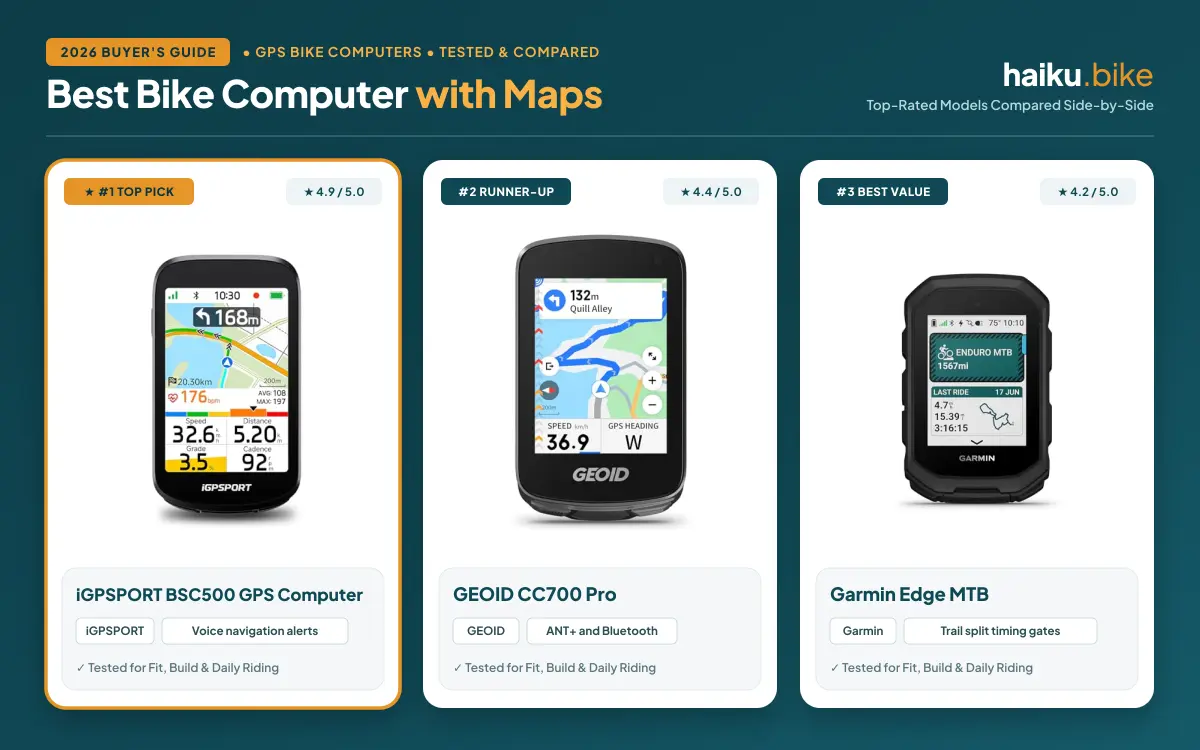
- Best overall: iGPSPORT BSC500 GPS Bike Computer earns this spot because its touchscreen, buttons, maps, rerouting, and voice navigation combine useful guidance features.
- Best value: Bikevee GPS Bike Computer, 2.4" Screen, Altitude earns this spot because it records ride and elevation data, offers up to 28 hours of runtime, and has IPX7 protection.
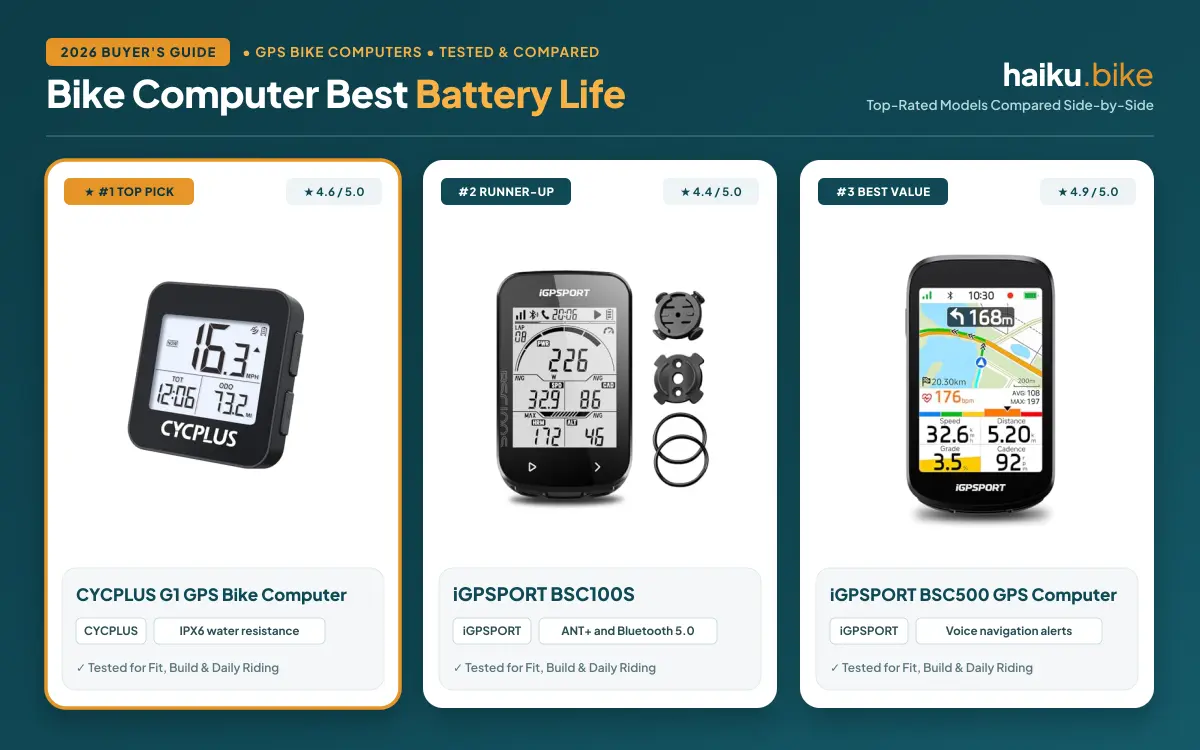
- Best for long battery life: CYCPLUS Wireless GPS Bike Computer G1, 70g earns this spot because CYCPLUS lists more than 55 hours of runtime and IPX6 water protection.
- Best for route customization: GEOID CC600 Color Screen Bike/Cycling Computer earns this spot because it accepts GPX routes, reroutes automatically, and offers customizable data pages.

Pros
- Touchscreen and button controls
- Up to 12 data fields per page
- Strava and Komoot route imports
- Automatic off-course rerouting
- Voice navigation alerts
Cons
- Battery life not listed
- Water-resistance rating not listed
- Wireless connectivity details not listed

Pros
- Built-in GPS
- No wheel sensor or spoke magnet needed
- Maker-rated 28-hour runtime
- IPX7 water resistance
- Altitude and climbing data
Cons
- No listed app or sensor compatibility
- Charging port not specified

Pros
- More than 55-hour maker-rated runtime
- IPX6 water resistance
- Automatic backlight
- GPS route and altitude data
- About 2.5 oz
Cons
- No listed app connectivity
- No listed sensor pairing
Pros
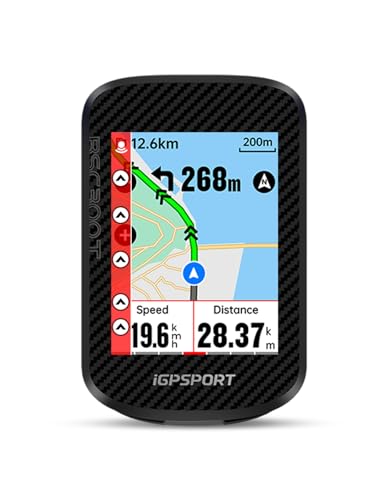
- 2.4-inch touchscreen and six buttons
- Offline maps and turn prompts
- Off-course route alerts
- ANT+ and Bluetooth 5.0
- Strava and Komoot sharing
Cons
- Battery life not listed
- Water-resistance rating not listed
- Mount details not listed

Pros
- Color route navigation with automatic rerouting
- WiFi and Bluetooth data transfer
- ANT+ device support
- Customizable data pages and layouts
- Indoor smart-trainer workouts
Cons
- Battery life not specified
- Water resistance rating not listed
- Mount compatibility not specified

Pros
- 2.4-inch color touchscreen
- GPS and GLONASS tracking
- Route upload and breadcrumb navigation
- 36-hour maker-rated battery life
- Bluetooth and ANT+ connectivity
Cons
- Sensors sold separately
- Extension mount not included
- Compatible accessories required for power data
Side-by-Side Comparison
| Computer | Display | Navigation | Battery life | Water protection | Connections and data |
|---|---|---|---|---|---|
| iGPSPORT BSC500 GPS Bike Computer | 3.3-inch touchscreen and buttons | Maps, turn reminders, rerouting, voice alerts | Not listed | Not listed | iGPSPORT app and supported third-party route apps |
| Bikevee GPS Bike Computer, 2.4" Screen, Altitude | 2.4-inch LCD | GPS tracking; route navigation not listed | Up to 28 hours, according to Bikevee | IPX7 | Speed, distance, altitude, gradient, ascent |
| CYCPLUS Wireless GPS Bike Computer G1, 70g | 2.0-inch FSTN display | GPS route tracking | More than 55 hours, according to CYCPLUS | IPX6 | Ride time, mileage, and altitude |
| iGPSPORT BSC300T GPS Bike Computer | 2.4-inch touchscreen and buttons | Offline maps, route preview, turn prompts | Not listed | Not listed | Over 130 ride data fields; app sharing |
| GEOID CC600 Color Screen Bike/Cycling Computer | 2.4-inch color screen | GPX uploads, turn alerts, automatic rerouting | Not listed | Not listed | Bluetooth, ANT+, WiFi; 108 data options |
| COOSPO Color Touchscreen GPS Bike Computer CS600 | 2.4-inch color touchscreen | Route uploads and breadcrumb trail | Up to 36 hours, according to COOSPO | IPX7 | Bluetooth, ANT+, app sync, 150+ data insights |
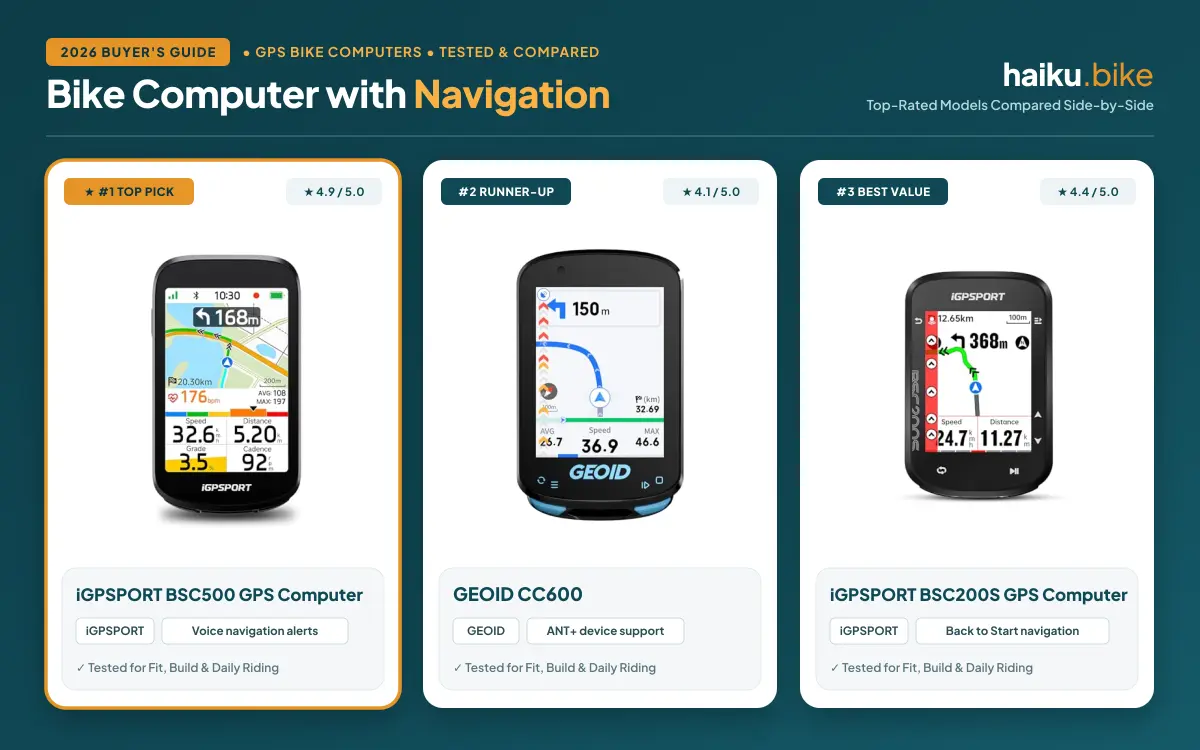
Navigation capability is the clearest dividing line for road riders exploring unfamiliar routes. The iGPSPORT BSC500, BSC300T, GEOID CC600, and COOSPO CS600 list guidance features, while Bikevee and CYCPLUS focus more on GPS tracking and ride data.
Common Mistakes to Avoid
GPS tracking does not automatically include maps or turn-by-turn directions. Check whether a computer supports route imports, offline maps, turn prompts, and rerouting separately, because those functions vary across the models in this guide.
Sensor buyers should confirm wireless protocols before choosing a computer. GEOID CC600 and COOSPO CS600 list Bluetooth and ANT+, while the other product descriptions do not specify those protocols; match the computer to the connection supported by your cadence sensor or power meter.
Battery claims need context because navigation and screen use can affect ride planning. CYCPLUS, Bikevee, and COOSPO publish runtime figures, but the other makers do not list battery life; compare published figures with your longest planned rides and charging access.
Water-protection ratings are not interchangeable, and an unstated rating should not be assumed. Bikevee and COOSPO list IPX7, while CYCPLUS lists IPX6; follow each manufacturer’s care instructions for riding, cleaning, and charging.
Best GPS Bike Computer for Road Cycling: Buying Guide
GPS Positioning and Satellite Support
Satellite support affects how a computer locates and records your ride, especially when route guidance matters. The iGPSPORT BSC500 lists five satellite systems and dual-band L1 and L5 reception, while the BSC300T and GEOID CC600 also list support for five satellite systems.
Compare the satellite systems named on each product page, but do not treat a longer list as a guarantee of reception in every setting. CYCPLUS identifies GPS positioning, and COOSPO lists GPS and GLONASS; Bikevee describes built-in GPS. Consider your usual roads and verify that recorded routes and ride metrics meet your needs.
Route Guidance and Maps
Route guidance determines whether a computer can help you follow a planned ride or only record where you went. The BSC500 supports routes through the iGPSPORT app and third-party apps, with turn reminders, rerouting, and voice alerts.
The BSC300T lists offline maps, route previews, and turn prompts, while the CC600 accepts GPX files and can reroute after you leave your course. COOSPO describes route uploads and breadcrumb guidance, a different feature set from full offline mapping. Check route file support, transfer steps, and offline availability before choosing a device for unfamiliar roads.
Route guidance also depends on how clearly the computer communicates an upcoming turn. The BSC500 adjusts warning distance to riding speed and provides voice cues, while the CC600 uses turn reminders. Riders who prefer fewer screen glances should compare alert methods, not only map availability.
Battery Life and Ride Length
Battery runtime determines how much charge margin a computer offers for long rides and navigation. CYCPLUS lists more than 55 hours, Bikevee lists up to 28 hours, and COOSPO lists up to 36 hours; these figures come from the respective manufacturers.
Runtime is not listed for the iGPSPORT BSC500, BSC300T, or GEOID CC600, so do not assume they match another computer. Compare a published figure with your longest ride, then leave room for route guidance and display use. Check charging details and cable type on the product page before buying.
Sensor Support and Data Compatibility
Sensor compatibility matters when you want a computer to show data from accessories such as cadence sensors or power meters. GEOID CC600 and COOSPO CS600 list both Bluetooth and ANT+ support, while the other descriptions do not specify those protocols.
Match each sensor’s connection type to the computer before ordering, and check whether the device displays the metrics you want. The BSC300T lists over 130 riding data fields, while the CC600 lists 108 data options. A broad menu helps only when the computer connects to your equipment and makes useful fields easy to find.
App support also affects route transfers, ride analysis, and sharing. The BSC500 supports the iGPSPORT app and routes from services such as Strava and Komoot; the BSC300T supports sharing to Strava and Komoot. Riders comparing other devices can browse the bike computers and GPS category.
Screen Readability and Controls
Screen layout and controls determine how quickly you can read ride data while moving. The BSC500 pairs a 3.3-inch touchscreen with buttons, while the BSC300T and CS600 have 2.4-inch touchscreens. CYCPLUS uses a 2.0-inch FSTN display with automatic backlighting.
Compare screen size, backlight behavior, and control options with the conditions in which you ride. Touch controls can make setup intuitive, while buttons provide another way to operate a computer. Check whether essential data fits on a page without frequent changes, and favor a clear layout over a long menu of metrics.
Weather Protection and Setup
Water protection matters when road rides continue through changing weather. Bikevee and COOSPO list IPX7 protection, and CYCPLUS lists IPX6; the other models do not state a rating. Follow manufacturer care guidance, and do not infer a protection level where none is specified.
Setup requirements shape how easily a computer fits into your routine. Bikevee uses built-in GPS without a wheel sensor or spoke magnet, while the BSC500 and BSC300T use app connections for route and data functions. Review mounting, pairing, and route-transfer instructions before a ride so the computer is ready for the features you plan to use.
How We Chose
We compare computers with the Haiku Ride Score: core performance 30%, build and weather resistance 20%, ease of use 20%, compatibility and battery 15%, and value 15%. This framework weighs route clarity, screen controls, sensor support, and maker-stated runtime for road riding.
Our evaluation draws on manufacturer specifications, compatibility information, and long-term owner feedback where available. We research and draft our guides with software tools, including AI, then run automated checks on product fit, sourcing, and our editorial rules. Our editor spot-checks guides rather than reading each one before publication. Our how we review page explains the method.
Price and Value: What Each Budget Gets You
Budget
Entry-level computers tend to prioritize GPS ride records, essential speed and distance fields, and straightforward setup over extensive mapping. Bikevee provides altitude and gradient data, automatic start and stop, and stated water protection, while CYCPLUS emphasizes long runtime and a readable backlit display. Riders in this tier may give up route guidance, detailed sensor compatibility, or a clearly specified app ecosystem, so confirm which functions matter most.
Mid-Range
Mid-range computers can add color displays, route transfers, configurable data pages, and wireless sensor connections. GEOID CC600 combines GPX navigation and rerouting with Bluetooth and ANT+, while COOSPO CS600 adds a touchscreen, breadcrumb routes, and stated runtime. These features suit riders who want more control over data and navigation, though mapping depth and published specifications still vary between devices.
Premium
Higher-tier choices in this group emphasize larger screens and a more developed navigation experience. The iGPSPORT BSC500 offers a 3.3-inch touchscreen, button controls, dual-band satellite reception, rerouting, and voice cues; the BSC300T adds offline maps and group tracking. Riders gain more guidance options, but runtime and water ratings are not listed for these computers, so check those needs separately.
Choosing Something Else
A smartphone in a secure handlebar mount can work for riders who need occasional directions and already carry a phone. A dedicated computer better suits riders who want cycling data pages or a separate device for recording rides. Consider phone battery use, screen exposure, and whether your sensors can connect before choosing between these setups.
Final Thoughts
Road riders who want several guidance tools in one computer should consider the iGPSPORT BSC500 GPS Bike Computer. Its maps, rerouting, voice cues, large touchscreen, and button controls suit unfamiliar routes. Its battery runtime and water rating are not listed, so riders who need those specifications should compare alternatives carefully.
Riders who prioritize long runtime and simple GPS ride records may prefer the CYCPLUS Wireless GPS Bike Computer G1, 70g, which CYCPLUS lists at more than 55 hours. For GPX imports, rerouting, and configurable screens, the GEOID CC600 Color Screen Bike/Cycling Computer offers a broader set of route and data tools, but its runtime and water rating are not listed.
The Bikevee GPS Bike Computer, 2.4" Screen, Altitude fits riders seeking essential ride and elevation data with stated runtime and IPX7 protection. The iGPSPORT BSC300T GPS Bike Computer suits riders who want offline maps, while the COOSPO Color Touchscreen GPS Bike Computer CS600 combines route features, Bluetooth, ANT+, and stated runtime.
Riders who need only occasional directions, or whose sensors require protocols a chosen computer does not list, may be better served elsewhere. Compare other devices in the GPS bike computer category or explore GPS computers for budget-minded riders before deciding.
FAQs
Do GPS bike computers work without a phone?
GPS bike computers can record ride data using built-in satellite positioning without a phone connection. Some features, including route transfers, setup, analysis, or sharing, may use a companion app. Bikevee and CYCPLUS emphasize standalone tracking, while iGPSPORT and GEOID describe app-based features. Check the manufacturer’s instructions to learn which functions work independently.
Which of the Best GPS Bike Computers for Road Cycling in 2026 provide navigation?
Several computers in this guide list navigation, but their features differ. The iGPSPORT BSC500 supports maps, route imports, turn reminders, and rerouting, while the BSC300T lists offline maps and turn prompts. GEOID CC600 supports GPX routes and rerouting; COOSPO CS600 lists route uploads and breadcrumb guidance. Compare mapping depth before choosing.
Can a GPS bike computer connect to a cadence sensor or power meter?
A GPS bike computer needs a wireless protocol supported by your cadence sensor or power meter. GEOID CC600 and COOSPO CS600 specify Bluetooth and ANT+ support, while the other product descriptions do not list those protocols. Check your sensor’s connection type and confirm computer compatibility before buying, especially if you rely on accessory data during rides.
How much battery life should a road cycling computer have?
The right battery life depends on your longest rides, navigation use, and access to charging. CYCPLUS lists more than 55 hours, Bikevee lists up to 28 hours, and COOSPO lists up to 36 hours. Compare manufacturer figures with your needs, and allow for variation from display and feature use. Several makers do not publish runtime.
Are GPS bike computers waterproof?
Water protection varies by GPS bike computer, so check for a stated rating rather than assuming every device handles rain equally. Bikevee and COOSPO list IPX7 protection, while CYCPLUS lists IPX6. The other computers do not state a rating. Follow manufacturer instructions for wet-weather use, cleaning, and charging to protect the device.
Can I use a phone instead of a GPS bike computer?
A phone in a secure handlebar mount can provide navigation for riders who need directions occasionally. A dedicated computer may suit riders who want cycling data pages or a separate device for ride recording. Consider phone battery use, screen exposure, and sensor compatibility. The bike computers and GPS category offers more options to compare.
How do I choose a readable screen for road cycling?
A readable bike computer screen should show priority data clearly and offer controls that suit your riding. Compare screen size, backlighting, and touchscreen or button operation in product specifications. CYCPLUS lists an FSTN display with automatic backlighting, while the BSC500 combines touchscreen operation with buttons. Check whether essential fields remain easy to view while moving.
Do all GPS bike computers support offline maps?
GPS tracking alone does not mean a computer displays maps or supports offline navigation. The iGPSPORT BSC300T specifies global offline map downloads, while other models describe route uploads, turn guidance, breadcrumb navigation, or ride recording. Check mapping features and route transfer steps if you ride where phone service may be limited or want navigation without a phone.
Write Your Review
No reviews yet. Be the first to share your experience!