

Commuters and recreational riders can lose time when a puncture lets air out of a tube. A self-sealing tube carries sealant that may close some small holes, but it cannot prevent every flat or repair major tire damage.
We compared 3 options in November 2026 from BELL, Goodyear, Slime, spanning a 27.5-inch tire, a 24-inch tire, and a 700c tire. Follow each maker’s installation instructions and local laws, and compare the full tire marking before ordering. Our guide to measuring bike tire size explains how to read that marking.
At a Glance: Which One Fits You
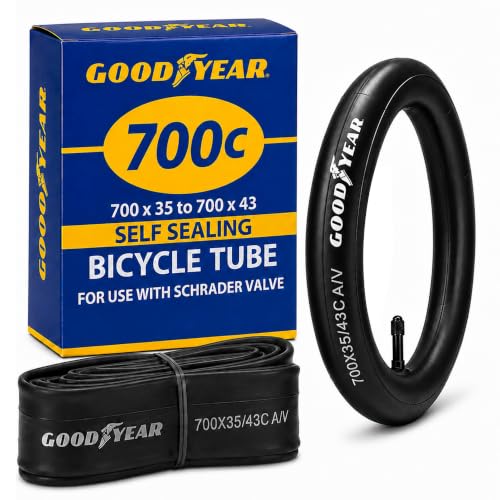
- Best overall: Goodyear Self-Sealing Bicycle Tube fits 700×35/43c tires and uses butyl rubber, though its valve type is not listed.
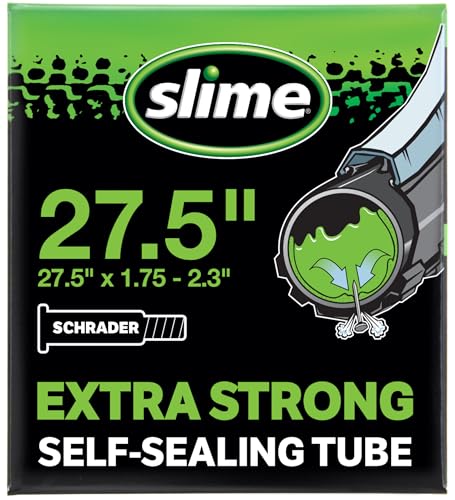
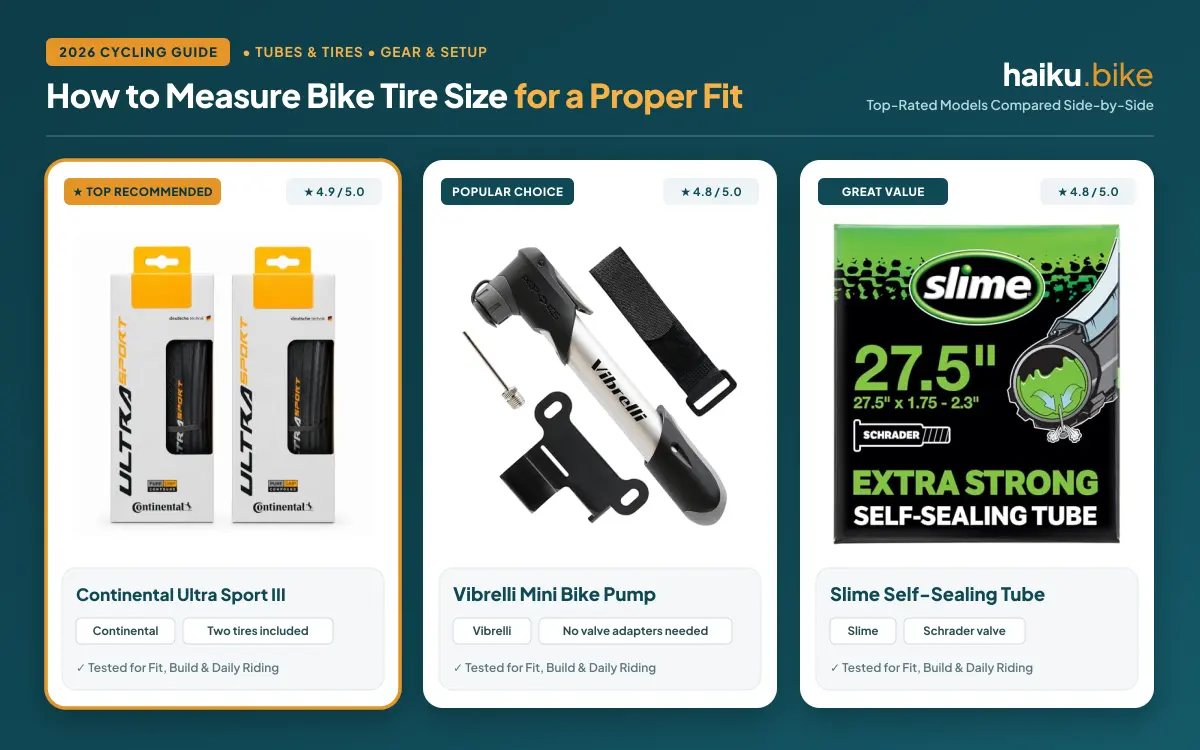
- Best value: Slime Extra Stong Self-Sealing Tube with Slime specifies a 27.5-inch tire range and sealant coverage for punctures up to 1/8 inch, or 3mm.
- Best for 24-inch mountain bike tires: Bell Self-Sealing Bicycle Inner Tube fits 24×1.75-2.25-inch tires and includes pre-installed sealant, but does not suit other wheel diameters.
Pros
- Built-in puncture sealant
- Seals punctures up to 1/8 inch
- Schrader valve
- Fits 27.5-inch tires
Cons
- Schrader valve only
- Limited to 1.75 to 2.3-inch tire width
- Sealant covers punctures only up to 1/8 inch

Pros
- Sealant installed in advance
- Seals punctures up to 1/8 inch
- 40 mm Schrader valve
- Fits 24-inch tires from 1.75 to 2.25 inches
Cons
- 300 g tube
- Who should skip it: riders with other tire sizes or Presta valves
Pros
- Self-sealing design
- 700c size
- Fits 35/43c tires
- Butyl rubber construction
- Designed for easy replacement
Cons
- Valve type not listed
- Fit limited to 35/43c tires
- Who should skip it: riders with other tire sizes
Side-by-Side Comparison
| Product | Tire fit | Valve | Sealant claim | Material or package detail |
|---|---|---|---|---|
| Slime Extra Stong Self-Sealing Tube with Slime | 27.5 x 1.75-2.3 inches | Schrader | Up to 1/8 inch (3mm), Fibro-Seal | Extra-strong tube; package count not listed |
| Goodyear Self-Sealing Bicycle Tube | 700 x 35/43c | Not listed | Not listed | Butyl rubber; package count not listed |
| Bell Self-Sealing Bicycle Inner Tube | 24 x 1.75-2.25 inches | Schrader, 40mm | Up to 1/8 inch | 300g; pre-installed sealant |
Tire diameter and width are the biggest differences because these tubes serve distinct wheel formats and cannot substitute for one another. Valve details and sealant claims matter next: Slime and Bell list Schrader valves and a puncture limit, while Goodyear does not list valve or sealant specifications here.
Common Mistakes to Avoid
Choosing by wheel diameter alone can lead to a tube that is too narrow or too wide. Read the complete tire sidewall marking, then compare both diameter and width with the tube range. The Slime tube fits 27.5 x 1.75-2.3-inch tires, Bell fits 24 x 1.75-2.25-inch tires, and Goodyear fits 700 x 35/43c tires.
Ignoring valve compatibility can make inflation difficult or prevent the valve from fitting through the rim. Slime and Bell list Schrader valves, while Goodyear does not list its valve type in the product details here. Check your current tube and rim opening, and confirm Goodyear’s valve specification before buying.
Expecting sealant to repair any tire problem can leave you unprepared for a large cut or damaged casing. Slime and Bell state a puncture limit of up to 1/8 inch, while Goodyear does not provide a sealant limit here. Carry a repair option suited to your route and replace damaged tires as needed.
Best Self-Sealing Bike Tubes Buying Guide
Tire Diameter and Width
Wheel diameter and tire width determine whether an inner tube fits inside a tire without excessive stretching or bunching. Read the full marking printed on your tire sidewall, rather than choosing by labels such as commuter or mountain bike.
Compare that marking with the tube’s stated range, including the unit and format. The Slime tube lists 27.5 x 1.75-2.3 inches, Bell lists 24 x 1.75-2.25 inches, and Goodyear lists 700 x 35/43c. For more help reading tire dimensions, see our bike tire sizing guide.
Do not assume that two tubes with similar widths share the same wheel diameter. If your tire marking falls outside a product’s stated range, choose a tube that explicitly covers it or ask the maker to confirm fit before ordering.
Valve Type and Length
Valve type and length affect whether a tube fits the rim opening and works with your pump. Slime lists a Schrader valve, and Bell lists a 40mm Schrader valve. Goodyear’s available product details do not specify valve type or length.
Check your current tube and rim before choosing a replacement, because Schrader and Presta valves have different widths. A valve must pass through the rim opening without force, and your pump head must connect securely.
Rim depth can also affect how easily you reach the valve with a pump. Bell lists a 40mm valve, but the other product details do not state valve length. Compare the new tube with your current setup, and consult our guide to pumping a Presta valve if your bike uses that valve style.
Sealant Claims and Repair Limits
Sealant can help close some punctures, but its stated coverage does not mean a tube can repair every flat. Slime says its Fibro-Seal technology seals punctures up to 1/8 inch, or 3mm, and Bell also states coverage up to 1/8 inch.
Goodyear’s product details do not list a puncture limit, so do not assume its coverage matches either other tube. Check the maker’s instructions for handling and repair guidance, especially if you ride far from support.
Sealant cannot be relied on to fix a large cut, damaged tire casing, or ongoing air loss. Inspect the tire after a puncture, and carry a spare tube or repair supplies appropriate to your route. Riders comparing other tire-care approaches can review our comparison of tubeless and tube tires.
Tube Material and Weight
Material and weight can help distinguish tubes when several options match your tire dimensions. Goodyear describes its tube as butyl rubber, while Bell lists a tube weight of 300g. Slime describes its tube as extra strong but does not list a weight in the product details.
Use published details rather than assuming that a heavier or thicker tube lasts longer. If carrying a spare matters to you, compare stated weights where available and check whether the product is sold as one tube or a multiple-tube package.
The package count is not listed for these products, so confirm what arrives before planning spare coverage. Material and weight matter less than correct fit; a tube that does not match the tire range is not a suitable replacement, regardless of its construction.
Installation and Upkeep
Careful installation helps reduce the chance of pinching a tube between the tire and rim. Slime says its tube installs like a traditional inner tube and includes instructions. Follow the directions supplied with the product, and check the tire and rim for debris before fitting a replacement.
After installation, check that the valve sits straight and that the tire bead sits evenly around the rim. Inflate within the pressure limits marked by the tire and rim makers, because the product details do not provide a universal pressure range.
Inspect the tire after a puncture instead of assuming sealant has resolved every problem. Ongoing air loss, visible casing damage, or a large cut calls for further attention and may require a separate repair or replacement.
How We Chose
We assess each tube with the Haiku Ride Score: core performance counts for 30%, build and weather resistance for 20%, ease of use for 20%, compatibility and fit for 15%, and value for 15%. For inner tubes, compatibility and fit mean matching the listed tire dimensions and valve details to a rider’s wheel and pump.
Our evaluation compares manufacturer specifications, fit information, and long-term owner feedback where available. We research and draft our guides with software tools, including AI, then run automated checks on product fit, sourcing, and our editorial rules. Our editor spot-checks guides rather than reading each one before publication. Our how we review page explains the method.
Price and Value: What Each Budget Gets You
Budget
Budget self-sealing tubes typically focus on basic fit and a stated sealant feature, with fewer published details about material or package contents. Slime stands out for naming Fibro-Seal technology and specifying its puncture limit. Riders give up certainty about package count and some construction details, so check those points before choosing this tube.
Mid-Range
Mid-range choices can pair a defined size with a named material or a clearly described valve. Goodyear specifies butyl rubber and a 700 x 35/43c fit, while leaving valve and sealant limits unlisted. This option suits riders whose tires match its range, but riders needing confirmed valve details should seek clarification first.
Premium
Higher-tier tubes may add specific installation or sealant details, but a higher tier does not make a tube compatible with more tire sizes. Bell lists a 40mm Schrader valve, 300g weight, and sealant coverage up to 1/8 inch. Those details help some buyers compare fit and features, but its 24-inch size limits who can use it.
Choosing Something Else
A conventional tube and separate patch kit suit riders who prefer to manage puncture repairs themselves or want a broader choice of sizes. A tubeless setup may suit riders whose rims and tires support conversion, but it requires compatible components and sealant upkeep. Check your current wheel setup before changing systems, and compare tubeless sealant options if conversion is suitable.
Final Thoughts
Riders with 700 x 35/43c tires can consider Goodyear Self-Sealing Bicycle Tube for its specified butyl rubber construction. Its product details do not list valve type or a sealant limit, so confirm those details first. Choose another tube if your tire falls outside the stated 700c range.
Riders with 27.5 x 1.75-2.3-inch tires may prefer Slime Extra Stong Self-Sealing Tube with Slime, which specifies a Schrader valve and sealant coverage up to 1/8 inch. The trade-off is limited size compatibility and no listed package count. Skip it if your tire or valve does not match.
For a 24 x 1.75-2.25-inch tire, Bell Self-Sealing Bicycle Inner Tube lists pre-installed sealant, a 40mm Schrader valve, and a stated weight. Its narrow wheel-size fit is the main drawback, so riders with other wheel diameters should choose a different tube. Compare more options in our Tubes & Tires category.
Skip self-sealing tubes if your tire size is not listed or if you need a guaranteed fix for large cuts and tire damage. A conventional tube, repair kit, or compatible tubeless setup may better match your needs. Confirm all dimensions and valve details before buying, and follow the maker’s maintenance instructions.
FAQs
How do self-sealing bike tubes work?
Self-sealing bike tubes contain sealant that can move toward some small punctures and help close them. Slime and Bell state coverage up to 1/8 inch, while Goodyear’s product details do not list a puncture limit. Sealant cannot be relied on to repair every flat, so inspect the tire and follow the maker’s instructions after air loss.
How do I choose the right self-sealing bike tube size?
The right self-sealing bike tube matches both the wheel diameter and tire width printed on your tire sidewall. Compare that complete marking with the tube’s stated range, such as 27.5 x 1.75-2.3 inches or 700 x 35/43c. Do not choose by bicycle type alone, because bikes in one category can use different tire sizes.
Which valve do self-sealing bike tubes use?
Self-sealing bike tubes may use Schrader or Presta valves, depending on the product. Slime lists Schrader, Bell lists a 40mm Schrader, and Goodyear’s product details do not list a valve type. Check your current tube, rim opening, and pump connection before ordering so the replacement suits your wheel.
Can self-sealing bike tubes repair every flat?
Self-sealing bike tubes cannot be relied on to repair every flat. Slime and Bell state coverage up to 1/8 inch, but that claim does not cover every possible puncture or tire problem. A large cut, damaged casing, or continuing air loss may require a separate repair or replacement, so carry supplies suited to your route.
Are self-sealing bike tubes compatible with any pump?
Self-sealing bike tubes are not automatically compatible with every pump, because pump heads must match the tube’s valve. Slime and Bell list Schrader valves, while Goodyear’s details do not specify its valve. Check your pump connection and the product’s valve information before buying, especially when replacing a tube with a different valve style.
How should I install a self-sealing bike tube?
Install a self-sealing bike tube according to the instructions supplied by its maker. Slime says its tube installs like a traditional inner tube. Check that the tube is not pinched, the valve sits straight, and the tire bead is even before inflating within the pressure limits marked by the tire and rim makers.
Where can I learn more about bike tire care?
Bike tire care resources can help you compare tubes, tire sizing, and other repair approaches for your setup. Start with the Pumps & Tire Care category for related guidance. Confirm your tire dimensions and valve type before ordering, because a feature-rich tube still needs to fit your wheel.
Write Your Review
No reviews yet. Be the first to share your experience!