Parents and caregivers who want to bring a young child on bike rides need a rear seat that matches both the bicycle and passenger. Mounting requirements, child size limits, harnesses and support differ, so checking fit before choosing helps narrow the options.
Follow the seat maker’s instructions and local laws, and check the product listing for ASTM F1625 certification rather than assuming a seat meets that standard. We compare 4 seats from BELL, Schwinn, XIEEIX and more for November 2026; families considering other ways to carry gear can also read our adult tricycle guide.
At a Glance: Which One Fits You
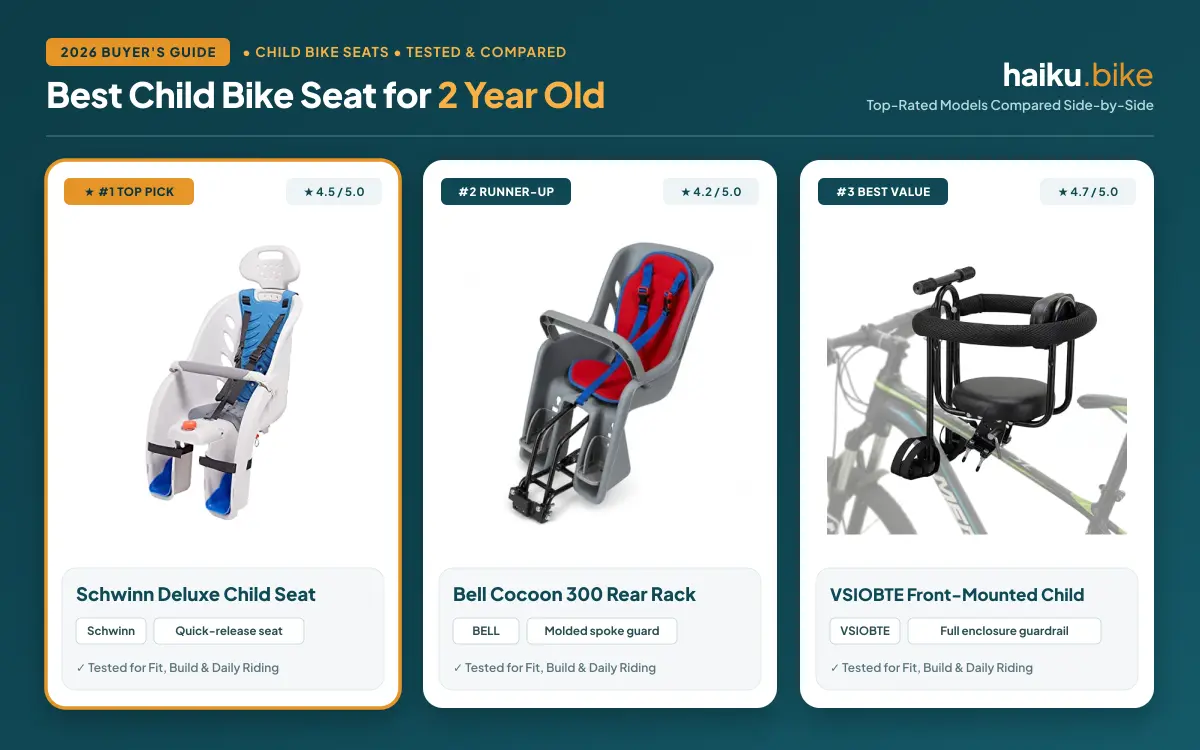
- Best overall: Schwinn Deluxe Child Bike Carrier earns this spot because its quick-release design, adjustable footwells and removable headrest offer useful flexibility.
- Best value: Bell Cocoon 300 Rear Mount Child Bike Seat earns this spot because it combines a five-point harness, spoke guard and rear reflector.
- Best for adjustable support: Bwcece Kid’s Bike Seat Rear with Adjustable earns this spot because its headrest adjusts to accommodate different child sizes.
- Best for position options: XIEEIX Rear Child Bike Seat earns this spot because its backrest offers sitting and sleeping positions for children within its stated limits.

Pros
- Quick-release seat
- 3-point harness and leg restraints
- Adjustable footwells
- Removable headrest
- Converts to rear rack carrier
Cons
- 40 lb maximum child weight
- Designed for most, not all, adult bikes
- Carries one child only

Pros
- Adjustable five-point harness
- Molded spoke guard
- Rear reflector included
- Mounting hardware and instructions included
- Fits most 26- and 27-inch bikes
Cons
- Requires compatible rear rack
- Not designed for rear-suspension bikes
- Maximum child weight: 40 lb

Pros
- Adjustable headrest
- Thick padded cushion
- Removable handrail
- Foot pedals included
- Reflective tape on back
Cons
- Requires a rear rack
- Rack dimensions limit compatibility
- Maximum load capacity not specified

Pros
- Sitting and sleeping backrest positions
- Three-point buckle harness
- Padded seat and armrests
- Disassembles for storage
Cons
- Requires a flat bike rack
- Rack must meet specific size limits
- Limited to children under 36 inches and 33 lb
Side-by-Side Comparison
| Seat | Mounting requirements | Child limits | Restraint | Notable feature |
|---|---|---|---|---|
| Bwcece Kid’s Bike Seat Rear with Adjustable | Rear rack longer than 11.81 in and narrower than 7.48 in | Age range stated as 18 months to 8 years; capacity depends on bike | Safety belt | Adjustable headrest, 17.72 to 23.62 in from cushion |
| Schwinn Deluxe Child Bike Carrier | Frame mount; maker says it works with most adult bikes | Age 1+; maximum 40 lb | Three-point harness and leg restraints | Quick release and removable headrest |
| XIEEIX Rear Child Bike Seat | Flat rack longer than 9.8 in, narrower than 6.7 in, no thicker than 0.5 in | Ages 1 to 3; under 36 in tall and under 33 lb | Three-point buckle belt | Sitting and sleeping positions |
| Bell Cocoon 300 Rear Mount Child Bike Seat | Rear rack; most standard 26-inch and 27-inch bikes without rear suspension | Age 1+; up to 40 lb | Five-point harness | Spoke guard and rear reflector |
Rack and frame compatibility is the first difference to resolve, since a seat that cannot mount as intended is not a suitable choice. The Bwcece and XIEEIX give specific rack dimensions, while Schwinn and Bell describe different fit conditions; also compare child limits with your passenger and the bicycle’s load capacity.
Common Mistakes to Avoid
Buying before measuring the rack can leave you with a seat that does not match its mounting requirements. The Bwcece needs a rack longer than 11.81 inches and narrower than 7.48 inches, while XIEEIX specifies a flat rack longer than 9.8 inches, narrower than 6.7 inches and no thicker than 0.5 inches.
Assuming that a general fit description guarantees compatibility can also create problems. Schwinn says its carrier works with most adult bikes, but you should still compare the frame and mounting area with the maker’s instructions; Bell specifically excludes bikes with rear suspension and requires a compatible rack.
Choosing by age alone overlooks weight, height and bicycle load limits. XIEEIX states age, height and weight requirements, while Bwcece says capacity depends on the bike; confirm every applicable limit and check the product listing for ASTM F1625 certification instead of inferring it from a harness or reflector.
Best Rear Child Bike Seat Buying Guide
Bike and Rack Compatibility
Bike and rack compatibility determines whether a rear child seat can attach according to its maker’s instructions. Start by identifying whether the seat mounts to the frame or a rear rack, then compare your bicycle’s mounting points, rack shape and dimensions with the stated requirements.
The Bwcece and XIEEIX require flat rear racks and specify dimensions, so measure the actual mounting surface rather than judging by appearance. Bell describes fit with most standard 26-inch and 27-inch bikes without rear suspension, while Schwinn describes its carrier as suitable for most adult bikes.
Your bicycle’s load limit matters alongside the seat’s fit notes. A rack that physically accepts a seat may not be approved for passenger loads, and Bwcece explicitly says capacity depends on the bike. Check the bicycle maker’s guidance and ask the seat maker about unclear mounting requirements.
Child Size and Weight Limits
Child size limits show whether a seat suits your passenger now and may help you understand how long it could remain suitable. Compare the child’s height and weight with every limit from the maker; an age range alone does not establish that a child fits the seat safely.
Schwinn and Bell each state a maximum child weight of 40 pounds and an age range beginning at 1+. XIEEIX specifies ages 1 to 3, height under 36 inches and weight under 33 pounds, so all three conditions matter when judging fit.
Bwcece describes its seat for children from 18 months to 8 years but does not give a numeric child weight limit in its feature information. The maker says capacity depends on the bicycle, so confirm the seat and bike limits before purchase rather than treating age as a substitute.
Harness and Passenger Protection
A harness and its associated features help keep a child positioned in the seat during a ride. Compare the restraint configuration, leg restraints, foot protection and side support, then confirm that adjustments can accommodate your passenger as directed by the manufacturer.
Bell lists a five-point harness and molded spoke guard. Schwinn lists a three-point harness, leg restraints and safety straps, while XIEEIX lists a three-point buckle belt and thick foot pedals; Bwcece describes a safety belt and handrail.
Those product descriptions do not establish ASTM F1625 certification. Check the product listing for certification information and follow the maker’s instructions for fitting and securing the child. A reflector can support visibility, but it does not replace suitable bicycle lights or careful riding practices.
Comfort and Support
Back, seat and foot support affect how comfortably a child can remain positioned during a ride. Look for information about padding, head support, foot placement and restraint adjustment, then consider whether those features suit your child’s size and ability to sit comfortably.
Schwinn lists custom padding, adjustable footwells and a removable headrest. XIEEIX describes a wide backrest, sponge armrests and a seat cushion, plus sitting and sleeping positions; families considering that option should still follow the maker’s guidance for passenger position.
Bwcece lists a thick cushion and adjustable headrest, while Bell uses a wrap-around bucket design. Product descriptions cannot predict how an individual child will respond, so compare dimensions and adjustment details with your passenger’s needs before choosing.
Installation and Removal
Installation design matters because the seat needs to attach securely and may need to come off when the bike carries no passenger. Check the stated mount type, included hardware and instructions, then confirm that the setup matches your bicycle rather than relying on a broad compatibility claim.
Schwinn lists a quick-release system and says removing the seat leaves a rear rack carrier. Bwcece says it includes hardware and instructions and can be assembled in three steps, but its rack dimensions still need to match your bike.
XIEEIX describes a split design assembled from a seat and foot pedal, with steel plates and stainless steel buckles used for attachment. Bell attaches to an existing rear rack with included hardware. Follow the maker’s instructions and check that fasteners remain secure before carrying a child.
Adjustability and Visibility
Adjustability can help match a seat to a growing passenger, while reflective details can contribute to visibility. Check which components move or detach, but do not assume a headrest adjustment changes the seat’s child weight or height limits.
Bwcece lists an adjustable headrest from 17.72 to 23.62 inches measured from the cushion, plus a removable handrail. Schwinn lists adjustable footwells and a removable headrest. These features serve different purposes, so choose according to the support your passenger needs.
Bell includes a rear reflector, and Bwcece describes reflective tape on the seat back. Neither feature replaces a bicycle light; choose lighting for your route and conditions. Our photochromic cycling glasses guide covers separate visibility and eyewear considerations for riders.
How We Chose
We score each seat with the Haiku Ride Score, weighing core performance at 30%, build and weather resistance at 20%, ease of use at 20%, compatibility and battery at 15%, and value at 15%. Battery does not apply to child seats, so mounting compatibility, passenger fit and practical use carry more relevance in this category.
We compare manufacturer specifications, compatibility information and long-term owner feedback when available, then assess how mounting, child limits, restraints and adjustments serve different families. We research and draft our guides with software tools, including AI, then run automated checks on product fit, sourcing, and our editorial rules. Our editor spot-checks guides rather than reading each one before publication. Read how we review for more on our method.
Price and Value: What Each Budget Gets You
Budget
At the budget end, riders can find core passenger features such as a bucket seat, harness and spoke guard. The Bell Cocoon 300 Rear Mount Child Bike Seat includes those details and a rear reflector, but it requires a compatible rack and excludes bikes with rear suspension. Buyers should prioritize fit and restraint features over assuming a lower-cost seat will suit every bicycle.
Mid-Range
Mid-range options may add more support or position flexibility while retaining specific mounting constraints. The XIEEIX Rear Child Bike Seat offers sitting and sleeping positions, while the Bwcece Kid’s Bike Seat Rear with Adjustable adds an adjustable headrest and removable handrail. Riders give up broad fit assumptions: both require checking rack dimensions, and each has distinct child limits or capacity qualifications.
Premium
At the upper end of this group, a seat may emphasize padding, adjustability and easier removal rather than a different basic carrying purpose. The Schwinn Deluxe Child Bike Carrier offers custom padding, adjustable footwells, a removable headrest and quick release. Its stated fit with most adult bikes still needs confirmation against your bicycle, and its three-point harness differs from Bell’s five-point restraint.
Choosing Something Else
A child trailer suits families who prefer a separate passenger compartment instead of carrying a child directly behind the rider. A trailer changes the bike’s width and handling, so riders should check its bicycle compatibility and follow its maker’s instructions. Families who cannot meet a rear seat’s rack requirements or passenger limits should consider a different transport category rather than forcing a poor fit.
Final Thoughts
Families seeking quick removal and adjustable foot support should consider the Schwinn Deluxe Child Bike Carrier. Its padding, removable headrest and three-point harness give riders clear features to compare, though the broad “most adult bikes” description does not guarantee fit on every bicycle.
Riders whose bike meets its rack and wheel requirements may prefer the Bell Cocoon 300 Rear Mount Child Bike Seat for its five-point harness and spoke guard. Families prioritizing headrest adjustment can consider the Bwcece Kid’s Bike Seat Rear with Adjustable, provided their rack dimensions and bicycle load capacity meet the maker’s requirements.
The XIEEIX Rear Child Bike Seat may suit families who value sitting and sleeping position options, if the child and flat rack meet its specific limits. Compare other family transport choices in our Kids & Family Cycling category before deciding which setup fits your rides.
Skip rear child seats if your bicycle cannot meet the mounting requirements, your child exceeds the listed limits or you need a separate passenger compartment. A trailer may suit those needs better; riders considering a different family bike purchase can also read our folding electric bike guide.
FAQs
How do I choose the right rear child bike seat for my bike?
Choosing a rear child bike seat starts with matching its mount requirements to your bicycle and rack. Measure the rack when the maker provides dimensions, then check frame, suspension and wheel restrictions. Confirm that your bicycle’s load limits and your child’s size meet the seat instructions. A general “fits most” description is not enough to confirm compatibility.
What weight limits do rear child bike seats have?
Rear child bike seat weight limits vary by model, so check the specific seat and bicycle rather than assuming one limit applies to all. Schwinn and Bell list a maximum child weight of 40 pounds, while XIEEIX specifies under 33 pounds. Bwcece does not state a numeric child limit in its feature details and says capacity depends on the bike.
Do rear child bike seats need ASTM F1625 certification?
ASTM F1625 is the relevant standard to check when comparing rear-mounted child bike seats in the United States. The specifications described here do not establish that any particular seat is certified, so check the product listing and contact the maker if certification details are unclear. Follow the manufacturer’s instructions and applicable local laws when carrying a child.
Can a rear child bike seat fit an existing rack?
A rear child bike seat can fit an existing rack only when the rack meets the maker’s mounting requirements. Bwcece and XIEEIX state specific rack dimensions, while Bell requires a compatible rack and excludes rear-suspension bikes. Schwinn says its carrier works with most adult bikes, but you should confirm fit against your bicycle before ordering.
Which harness is safer on a rear child bike seat?
A rear child bike seat’s harness is one feature to compare, but the number of restraint points alone does not establish certification or guarantee protection. Bell lists a five-point harness, while Schwinn and XIEEIX list three-point restraints. Choose a seat that fits your child, secure every restraint as directed and check the listing for ASTM F1625 information.
Can a child sleep in a rear child bike seat?
A child should use a rear child bike seat only according to its maker’s instructions, including guidance about passenger position. XIEEIX describes sitting and sleeping positions, and Bwcece says its adjustable headrest can support a sleeping position. Those descriptions do not replace checking fit, securing the child properly and supervising the passenger throughout the ride.
Are rear child bike seats suitable for night rides?
A rear child bike seat’s reflector or reflective material can contribute to visibility, but it does not replace suitable bicycle lights. Bell lists a rear reflector, and Bwcece describes reflective tape. Check local requirements and choose lights for your route and conditions; our photochromic glasses guide covers eyewear as another riding consideration.
How often should I check a rear child bike seat?
Check a rear child bike seat and its mounting hardware according to the manufacturer’s instructions, especially before carrying a child. Confirm that fasteners remain secure, the rack and seat show no visible damage, and the harness and foot restraints work as intended. Contact the maker for guidance if a component is damaged or does not adjust correctly.
Write Your Review
No reviews yet. Be the first to share your experience!