

Riders moving between sunny roads, shaded paths, and tree cover need eyewear that adapts as light changes. Photochromic cycling glasses adjust lens tint in response to light, but tint range, transition speed, coverage, and fit vary by product.
We compare 5 glasses for November 2026, including frameless designs and an option with a prescription insert. Start with the light conditions and fit you need, then compare the maker’s stated lens details. Our guide to photochromic lenses for cycling explains how changing tint may suit different rides.
At a Glance: Which One Fits You
- Best overall: ROCKBROS Photochromic Sports Sunglasses earns this spot because its stated 16%-83% transmittance range and included myopia frame address changing light and prescription needs.
- Best value: KAPVOE Photochromic Cycling Glasses Clear Mountain earns this spot because its TR90 full-frame design and UV400 protection offer straightforward core features.
- Best for low weight: ROCKBROS 22g Photochromic Sports Sunglasses Anti earns this spot because ROCKBROS lists a 22g pair weight and frameless construction.
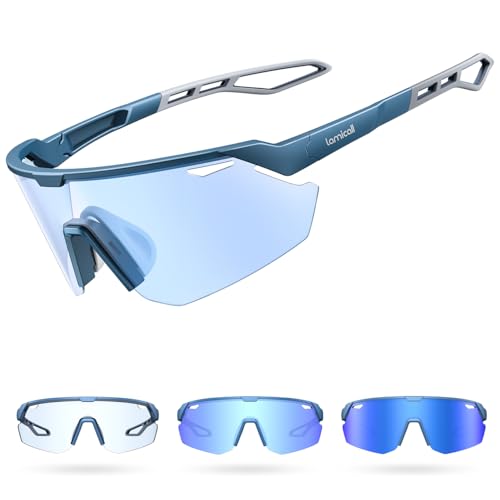
- Best for adjustable fit: Lamicall Photochromic Sports Sunglasses for Men earns this spot because its nose pads have three adjustment levels.


Pros
- Photochromic lenses
- About 0.8 oz per pair
- Frameless peripheral view
- Adjustable rubber nose bridge
- UV400 coating
Cons
- No light transmission range listed
- No lens transition speed listed
Pros
- Photochromic lenses for changing outdoor light
- UV400 protection
- 27-gram TR90 frame
- Three-level adjustable nose pads
- Vents help reduce fogging
Cons
- No stated tint range or transition time
- Who should skip it: riders needing documented lens darkness

Pros
- Photochromic tint adjusts with UV intensity
- UV400 protection coating
- Lightweight, frameless design
- Adjustable rubber nose pad
- Open-bottom downward view
Cons
- Tint depth depends on UV intensity
- No lens-change or fit measurements listed
- Who should skip it: riders needing consistently dark lenses

Pros
- Photochromic lens
- UV400 protection
- Impact-resistant polycarbonate lenses
- Flexible TR90 frame
- Grippy rubber nose pads
Cons
- One size only
- Lens darkness range not specified
- No fit dimensions listed
Side-by-Side Comparison
| Product | Lens details | Frame design | Prescription insert | Weight | Included accessories |
|---|---|---|---|---|---|
| ROCKBROS Photochromic Sports Sunglasses | 16%-83% transmittance; UV400 protection | Oversized wraparound | Included; prescription lenses not included | Not listed | Hard case, cloth, pouch, myopia frame, polarization card, certificate |
| ROCKBROS 22g Photochromic Sports Sunglasses Anti | Photochromic; UV400 coating | Frameless | Not listed | 22g per pair, according to ROCKBROS | Not listed |
| Lamicall Photochromic Sports Sunglasses for Men | Photochromic; UV400 protection | TR90 frame; adjustable nose pads | Not listed | 27g frame, according to Lamicall | Hard case, cloth, pouch, instruction manual |
| SCVCN Photochromic Cycling Glasses Sports | Photochromic; UV400 coating | Frameless design; TR90 frame construction | Not listed | 32g per pair, according to SCVCN | Not listed |
| KAPVOE Photochromic Cycling Glasses Clear Mountain | Photochromic; UV400 protection | Full-frame TR90 | Not listed | Not listed | Not listed |
The biggest practical difference is how much each maker specifies about lens range and fit. ROCKBROS Photochromic Sports Sunglasses state a transmittance range and include a myopia frame, while several alternatives list photochromic action without a numerical range.
Common Mistakes to Avoid
Assuming every photochromic lens changes equally quickly can lead to poor visibility when a route moves rapidly between sun and shade. Only ROCKBROS Photochromic Sports Sunglasses state a numerical transmittance range here, and none of these products gives a transition-speed figure.
Treating an included prescription frame as finished prescription eyewear is another avoidable mistake. ROCKBROS Photochromic Sports Sunglasses include a myopia frame, but corrective lenses are separate; ROCKBROS recommends the frame for myopia below 400° and astigmatism below 200°.
Choosing glasses by lens coverage alone can leave temples pressing beneath helmet straps or a frame shifting during a ride. Check fit with your helmet secured, look over each shoulder, and confirm the return terms if you cannot assess comfort before ordering.
A dark lens does not prove UV protection, and a photochromic lens is not automatically suitable for night riding. Check the maker’s stated protection and lens details, then choose eyewear for the actual light conditions on your route.
Best Photochromic Cycling Glasses Buying Guide
Transmittance Range and Transition Speed
Transmittance describes how much visible light passes through a lens, making it useful for judging whether eyewear may suit changing conditions. ROCKBROS lists a 16%-83% range for ROCKBROS Photochromic Sports Sunglasses, with higher transmission in lower light and lower transmission in bright conditions.
Most other products here describe lenses that darken and lighten but do not provide a numerical range. Check whether a listing states both its light transmission range and transition speed if your rides include tunnels or fast shifts from open sun to shade. Without those details, you cannot compare how quickly different lenses respond.
Photochromic response also depends on the light conditions described by the maker, so do not assume a lens becomes fully clear or dark enough for every setting. Riders who frequently ride after dark should consider eyewear specifically suited to low-light conditions rather than relying on a changing tint.
Prescription Compatibility
A prescription insert holds corrective lenses inside sports glasses, which can help riders avoid wearing separate everyday frames beneath cycling eyewear. ROCKBROS Photochromic Sports Sunglasses include a myopia frame, while the other products in this comparison do not list an insert.
The included frame does not come with corrective lenses. ROCKBROS recommends it for myopia below 400° and astigmatism below 200°, but those recommendations do not confirm suitability for every prescription or face.
Before choosing any cycling glasses with a prescription insert, confirm insert dimensions, lens installation requirements, and fit with an optical provider. Riders whose prescription approaches or exceeds the stated guidance should get individual advice before buying, rather than assuming an insert will accommodate their correction.
Coverage, Frame Shape, and Field of View
Lens coverage can help shield eyes from wind and debris, while frame shape affects the view around the lens. ROCKBROS Photochromic Sports Sunglasses use an oversized wraparound lens and state a 180-degree field of view.
ROCKBROS 22g Photochromic Sports Sunglasses Anti and SCVCN Photochromic Cycling Glasses Sports use frameless designs. A frameless lower edge may leave more of the downward view open, but product descriptions cannot establish what will feel comfortable or unobstructed for every face.
Compare the frame outline with your riding position and helmet before choosing. Check whether the lens interferes with your view when you look down at the road or turn your head, and consider return terms when fit cannot be confirmed before purchase.
UV Protection and Lens Material
UV protection is separate from lens tint: a dark appearance does not show how much ultraviolet radiation a lens blocks. All five products list UV400 protection or a UV400 coating, but compare the wording and care guidance on the specific product page.
Several makers describe their lenses as polycarbonate, or PC, and make impact-resistance claims. Those descriptions are product claims, not a promise that a lens cannot be damaged. Follow the maker’s instructions and replace eyewear if lenses become damaged or obstruct your view.
Store glasses in a case when available, and remove grit carefully before wiping lenses. ROCKBROS Photochromic Sports Sunglasses and Lamicall Photochromic Sports Sunglasses for Men include a hard case and cleaning cloth; other package contents vary by product.
Fit, Weight, and Stability
Fit and contact points determine whether cycling glasses stay comfortable and secure over a ride. ROCKBROS lists its frameless pair at 22g per pair, Lamicall lists a 27g frame, and SCVCN lists its pair at 32g.
Lamicall describes nose pads with three adjustment levels, while ROCKBROS 22g Photochromic Sports Sunglasses Anti and SCVCN Photochromic Cycling Glasses Sports list adjustable rubber nose pads. KAPVOE describes rubber nose pads designed to grip when wet. These features offer adjustment or grip, but cannot guarantee a fit for every rider.
Try glasses with your helmet in place, since straps can change how temples sit against your head. Move your head as you would while riding and check for slipping or pressure. The listed weights are not directly equivalent because Lamicall specifies frame weight while other makers specify pair weight.
Accessories and Everyday Care
Accessories affect how easily cycling glasses can be stored, cleaned, and adapted to a prescription. ROCKBROS Photochromic Sports Sunglasses include a hard case, cloth, pouch, myopia frame, polarization card, and certificate; Lamicall lists a case, cloth, pouch, and instruction manual.
Do not assume every package includes a case or cleaning cloth. Check package contents if you need specific accessories, and remember that the ROCKBROS myopia frame requires prescription lenses fitted separately.
Follow the maker’s care instructions and avoid wiping grit across the lens, since abrasive debris can scratch eyewear. A hard case can help separate glasses from tools and keys in a bag. For more fit context, our cycling glasses category collects related eyewear guidance.
How We Chose
We assess these glasses with the Haiku Ride Score: core performance counts for 30%, build and weather resistance for 20%, ease of use for 20%, compatibility and battery for 15%, and value for 15%. For eyewear, we compare lens details, fit information, prescription compatibility, materials, and included accessories against rider needs.
Our evaluation draws on manufacturer specifications, compatibility information, and long-term owner feedback when available. We research and draft our guides with software tools, including AI, then run automated checks on product fit, sourcing, and our editorial rules. Our editor spot-checks guides rather than reading each one before publication. Our how we review page explains our editorial method.
Price and Value: What Each Budget Gets You
Budget
At the budget end, riders can find photochromic lenses, UV400 protection, and basic frame features without extensive fit adjustments or a prescription insert. KAPVOE Photochromic Cycling Glasses Clear Mountain offer a full-frame TR90 design and rubber nose pads. Buyers may give up a stated transmittance range, detailed package contents, and additional fit adjustments, so check the product page closely.
Mid-Range
Mid-range choices can add lighter construction, adjustable nose pads, or more clearly described frame materials while retaining photochromic lenses. ROCKBROS 22g Photochromic Sports Sunglasses Anti list a 22g pair weight and frameless build; SCVCN Photochromic Cycling Glasses Sports lists TR90 frame construction and a 32g pair weight. Riders may still give up a published tint range or prescription insert.
Premium
At the upper end of this group, product details may add a numerical transmittance range, more accessories, or fit adjustments. ROCKBROS Photochromic Sports Sunglasses include a myopia frame and state a 16%-83% range, while Lamicall Photochromic Sports Sunglasses for Men list adjustable nose pads and a hard case. These features do not guarantee perfect fit or faster tint changes.
Choosing Something Else
Riders who mostly ride in consistent light may prefer clear or fixed-tint cycling glasses, avoiding reliance on a photochromic transition. Prescription sunglasses from an optical provider may suit riders who need a precise correction or cannot confirm insert compatibility. Either alternative can mean giving up the convenience of one lens intended for changing light, so match eyewear to typical routes.
Final Thoughts
Riders who want a stated tint range and prescription-insert option should compare ROCKBROS Photochromic Sports Sunglasses. Its wraparound lens has a stated 180-degree field of view, and the package includes a myopia frame. The trade-offs are that corrective lenses are separate, the glasses’ weight is not listed, and the maker does not state transition speed.
For riders who prioritize low listed weight and frameless construction, ROCKBROS 22g Photochromic Sports Sunglasses Anti may be a closer fit. ROCKBROS lists a 22g pair weight and adjustable rubber nose bridge, but does not give a numerical transmittance range or list prescription support. Riders who want adjustable nose pads can also compare Lamicall Photochromic Sports Sunglasses for Men.
Riders seeking a simple full-frame design can consider KAPVOE Photochromic Cycling Glasses Clear Mountain, while SCVCN Photochromic Cycling Glasses Sports list frameless construction and adjustable nose pads. Both lack a numerical transmittance range. Skip these products if you need a confirmed prescription fit, a published transition speed, or eyewear specifically suited to night riding. Our bike seat height covers another way to refine riding comfort.
FAQs
Do photochromic cycling glasses work in changing light?
Photochromic cycling glasses change tint in response to light, which can help riders move between sun and shade without swapping lenses. The ROCKBROS Photochromic Sports Sunglasses state a 16%-83% transmittance range, while other glasses here do not give a numerical range. None lists transition speed, so check that specification if your route includes frequent changes.
Which of the Best Photochromic Cycling Glasses in 2026 support prescription lenses?
ROCKBROS Photochromic Sports Sunglasses include a myopia frame designed to hold prescription lenses, but corrective lenses are not included. ROCKBROS recommends the frame for myopia below 400° and astigmatism below 200°. Ask an optical provider to confirm the insert and prescription are suitable before ordering, especially if your correction approaches or exceeds those guidelines.
Are photochromic cycling glasses suitable for night riding?
Photochromic cycling glasses may lighten in low light, but that does not establish that they are suitable for night riding. The products compared here do not state transition speed, and most do not publish a numerical transmittance range. Riders who prioritize night visibility should choose eyewear intended for low-light conditions and check the maker’s stated lens guidance.
Do photochromic cycling glasses provide UV protection?
Each product in this comparison lists UV400 protection or a UV400 coating. A lens changing tint or appearing dark does not by itself establish UV protection, so check the maker’s stated details for the exact product. Follow its care guidance as well, since scratched or damaged lenses may obstruct your view while riding.
How should cycling glasses fit with a helmet?
Cycling glasses should sit securely without creating uncomfortable pressure beneath helmet straps or blocking your view. Put on your helmet, secure its straps, and check how the temples rest while you turn your head and look down. Frame fit varies, so review return terms if you cannot assess comfort before buying.
How do I clean and store photochromic cycling glasses?
Clean photochromic cycling glasses according to the maker’s instructions, taking care not to wipe grit across the lens. ROCKBROS Photochromic Sports Sunglasses and Lamicall Photochromic Sports Sunglasses for Men include a cleaning cloth and hard case. Store eyewear in a case when available, rather than loose beside tools or keys that could scratch the lenses.
Can I use an included myopia frame without prescription lenses?
The myopia frame included with ROCKBROS Photochromic Sports Sunglasses is designed to hold corrective lenses, which are not included. An optical provider can advise whether the insert can accommodate your prescription and how lenses should be fitted. The maker’s recommended prescription limits do not confirm compatibility for every rider, so seek individual guidance before purchase.
Where can I learn more about photochromic lenses for cycling?
Photochromic lenses may suit rides that alternate between brighter and darker conditions, but their range and response differ by product. Compare stated transmittance, UV protection, fit, and prescription support before choosing. Our photochromic cycling lens guide explains what riders should consider when choosing eyewear for changing light.

Write Your Review
No reviews yet. Be the first to share your experience!