Affiliate disclosure: Haiku.Bike may earn a commission from qualifying purchases made through links on this page. That does not change product selection or editorial judgment.
\n\n\nCommuters riding home after sunset need lights that help reveal pavement and make them more visible to drivers at intersections. These Best Bike Lights range from simple silicone safety lights to rechargeable front and rear sets, with trade-offs in beam coverage, runtime, mounting, and weather protection.
We compared 8 options from brands including Malker, Ascher, Victoper and more for riders weighing practical lighting choices in November 2026. Follow each manufacturer’s instructions and local laws, and use reflective clothing as an added visibility measure. Riders comparing other commuter gear can browse our Commuting & Comfort category.
At a Glance: Which One Fits You
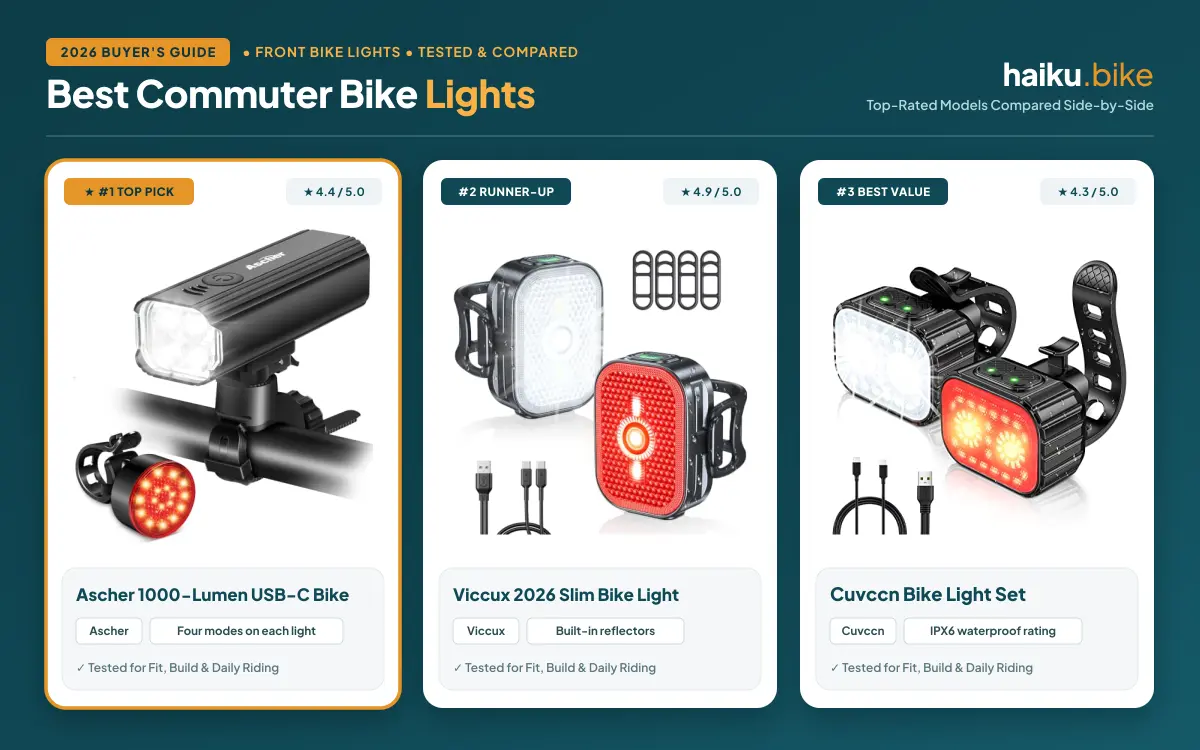
- Best overall: Zewdov 1000 Lumens Super Bright Bike Lights earns this spot because its maker lists a 1,000-lumen headlight, auxiliary floodlights, multiple modes, and IP65 protection.
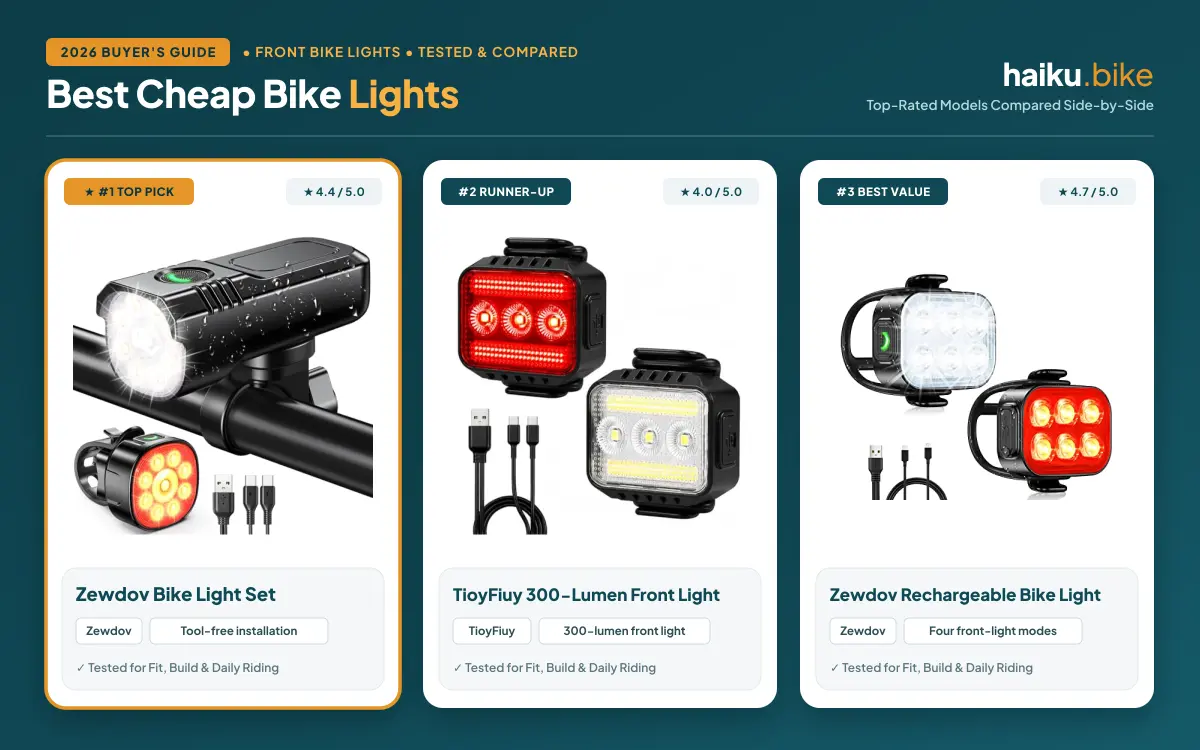
- Best value: TioyFiuy Bright Bike Lights Set for Night Riding earns this spot because both lights have nine modes, memory, and tool-free silicone straps.
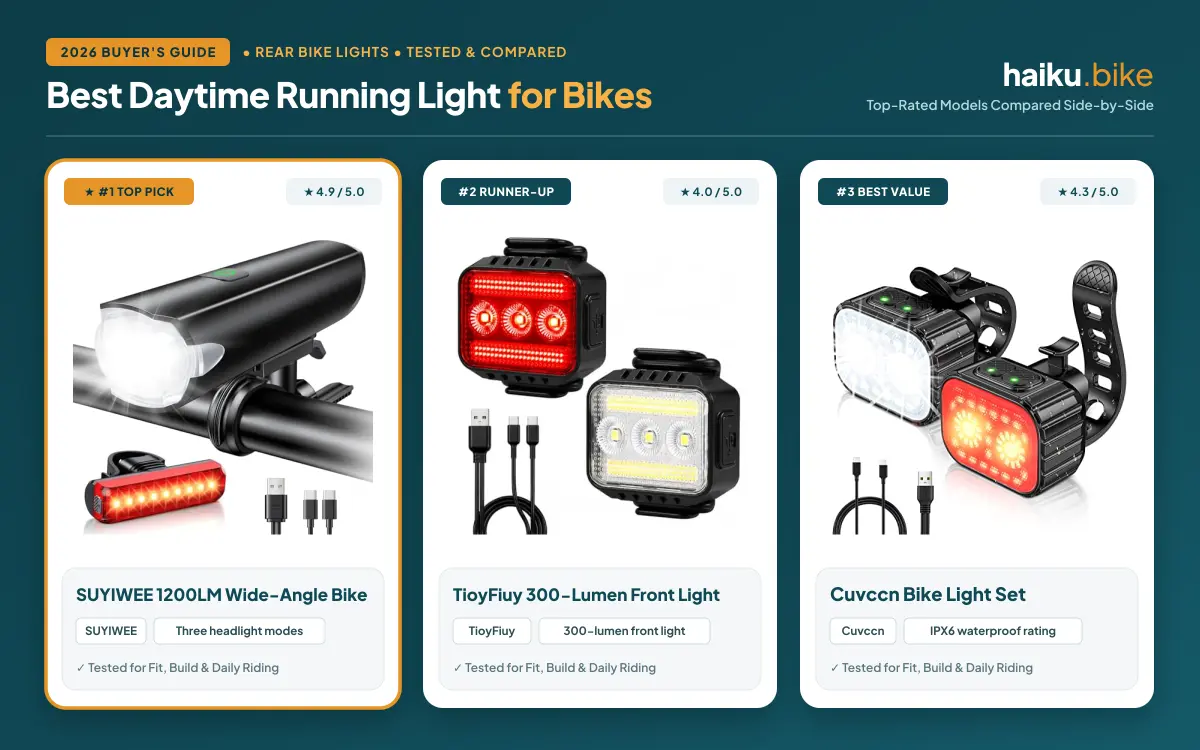
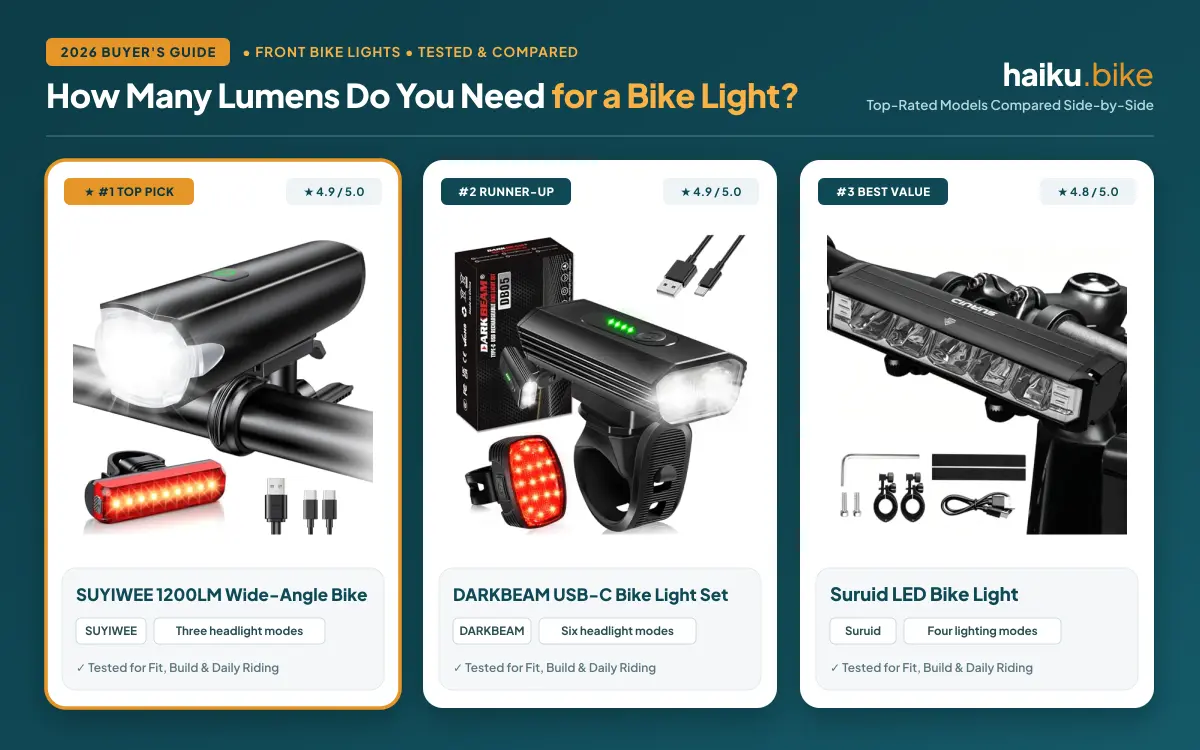
- Best for side visibility: SUYIWEE 1200LM Wide Angle Bike Lights earns this spot because its maker specifies side-emission lenses and a 270-degree beam.
- Best for long flash runtime: Cuvccn Bike Lights Super Bright earns this spot because its maker lists up to 58 hours for the front light in slow-flash mode.

Pros
- Front and rear lights included
- Multiple steady and flash modes
- USB-C charging cable included
- Tool-free installation
- Aluminum alloy casing
Cons
- Four-hour runtime at highest headlight brightness
- Mode controls use single-click, double-click, and long-press

Pros
- Tool-free silicone installation
- Three modes per light
- Waterproof construction
- Four lights in set
- Batteries included
Cons
- Runtime not listed
- Water-resistance rating not listed
- Package color details conflict
Pros
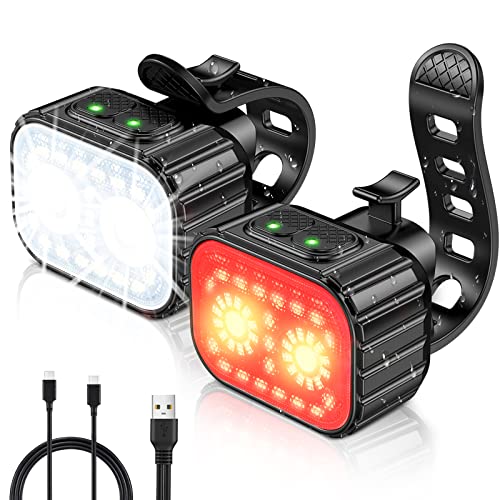
- Long stated flash runtimes
- Independent front and rear switches
- IPX6 waterproof rating
- Tool-free handlebar mounting
Cons
- No stated lumen output
- No stated steady-mode runtime

Pros
- 270° wide-angle front beam
- Three headlight modes
- Five rear-light modes
- IP65 water resistance
- Quick-release brackets
Cons
- Handlebar fit range not listed
- Rear-light runtime conditions not specified
- Light output not stated for rear light

Pros
- Front and rear lights included
- Four front-light modes
- Six rear-light modes
- IP65 water resistance
- Two pairs of mounting straps
Cons
- No runtime per charge stated
- No brightness rating stated
- Elastic strap mounting only

Pros
- Front and rear lights included
- USB rechargeable
- Four lighting modes
- Tool-free silicone strap mounts
- 3.5 oz combined weight
Cons
- No lumen rating listed
- Runtime varies by mode
- No charging port type listed
Pros
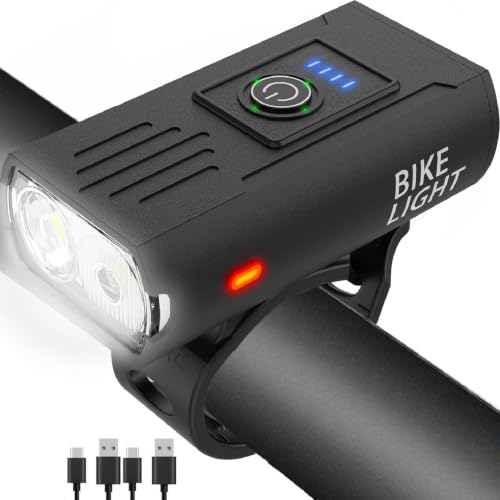
- Six front-light modes
- Two front LEDs
- USB rechargeable
- IPX4 water resistance
- Lightweight, portable design
Cons
- No battery runtime listed
- No lumen output listed
- Mount compatibility details absent

Pros
- 300-lumen front light
- Nine modes per light
- Tool-free silicone-strap mounting
- 35 g per light
- Rated 4 to 20 hours runtime
Cons
- No stated water-resistance rating
- No exact mount-fit range listed
Side-by-Side Comparison
| Light | Modes | Weather rating | Runtime stated by maker | Mount and charging |
|---|---|---|---|---|
| Malker Bicycle Light Front and Rear Silicone LED | High, low, strobe | Waterproof claim; rating not listed | Not listed | Silicone; batteries included |
| SUYIWEE 1200LM Wide Angle Bike Lights | 3 front, 5 rear | IP65 | Front up to 6 hours high; rear up to 430 hours | Quick-release; USB-C |
| Zewdov Bike Lights for Night Riding | 4 front, 6 rear | IP65 | Not listed by mode | Elastic straps; USB charging |
| Ascher Ultra Bright USB Rechargeable Bike Light | 4 | IPX4 | Front 5 to 12 hours; rear 9 to 16 hours | Silicone straps; USB charging |
| Zewdov 1000 Lumens Super Bright Bike Lights | 8 front, 7 rear | IP65 | Front up to 4 hours at highest brightness; rear up to 50 hours | Bracket and strap; USB-C |
| Cuvccn Bike Lights Super Bright | Front 2 x 4; rear 2 x 6 modes | IPX6 | Front up to 58 hours; rear up to 25 hours in slow flash | Buckle-style mount; USB charging |
| Victoper Bike Light, High Lumens Super Bright | 6 front | IPX4 | Not listed | Mount; rechargeable |
| TioyFiuy Bright Bike Lights Set for Night Riding | 9 front, 9 rear | Water resistance claim; rating not listed | 4 to 20 hours | Silicone straps; USB charging |
Weather rating and mode-specific runtime separate these sets more clearly than mode counts alone. Riders who face wet roads can compare stated IP ratings, while commuters with long trips should check whether the listed runtime applies to their preferred brightness or flash setting.
Common Mistakes to Avoid
Choosing a headlight by its lumen claim alone can overlook beam shape, glare, and side visibility. The Zewdov 1000 Lumens set lists auxiliary floodlights, while the SUYIWEE set specifies side-emission lenses; those features describe different coverage considerations, not a guarantee of performance on every street.
Taking maximum runtime as typical runtime can leave riders short of light on the way home. Cuvccn’s longest stated figures apply to slow-flash mode, and the maker gives different figures for each light. Compare the mode you plan to use and leave room for delays between charges.
Assuming every package contains a front and rear light can also lead to a mismatched setup. Victoper’s product name and features describe a front light, while the other sets here specify front and rear lights. Confirm package contents and check mounting clearance around your handlebar and seat post before ordering.
Unrated waterproof claims provide less specific information than a stated IP code. Malker and TioyFiuy describe water resistance without an IP rating, so riders who often encounter rain may prefer a product with a listed rating and should still follow instructions for charging-port care.
Best Bike Lights: Buying Guide
Beam Output and Pattern
Beam output and pattern determine how a front light illuminates the route and how visible it may be from other angles. Lumen figures offer one point of comparison, but they do not explain where the beam lands, how wide it spreads, or whether it reaches road edges.
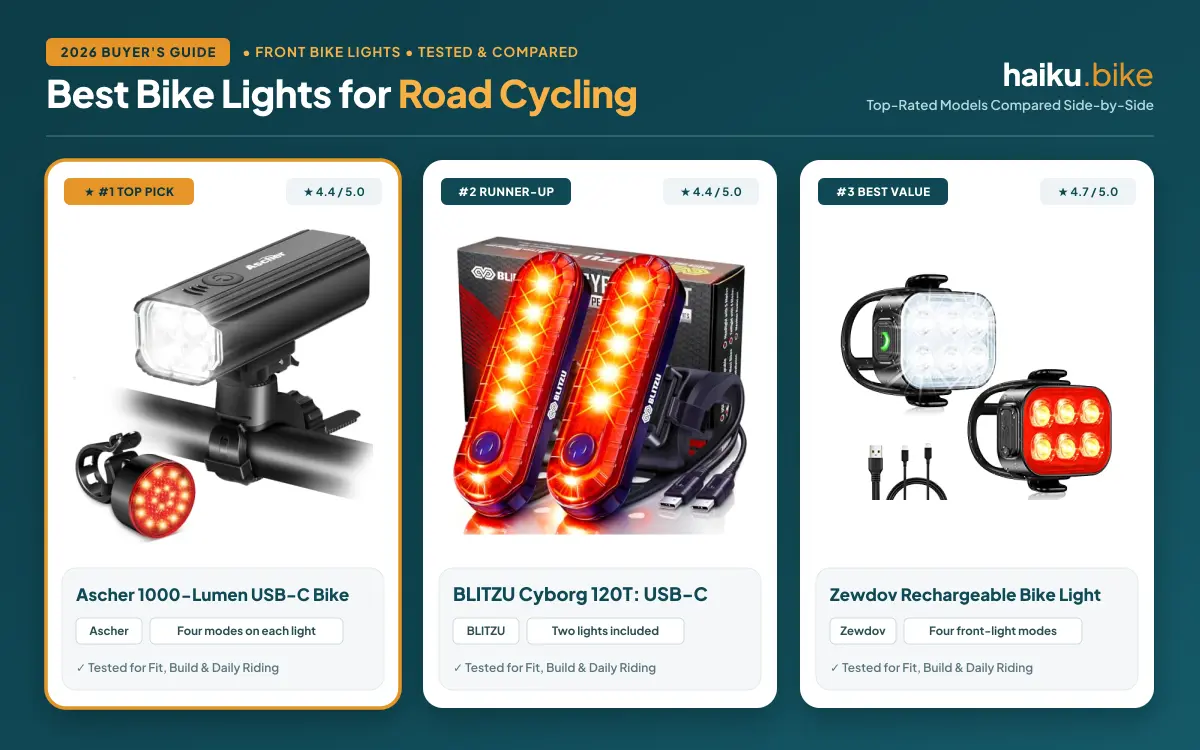
Zewdov lists a 1,000-lumen headlight with auxiliary floodlights, while SUYIWEE lists 1,200 lumens and side-emission lenses. TioyFiuy lists 300 lumens for its front light. These are maker specifications, not guarantees about what you will see in every riding environment.
For unlit roads, look for a forward beam suited to seeing surface changes, and consider how you can aim it without shining into oncoming traffic. On lit streets, a lower setting may help preserve battery while keeping you visible. More output alone does not settle which light suits your route.
Front and Rear Visibility
A front light helps illuminate the road, while a rear light helps people approaching from behind notice your bicycle. Most products here are described as front and rear sets, but Victoper’s features describe a front light, so confirm what its package includes before choosing it as your only light.
Mode selection can help riders adapt to changing conditions, but a long list of modes is not automatically easier to use. Zewdov lists four front modes and six rear modes, while TioyFiuy lists nine for each light. Consider whether controls are easy to operate during a stop.
Side visibility can matter at intersections and driveways where traffic approaches from an angle. SUYIWEE specifies side-emission lenses and a 270-degree beam. A rear light still cannot replace reflective clothing or careful road positioning, particularly when traffic can approach from several directions.
Runtime by Mode
Runtime matters because a light that loses power before your ride ends cannot provide dependable illumination. Compare front and rear figures separately, then check whether the maker’s stated duration applies to high, low, or flashing mode.
Cuvccn lists up to 58 hours for its front light and 25 hours for its rear light in slow flash. Ascher lists 5 to 12 hours for its front light and 9 to 16 hours for its rear light, depending on mode. Those figures describe different operating conditions.
Estimate your longest regular trip and allow time for detours or missed charging. If the maker does not publish mode-specific runtime, do not assume the light will cover a long ride simply because it offers several settings. A battery indicator, where specified, can also help guide charging habits.
Weather Protection
An IP rating gives riders a more specific reference for weather protection than an unqualified waterproof claim. Products in this guide list IP65, IPX6, or IPX4, while Malker and TioyFiuy describe water resistance without stating an IP code.
Ascher and Victoper list IPX4, Cuvccn lists IPX6, and Zewdov and SUYIWEE list IP65. These ratings do not mean every light can be submerged or charged with ports uncovered. Follow the manufacturer’s care instructions and inspect covers before connecting a charging cable.
Riders who regularly encounter rain may prefer a stated rating that suits their riding conditions, while occasional damp-weather riders may prioritize other features. An unspecified rating leaves less information for comparing protection. In either case, do not treat a weather rating as permission to ignore care guidance.
Mounting, Fit, and Removal
Mounting affects whether a light stays in position and how easily you can remove it when parking. Silicone straps, elastic bands, brackets, and buckles each attach differently, so check the product’s instructions against your handlebar shape, seat post, and available space.
Malker and TioyFiuy use silicone straps, Ascher describes a strap with multiple openings, and Cuvccn describes a buckle-style mount. Zewdov supplies elastic straps. These descriptions help you compare installation approaches, but they do not establish that every mount fits every bicycle.
Check whether a handlebar bag, basket, or other accessory could block the beam. Riders who remove lights after locking up may value a quick-release approach, while riders who leave lights installed should confirm that the mount holds the chosen angle. Follow the manufacturer’s installation steps.
Charging and Controls
Charging format and controls affect how easily you can keep lights ready for daily rides. SUYIWEE and Zewdov describe USB-C charging, while other rechargeable products specify USB charging. Malker includes batteries, so check the product information if rechargeable operation matters to your routine.
SUYIWEE says both lights can charge through dual Type-C ports, and Zewdov lists a two-port USB-C cable. Cuvccn includes a low-battery indicator. Zewdov’s headlight uses several button actions to change modes, so review the instructions before riding if quick mode changes matter to you.
A regular charging habit is more reliable than waiting for a light to fail during a trip. Confirm cable compatibility before relying on a power bank, and follow maker guidance for storage if you leave rechargeable lights unused. Check battery indicators when the product includes them.
Riders comparing lights with other cycling electronics can also browse our Lights & Radar category. For routes where navigation matters as much as visibility, our bike computer guide for gravel riding covers a different kind of ride technology.
How We Chose
We score options with the Haiku Ride Score: core performance counts for 30%, build and weather resistance for 20%, ease of use for 20%, compatibility and battery for 15%, and value for 15%. We compare manufacturer specifications, compatibility information, and long-term owner feedback when those details are available.
Our evaluation considers beam details, mode-specific runtime, weather ratings, and mounting approaches. We researched and drafted this guide with software tools, including AI, then reviewed and edited it before publication. Our how we review page explains our editorial method.
Price and Value: What Each Budget Gets You
Budget
At the entry level, riders can find straightforward lights with basic modes and simple mounting. Malker Bicycle Light Front and Rear Silicone LED uses tool-free silicone and includes batteries, but its maker does not list runtime or an IP rating. That makes it a practical fit for riders prioritizing uncomplicated installation, while those needing rechargeable operation or clearly stated weather protection should compare other options.
Mid-Range
Mid-range options add features such as rechargeable front and rear lights, more mode choices, and stated runtime. Ascher Ultra Bright USB Rechargeable Bike Light lists mode-dependent runtime for both lights and an IPX4 rating. The trade-off is that its protection rating and published beam details may not meet the needs of riders seeking a higher stated rating or specified side-emission coverage.
Premium
At the upper end of this group, some lights add broader feature sets, more detailed runtime claims, and higher stated weather ratings. Zewdov 1000 Lumens Super Bright Bike Lights pairs a listed 1,000-lumen headlight with auxiliary floodlights and IP65 protection. Its maker lists up to four hours at highest brightness, so riders should weigh output against time between charges.
Choosing Something Else
Riders on familiar, well-lit streets may prefer a compact visibility light combined with reflective clothing rather than a larger headlight set. That approach suits short trips where illuminating a dark road is not the main need. Riders on unlit routes should choose lighting intended to illuminate the path, and follow local laws for bicycle lighting.
Final Thoughts
Riders wanting a broad feature set for mixed night routes should consider Zewdov 1000 Lumens Super Bright Bike Lights. Its listed output, auxiliary floodlights, multiple modes, and IP65 rating suit varied riding needs. The trade-off is its maker’s stated runtime of up to four hours at highest brightness.
For riders who prioritize a long stated slow-flash runtime, Cuvccn Bike Lights Super Bright lists up to 58 hours for the front light and 25 hours for the rear. Those figures apply to slow flash, not every mode. Riders seeking side visibility can compare SUYIWEE 1200LM Wide Angle Bike Lights, whose maker specifies a 270-degree beam and IP65 protection.
Commuters wanting many modes and tool-free straps may prefer TioyFiuy Bright Bike Lights Set for Night Riding. Its maker lists nine modes per light and 4 to 20 hours of runtime depending on mode, but gives no IP rating. Riders who prefer a simpler mount can consider Malker Bicycle Light Front and Rear Silicone LED, although runtime is not listed.
Riders who need detailed beam-shaping information or a mounting setup these products do not provide should choose a different lighting category. A high-output light may also be unnecessary for short trips on well-lit streets. Riders comparing adjacent safety gear can browse our Helmets & Safety category and folding electric bike guide.
FAQs
What should I look for in Best Bike Lights for commuting?
Best Bike Lights for commuting should provide a useful front beam, a rear light, a secure mount, and runtime suited to your trip. Check the maker’s mode-specific runtime and weather rating rather than relying only on lumen claims. Simple controls can also help when you need to change settings during a stop.
Which Best Bike Lights in 2026 have the longest stated runtime?
Among these Best Bike Lights, Cuvccn lists up to 58 hours for its front light and 25 hours for its rear light in slow-flash mode. Those figures apply to a particular setting, not every mode. Compare runtime by light and setting, then choose a system that covers your usual ride with charging time to spare.
Are these Best Bike Lights suitable for riding in rain?
Several Best Bike Lights here have stated weather ratings: Zewdov and SUYIWEE list IP65, Cuvccn lists IPX6, and Ascher and Victoper list IPX4. Malker and TioyFiuy describe water resistance without an IP code. Follow care instructions, protect charging ports, and do not assume a light can be submerged.
Can I mount bike lights on different handlebar sizes?
Bike light fit depends on the mount style, bicycle shape, and available handlebar or seat-post space. Compare the maker’s mounting instructions with your bicycle before ordering, because a strap or bracket may not suit every setup. Check that bags and accessories will not block the beam, and confirm that the mount holds the light in position.
How often should I charge rechargeable bike lights?
Rechargeable bike lights should be charged according to their maker’s runtime guidance and your riding schedule. A high setting may use the battery faster than a flashing mode, so consider your usual setting when planning charging. Check battery indicators when available, and follow storage guidance if the lights will remain unused for an extended period.
Do bike lights need to be visible from the side?
Side visibility can help other road users notice a cyclist approaching an intersection or driveway. SUYIWEE specifies side-emission lenses and a 270-degree beam, while other sets may emphasize forward or rear visibility. Check product descriptions for side-facing features, and use reflective clothing as an additional measure rather than a replacement for lights.
Can I use these bike lights on a backpack or stroller?
Some makers describe uses beyond bicycles, including backpacks and strollers, but attachment depends on the included mount. Malker lists backpack use, and Zewdov describes use on strollers and backpacks. Confirm that a light remains secure and visible in its intended position, and follow local bicycle-lighting laws when riding.
Where can I compare other cycling safety gear?
Riders comparing lights with other safety equipment can browse our Helmets & Safety category. Helmet features do not replace front and rear lights when those are needed for your ride. Compare mounting, visibility direction, battery needs, and maker instructions before choosing a complete setup.
Write Your Review
No reviews yet. Be the first to share your experience!