
Gravel riders often need clear ride data and dependable route cues where paved roads, signs, and familiar landmarks become scarce. A bike computer can record your ride, guide you along an uploaded route, or provide basic speed and distance without GPS.
Our guide compares 8 options from CATEYE, SY, CYCPLUS, and other brands for November 2026. Decide whether you need route guidance, sensor connections, or simple ride statistics, and browse our Bike Computers & GPS category for more choices.
At a Glance: Which One Fits You
- Best overall: GEOID CC700 2.8" Color Screen Bike/Cycling earns this spot because it supports GPX route uploads, turn reminders, and automatic rerouting.
- Best value: iGPSPORT BSC100S GPS Bike Computer earns this spot because it pairs ANT+ and Bluetooth 5.0 sensor support with a stated runtime of up to 40 hours.
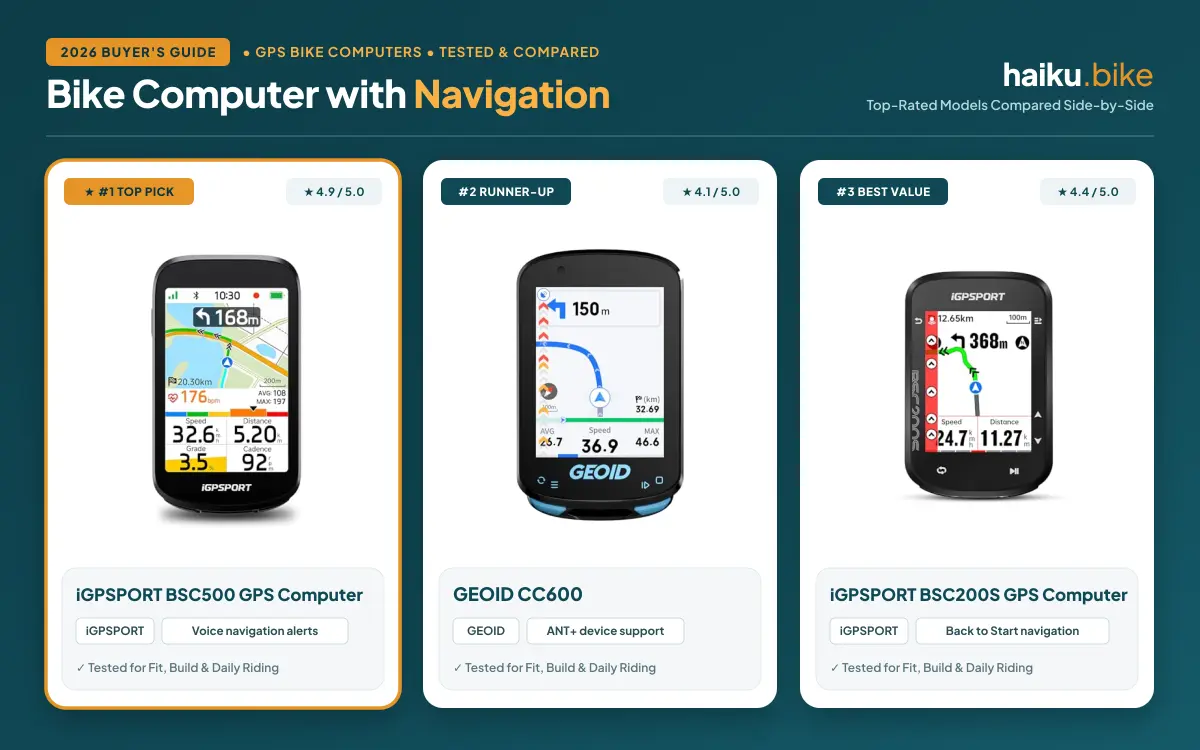
- Best for route guidance: iGPSPORT BSC200S GPS Bike Computer earns this spot because it supports imported routes, turn reminders, and Back to Start navigation.
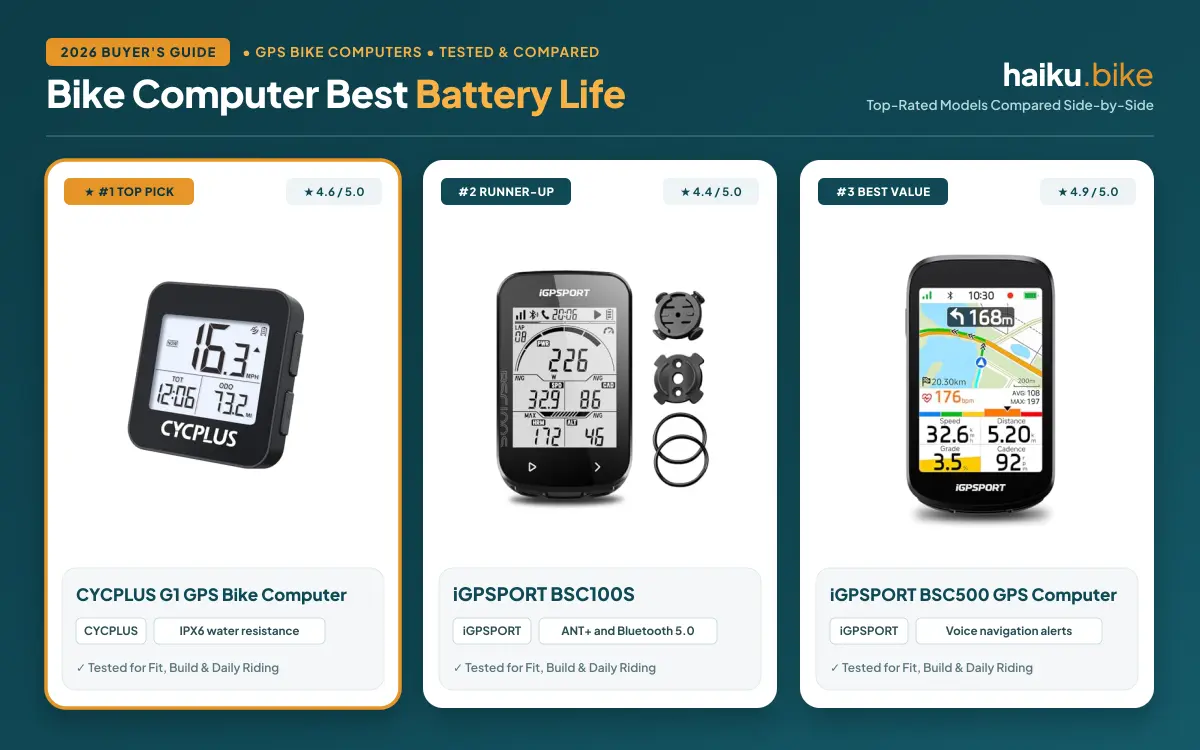
- Best for long rides: CYCPLUS Wireless GPS Bike Computer G1, 70g earns this spot because CYCPLUS lists more than 55 hours of operation.

Pros
- Color route guidance with automatic rerouting
- ANT+ and Bluetooth connectivity
- Strava and TrainingPeaks auto-sync
- Customizable data pages and layouts
- Smart-trainer workout controls
Cons
- Battery life not stated
- Water resistance not specified
- Mount compatibility not stated

Pros
- Up to 40-hour battery life
- 2.6-inch anti-glare screen
- Strava and Komoot sharing
- ANT+ and Bluetooth 5.0
- IPX7 water resistance
Cons
- Mapping not listed
- Sensor compatibility may be needed for some metrics

Pros
- More than 55-hour maker-rated runtime
- IPX6 water resistance
- Automatic backlight
- GPS route and altitude data
- About 2.5 oz
Cons
- No listed app connectivity
- No listed sensor pairing

Pros
- Current, maximum, and average speed
- Automatic stop detection
- Trip and total distance tracking
- Battery life up to three years
- Beginner-friendly entry-level design
Cons
- Wired connection
- No app or wireless compatibility details provided

Pros
- Tracks speed, distance, and riding time
- Vibration-activated auto wake
- Nighttime backlight
- Two-button interface
- Customizable tire-size settings
Cons
- May not work with some electric-assist bikes
- Wireless unit may make a slight rattle

Pros
- Routes from Strava, Ride with GPS, and Komoot
- Back to Start navigation
- More than 100 riding data fields
- Up to 25-hour maker-rated battery life
- USB-C charging
Cons
- Water-resistance rating not listed
- Wireless protocols not specified
- Requires iGPSPORT app for route setup

Pros
- GPS tracking without wheel sensor
- Up to 28-hour rated runtime
- Altitude and ascent data
- Automatic backlight and ride recording
- USB-C charging
Cons
- No listed ANT+ or Bluetooth support
- No listed app compatibility

Pros
- 2.4-inch color touchscreen
- GPS and GLONASS tracking
- Route upload and breadcrumb navigation
- 36-hour maker-rated battery life
- Bluetooth and ANT+ connectivity
Cons
- Sensors sold separately
- Extension mount not included
- Compatible accessories required for power data
Side-by-Side Comparison
| Computer | Navigation or positioning | Stated battery life | Display | Connectivity |
|---|---|---|---|---|
| SY Bicycle Speedometer and Odometer | Speed and distance; GPS not listed | Not listed | LCD with night backlight | Not listed |
| CATEYE Velo 7 Wired Bike Computer | Wired; GPS not listed | Up to three years, according to CATEYE | Not listed | Not listed |
| CYCPLUS Wireless GPS Bike Computer G1, 70g | GPS tracking | More than 55 hours, according to CYCPLUS | 2.0-inch FSTN | Not listed |
| GEOID CC700 2.8" Color Screen Bike/Cycling | GPX routes, turn reminders, rerouting | Not listed | 2.8-inch color | ANT+, Bluetooth, WiFi |
| iGPSPORT BSC100S GPS Bike Computer | Five satellite systems | Up to 40 hours, according to iGPSPORT | 2.6-inch anti-glare | ANT+, Bluetooth 5.0 |
| iGPSPORT BSC200S GPS Bike Computer | Route import, turn guidance, Back to Start | Up to 25 hours, according to iGPSPORT | 2.4-inch color | Not listed |
| BKVTOP Wireless GPS Bike Computer, 50g | GPS tracking | Up to 28 hours, according to BKVTOP | 2.4-inch LCD | Not listed |
| COOSPO Color Touchscreen GPS Bike Computer CS600 | Route uploads, breadcrumb trail | 36 hours, according to COOSPO | 2.4-inch color touchscreen | ANT+, Bluetooth |
Route guidance is the clearest dividing line: GEOID, iGPSPORT BSC200S, and COOSPO describe specific route features, while GPS tracking alone does not establish on-screen directions. Battery claims also vary, so riders planning long days should compare stated runtime with their route and display needs.
Common Mistakes to Avoid
GPS tracking does not necessarily include maps, turn prompts, or rerouting. CYCPLUS G1 and BKVTOP describe GPS ride tracking, but their listed features do not confirm route guidance, so riders exploring unfamiliar roads should check for explicit route functions.
A simple speedometer may not fit a rider who wants location-based distance or navigation. CATEYE Velo 7 is wired, while SY describes speed, distance, and riding time; check how a computer measures speed and whether its sensor arrangement suits your bicycle.
Wireless sensor support is not universal, and the word Bluetooth alone does not confirm compatibility with every accessory. iGPSPORT BSC100S lists ANT+ and Bluetooth 5.0, while GEOID CC700 and COOSPO CS600 list ANT+ and Bluetooth; compare those protocols with your sensors before buying.
Riders can also underestimate screen controls, battery needs, or weather-care limits. Compare the maker’s runtime claim with your planned ride, consider whether buttons or touchscreen suit rough roads, and follow the device instructions for mounting, wet-weather use, and charging.
Best Bike Computer for Gravel Riding: Buying Guide
Route Guidance and GPS Positioning
GPS positioning records where a ride takes place, while route guidance helps a rider follow a planned course. Those functions overlap, but one does not guarantee the other, so check for route imports, turn reminders, breadcrumb trails, or rerouting when choosing a computer for unfamiliar gravel roads.
GEOID CC700 supports external GPX uploads, turn reminders, and automatic rerouting; iGPSPORT BSC200S supports imported routes and Back to Start guidance. COOSPO CS600 describes uploaded routes and breadcrumb navigation, while CYCPLUS G1 lists GPS tracking without specific guidance features.
Satellite support can help establish location, but multiple systems do not create route instructions. iGPSPORT BSC100S lists GPS, BeiDou, GLONASS, Galileo, and QZSS support; consider its positioning separately from navigation. Our GPS Bike Computers category offers more devices to compare.
Battery Life for Long Gravel Days
Battery life matters when a route lasts for hours or passes far from convenient charging. Compare the maker’s stated runtime with your expected ride and leave room for detours, pauses, and screen use; a published maximum is not a guarantee for every setup.
CYCPLUS lists more than 55 hours, iGPSPORT lists up to 40 hours for BSC100S and up to 25 hours for BSC200S, and COOSPO lists 36 hours. BKVTOP lists up to 28 hours, while CATEYE states up to three years for Velo 7.
Charging access matters for repeated rides and multi-day routes. iGPSPORT BSC100S and BSC200S, as well as COOSPO CS600, describe Type-C charging; check current maker instructions for charging and care. Charge before departure and decide how you will recharge if your route extends beyond one ride.
Sensor Support and Data Fields
Sensor support determines whether a computer can display information from accessories you already own. Check for ANT+, Bluetooth, or both, then compare those protocols with each sensor’s specifications instead of assuming that every wireless accessory will pair.
iGPSPORT BSC100S lists ANT+ and Bluetooth 5.0 support for speed, cadence, and heart-rate sensors. GEOID CC700 supports ANT+ and Bluetooth, and COOSPO CS600 lists both protocols; connection details are not listed for every computer in this guide.
Customizable data pages help riders keep useful metrics visible without frequent menu changes. BSC100S lists more than 40 riding data fields, BSC200S lists over 100, and GEOID CC700 supports up to 108 data items; confirm the metrics you need work with your chosen sensors.
Screen Readability and Controls
Screen readability affects how quickly you can check speed, distance, or directions on uneven roads. Compare display size, glare handling, backlighting, color, and controls; a larger screen does not automatically make your preferred information easier to read at a glance.
GEOID CC700 has a 2.8-inch color screen, and iGPSPORT BSC100S has a 2.6-inch anti-glare screen. CYCPLUS G1 uses a 2.0-inch FSTN display with automatic backlight, while COOSPO CS600 has a 2.4-inch color touchscreen with automatic backlight adjustment.
Touch controls and physical buttons can feel different on rough roads or when you wear gloves. GEOID CC700 uses a three-button design, while COOSPO CS600 uses a touchscreen; review the interface and page layout before choosing, especially if you expect to change screens while riding.
Weather Protection and Mounting
Weather protection and a secure mount help keep a computer usable when conditions change. Compare the stated water-resistance rating and included mounting hardware, then follow maker instructions for installation, wet-weather use, cleaning, and charging.
iGPSPORT BSC100S, BKVTOP, and COOSPO CS600 list IPX7 protection, while CYCPLUS G1 lists IPX6. SY describes its speedometer as waterproof without giving an IP rating, so do not assume that these descriptions indicate identical protection.
BKVTOP says its package includes a standard mount, rubber pad, and mounting rings. Mounting details are not listed for every option, so confirm the included hardware and handlebar fit before ordering; position the unit where it stays visible without crowding other cockpit equipment.
GPS Computer or Simple Speedometer
A GPS computer records location-based ride information, while a basic wired or wireless speedometer can cover speed, distance, and time. Choose based on whether your gravel routes call for route guidance, GPS tracking, or straightforward ride statistics without navigation features.
CATEYE Velo 7 shows current, maximum, and average speed, distance, elapsed time, pace arrow, and clock, and it pauses time counting automatically at stops. SY measures speed, distance, and riding time and provides a night backlight; neither description lists GPS navigation.
Wheel and sensor setup can affect a speedometer’s operation, so follow installation instructions and check bicycle compatibility. SY notes that compatibility may vary with some electric-assist bicycles. Riders who need route prompts should compare GPS computers and browse the Bike Computers & GPS category.
How We Chose
We score computers with the Haiku Ride Score: core performance 30%, build and weather resistance 20%, ease of use 20%, compatibility and battery 15%, and value 15%. This framework helps us compare navigation, positioning, displays, sensor support, stated runtime, and weather protection against common gravel-riding needs.
We evaluate manufacturer specifications, compatibility information, and long-term owner feedback, then assess how each computer fits different routes and rider priorities. We research and draft our guides with software tools, including AI, then run automated checks on product fit, sourcing, and our editorial rules. Our editor spot-checks guides rather than reading each one before publication. Our how we review page explains our approach.
Price and Value: What Each Budget Gets You
Budget
At the budget end, riders can get basic speed and distance tracking or GPS ride recording without full route guidance. SY Bicycle Speedometer and Odometer covers core ride statistics and has a night backlight, while CATEYE Velo 7 adds automatic stop detection. These simpler devices give up listed GPS navigation and broad sensor connectivity, so they fit familiar routes better than remote exploration.
Mid-Range
Mid-range computers add GPS tracking, clearer displays, longer stated runtimes, or sensor connections. iGPSPORT BSC100S combines ANT+ and Bluetooth 5.0 with an anti-glare screen and a stated runtime of up to 40 hours, while CYCPLUS G1 emphasizes GPS recording and more than 55 hours. These choices do not list the same route guidance as dedicated navigation-focused devices.
Premium
At the upper end of this group, computers add richer route interfaces, color displays, customizable data, or touchscreen control. GEOID CC700 supports GPX uploads and automatic rerouting; COOSPO CS600 offers route uploads, breadcrumb guidance, and a touchscreen. Riders pay in added setup and interface complexity, and should confirm that specific app and route features suit their preferred workflow.
Choosing Something Else
A smartphone with a secure handlebar mount can suit riders who already navigate with a mapping app and want familiar maps. Phone battery use, visibility, and weather protection still need planning, especially on remote rides. Riders who mainly want glanceable cycling metrics may prefer a dedicated computer with a display, controls, and runtime designed for riding.
Final Thoughts
Gravel riders who regularly follow unfamiliar routes should consider the GEOID CC700 2.8" Color Screen Bike/Cycling. Its GPX uploads, turn reminders, and automatic rerouting suit planned routes, though its listed specifications do not state battery runtime.
The iGPSPORT BSC200S GPS Bike Computer suits riders who want imported routes, Back to Start guidance, and a stated runtime of up to 25 hours. Riders who prioritize sensor support and longer stated runtime may prefer the iGPSPORT BSC100S GPS Bike Computer, which lists ANT+, Bluetooth 5.0, and up to 40 hours.
For long outings where stated runtime matters more than listed route guidance, the CYCPLUS Wireless GPS Bike Computer G1, 70g lists more than 55 hours. Riders who want uploaded routes and a color touchscreen can consider the COOSPO Color Touchscreen GPS Bike Computer CS600, though touchscreen controls may not suit everyone on rough ground.
Riders who need only basic speed and distance can skip GPS computers and choose a simpler unit, such as the CATEYE Velo 7 Wired Bike Computer or SY Bicycle Speedometer and Odometer. Neither description lists GPS route guidance, so riders seeking maps should compare dedicated navigation devices in our GPS Bike Computers category.
FAQs
What makes a bike computer useful for gravel riding?
A bike computer is useful for gravel riding when its display, battery, and navigation features fit the rider’s routes. GPS tracking records location, while route guidance can provide prompts on unfamiliar roads. Sensor support also matters if you use cadence, speed, or heart-rate accessories, so check specific functions and protocols before choosing a device.
Does GPS tracking mean a computer has route navigation?
GPS tracking does not necessarily mean a bike computer provides route navigation. Tracking can record location and ride metrics, while navigation requires stated features such as route uploads, turn reminders, breadcrumb guidance, or rerouting. Check how routes transfer to the computer and how directions appear before relying on it for unfamiliar gravel roads.
Which sensors can a GPS bike computer connect to?
A GPS bike computer can connect only to sensors supported by its wireless protocols and by the sensor itself. iGPSPORT BSC100S lists ANT+ and Bluetooth 5.0 support for speed, cadence, and heart-rate sensors, while COOSPO CS600 lists ANT+ and Bluetooth. Confirm that both devices support the same protocol before purchase.
How much battery life should a gravel bike computer have?
A gravel bike computer should have enough stated battery life for your planned ride, with reserve for detours and screen use. Manufacturer figures range from iGPSPORT BSC200S at up to 25 hours to CYCPLUS G1 at more than 55 hours. Treat runtime claims as estimates, charge before riding, and plan for longer routes.
Can I use a GPS bike computer in heavy rain?
A GPS bike computer’s water-resistance rating describes protection stated by its maker, but riders should follow the device manual for wet-weather care. Several computers in this guide list IPX7, while CYCPLUS G1 lists IPX6. Check the exact rating and instructions for cleaning and charging rather than assuming all devices handle exposure identically.
Which Best Bike Computer for Gravel Riding in 2026 offers route guidance?
GEOID CC700, iGPSPORT BSC200S, and COOSPO CS600 explicitly list route features. GEOID describes GPX uploads, turn reminders, and rerouting; BSC200S lists imported routes and Back to Start; COOSPO describes route uploads and a breadcrumb trail. Check route formats and guidance details against your preferred navigation app before buying.
Are wired bike computers suitable for gravel riding?
A wired bike computer can suit gravel riders who want basic speed, distance, and elapsed-time data without GPS navigation. CATEYE Velo 7 is a wired option with automatic stop detection, while GPS computers provide location-based tracking. Confirm wheel and sensor installation requirements, especially if your bicycle has an unusual setup.
Should I use a phone instead of a bike computer?
A phone can suit riders who want familiar mapping apps and detailed maps on the handlebar. A dedicated computer may better fit riders who prioritize cycling data, glanceable displays, and ride-specific features. Compare mounting, battery needs, and weather protection for your setup, then explore our Bike Computers & GPS category.
Write Your Review
No reviews yet. Be the first to share your experience!