
Adult tricycles are not usually hard to pedal, but they can feel awkward to steer at first. Three wheels keep the bike upright when stopped, yet the fixed rear wheels make turns feel different from turns on a two-wheel bike. Slow practice helps you learn the handling.
Adult tricycle handling matters most if you are new to cycling, returning after a break, or choosing a ride for errands. Follow the manufacturer’s instructions for setup and use, and ask a bike shop to check any work you are unsure about.
How Adult Tricycles Work
An adult tricycle balances on three wheels instead of leaning into turns like a two-wheel bicycle. The wide rear track can feel reassuring while you stop, start, and ride straight, but it does not make every maneuver easier.
Most adult tricycles have two rear wheels connected by an axle and one front wheel that steers. When you turn the handlebars, the front wheel changes direction while the rear wheels keep their spacing. That layout can make tight turns feel wide or unusual.
Adult tricycles also carry baskets and cargo more steadily while stopped, but extra load can affect steering and braking. A basket full of groceries may shift the bike’s balance, so start with light cargo and secure it before riding.
What Changes the Learning Curve
Turning technique
Turning is often the biggest adjustment because an adult tricycle does not lean into a corner like a bicycle. A fast or sharp turn can feel unstable, particularly if you steer abruptly or carry weight in a high basket.
Practice broad turns at a walking pace in an open, level area. Look through the turn, steer smoothly, and slow before entering it. Avoid trying to pivot sharply in a confined space until you understand how much room your tricycle needs.
Starting and stopping
Starting and stopping can feel straightforward because the tricycle can stay upright without you balancing at a standstill. You can place both feet down when stopped, which may make mounting and dismounting feel less demanding.
Braking still takes attention. Learn which brake controls each wheel and how the tricycle responds at a slow pace before riding near people, vehicles, or obstacles. Keep both hands on the handlebars when stopping and avoid sudden inputs.
Road surface and slope
Uneven pavement, sloped driveways, and curbs can make adult tricycles harder to control than smooth, level paths. The three wheels may meet a bump at different times, and a side slope can pull the tricycle toward its lower side.
Choose a smooth practice area first, then add gentle slopes only when steering and braking feel familiar. Approach surface changes slowly and squarely. If a route has a steep cross-slope or narrow passage, walking the tricycle may be the easier choice.
Fit and reach
A tricycle that fits your body is easier to control than one that forces you to stretch or crowd the handlebars. Check that you can reach the grips and brake levers comfortably and step onto the frame without awkward movement.
Seat adjustment and frame design vary, so confirm the maker’s fit guidance before choosing a model. The adult tricycle buying guide can help you compare common features, while the Adult Tricycles & E-Trikes category covers related guides.
Gears and cargo
Gears can reduce effort on hills, but they do not remove the need to steer and brake smoothly. A single-speed model may suit flat routes, while multiple gears offer more flexibility when terrain changes.
Cargo adds another handling change. Keep loads low, balanced, and within the maker’s stated limits. Secure loose items so they cannot slide into a wheel or interfere with steering, and practice again after loading the basket.
How to Make the First Rides Easier
You can make an adult tricycle easier to learn by setting it up correctly and practicing one skill at a time. Choose a quiet, level area with room to turn, and leave baskets empty until you feel comfortable.
- Check assembly, tire condition, and brake operation using the manufacturer’s instructions.
- Adjust the seat and handlebars so you can reach controls without straining.
- Practice mounting, starting, coasting, and stopping at a slow pace.
- Make broad turns in both directions, then gradually try smaller ones.
- Add light, secured cargo only after basic handling feels predictable.
- Choose a familiar route with smooth surfaces before riding in traffic or on hills.
Riding a tricycle on a familiar route can still require planning around its width and turning space. Check whether gates, paths, storage areas, and doorways have room for the full rear end, and allow extra space when passing obstacles.
Riders comparing other bike types can also read Haiku Bike’s guides to bikes and e-bikes and electric bikes for heavier riders. Those guides cover different designs, so compare fit and intended use rather than assuming another bike handles like a tricycle.
Gear That Helps
Adult tricycle features vary, so compare fit, brake layout, gearing, and storage against your route and comfort needs. A model with useful adjustment and manageable cargo space may make learning easier, but practice remains important.

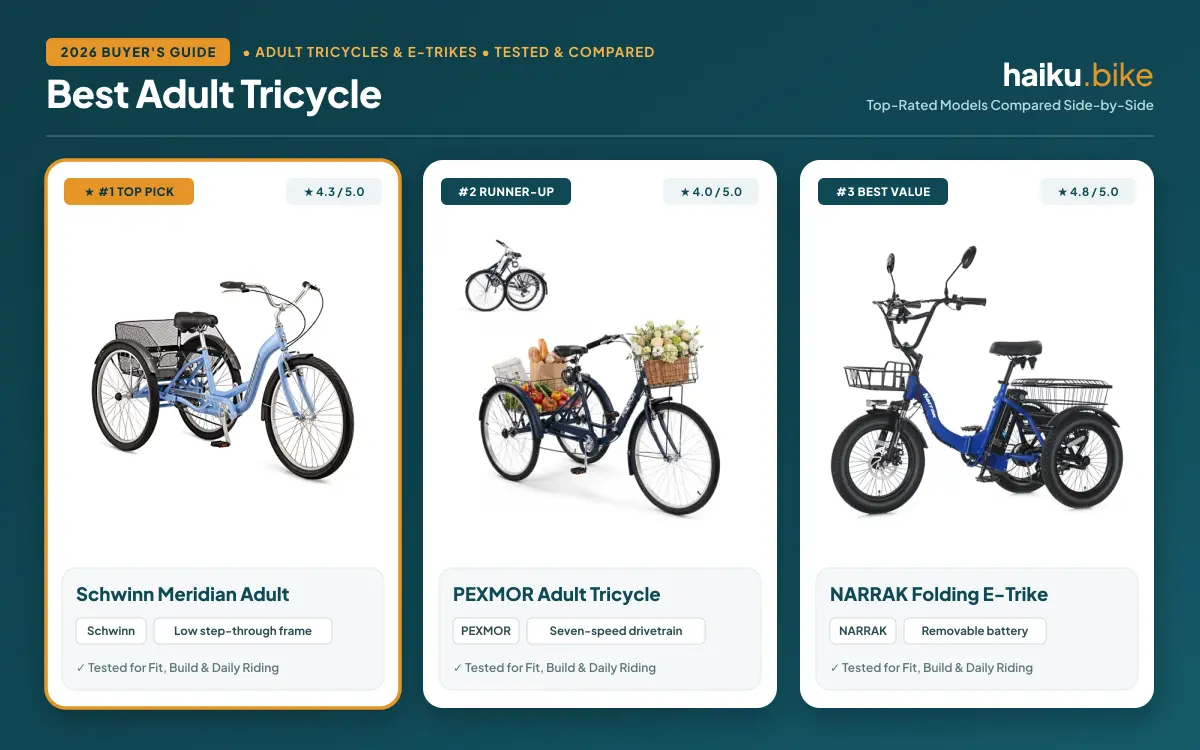
Pros
- Seven-speed drivetrain
- Wide seat with backrest
- Rear basket rated for 50 lb
- Low step-through frame
- Assembly tools and manual included
Cons
- Only 24-inch wheel size specified
- Product weight not listed
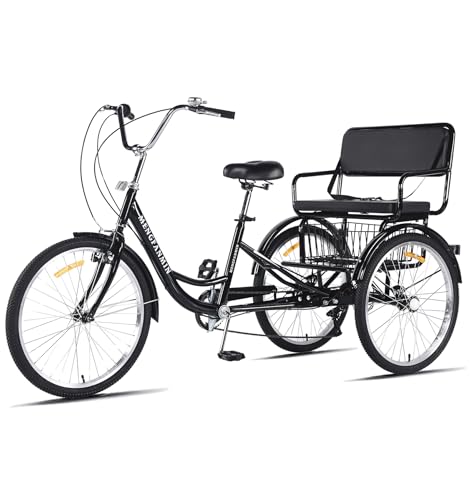
Pros
- 7-speed drivetrain
- Removable child seat
- Large rear basket
- Adjustable handlebars
- Full-coverage fenders
Cons
- No child-seat weight limit listed
- Tricycle weight not listed
- No assembly details provided

Pros
- Shimano 7-speed drivetrain
- Dual brakes
- Adjustable seat height
- 44 lb-capacity basket
- Treaded tires and cushioned saddle
Cons
- 56.88 lb weight
- Basket capacity limited to 44 lb
- 24-inch wheel size

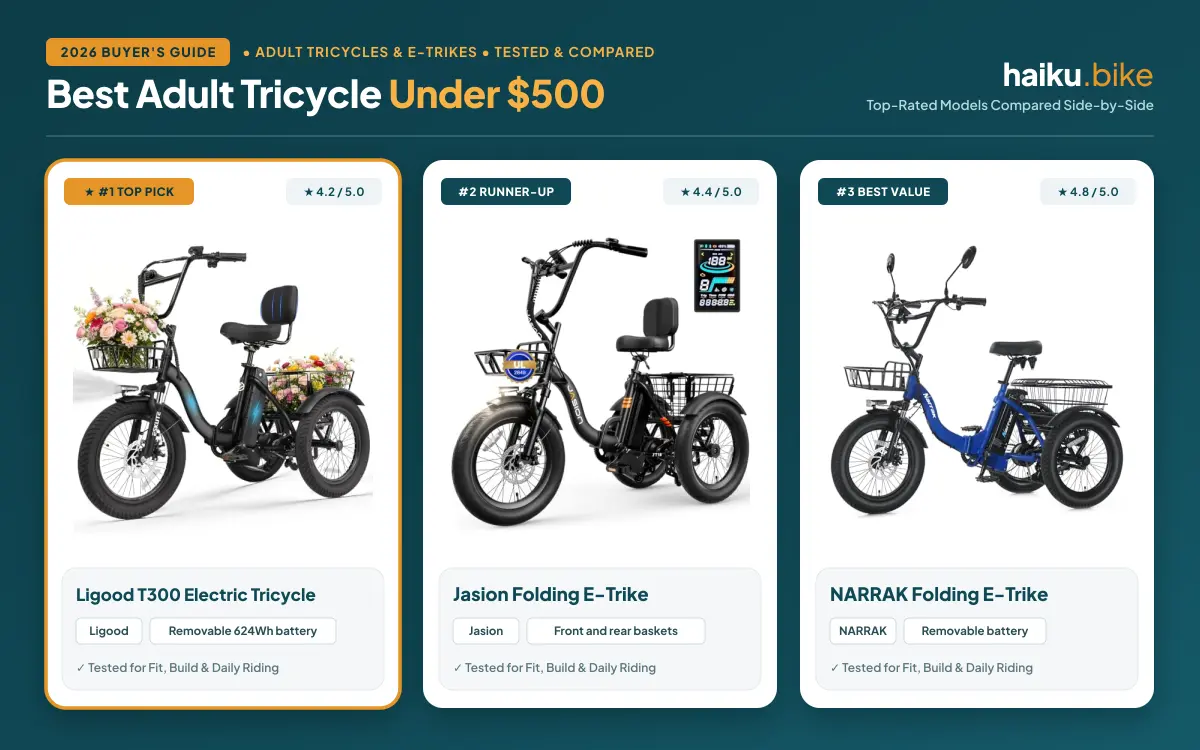
Pros
- Front and rear storage baskets
- Padded seat with backrest
- Adjustable seat position
- Drum brakes
- 350 lb maker-rated load capacity
Cons
- Single-speed drivetrain
- 18-inch wheel size only
- Bike weight not listed
FAQs
Are adult tricycles easier than bicycles?
Adult tricycles can be easier to balance while stopped because three wheels support the bike without leaning. They can be harder to turn in tight spaces, and cornering takes a different technique than on a bicycle. The easier choice depends on your route, fit, and comfort with each design.
Do adult tricycles tip over easily?
Adult tricycles can tip if a rider takes a sharp turn quickly, rides across a strong side slope, or carries unbalanced cargo. Three wheels help the bike stand upright at rest, but they do not prevent tipping in every situation. Turn gradually, slow beforehand, and keep loads secure and balanced.
Can you ride an adult tricycle on hills?
Adult tricycles can handle some hills, but steep grades may demand more effort and careful braking. Gears can help match pedaling effort to the terrain, while the tricycle’s weight and cargo also affect climbing. Check the route and manufacturer’s guidance, and practice on gentle slopes before choosing hillier rides.
How long does it take to learn an adult tricycle?
Learning time varies with your cycling experience, the tricycle’s fit, and the surfaces you ride. Many riders need practice to get used to turning and judging the rear wheels’ width. Start in a clear area and move to more complex routes only when the controls feel familiar.
Can an adult tricycle carry groceries?
Many adult tricycles include baskets for errands, but each model has its own cargo limits. Check the maker’s instructions, distribute items evenly, and secure anything that could move. A loaded basket can change steering and braking, so take a short practice ride before carrying groceries on your usual route.
Should you practice before riding on public roads?
Practicing first helps you learn starting, stopping, turning, and the tricycle’s width before handling busier surroundings. Begin in an open, quiet area, then choose a low-stress route that suits your skill. Check local rules before riding, since requirements can vary by location.
Write Your Review
No reviews yet. Be the first to share your experience!