

Low tires can slow a commute, change how a bike feels on the road, or leave a rider sorting out inflation before a trail ride. A floor pump works well for regular home use, while a compact electric pump can reduce manual effort and travel more easily.
Our Best Bike Pump Under $50 guide compares 3 options from BV, Fanttik, GIYO for November 2026. The choices include two manual floor pumps and one rechargeable electric pump; riders focused on Presta connections can also consult our bike pump guide for Presta valves.
At a Glance: Which One Fits You
- Best overall: BV Bicycle Pump Durable Steel Bike Floor Pump earns this spot because its steel barrel and reversible twin valve head support Presta and Schrader valves.
- Best for portable inflation: Fanttik X9 Ace Mini Electric Bike Pump, 150PSI earns this spot because its compact electric design offers automatic shutoff at a selected pressure.
- Best for pressure readings: GIYO Bike Floor Pump – 3" Dual Scale Gauge earns this spot because its gauge has finer increments at lower pressures.

Pros
- Presta and Schrader compatibility
- No valve-head reversal needed
- Rated to 160 psi
- Steel barrel
- Ergonomic handle
Cons
- No weight listed
- No pressure-gauge details listed

Pros
- Presta and Schrader compatibility
- Automatic pressure shutoff
- 5,000 mAh battery
- Up to 8 inflations per charge
- About 0.85 lb
Cons
- 25-minute continuous-use limit
- Requires battery charging
Pros
- Presta and Schrader compatibility
- One-handed thumb-lock lever
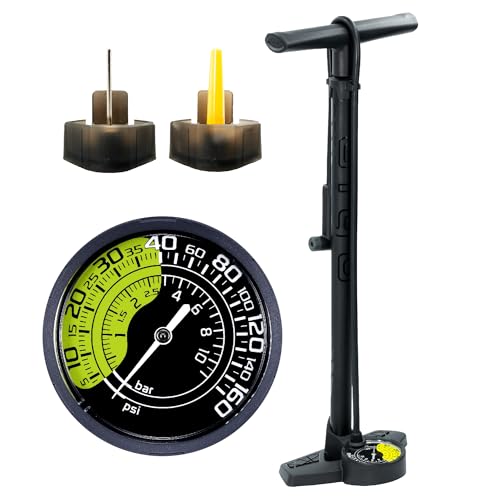
- Dual-scale 3-inch gauge
- Steel barrel
- Needle valve and ball inflator included
Cons
- 5 PSI gauge increments above 40 PSI
- 160 PSI maximum
Side-by-Side Comparison
| Feature | BV Bicycle Pump Durable Steel Bike Floor Pump | Fanttik X9 Ace Mini Electric Bike Pump, 150PSI | GIYO Bike Floor Pump – 3" Dual Scale Gauge |
|---|---|---|---|
| Type | Manual floor pump | Portable electric pump | Manual floor pump |
| Maximum pressure | 160 PSI | 150 PSI | 160 PSI |
| Valve compatibility | Presta and Schrader | Presta and Schrader | Presta and Schrader |
| Pressure display | Not listed | Digital display, 1 PSI accuracy | 3-inch dual-scale gauge |
| Power or accessories | Manual; not listed | 5,000 mAh battery; charging cable included | Manual; needle valve and ball inflator included |
The biggest difference is pump format: BV and GIYO use manual floor-pump designs, while Fanttik adds electric inflation and automatic shutoff. Riders who inflate at home may prefer a pump without charging needs; riders prioritizing portability may accept battery dependence.
Common Mistakes to Avoid
Maximum pressure alone does not show whether a pump suits your usual tire pressure. GIYO specifies finer gauge increments in its lower range, while BV does not list gauge accuracy; check the display details if pressure readings matter to your setup.
Valve compatibility does not mean every pump head attaches in the same way. BV uses a reversible twin head, GIYO uses a thumb-touch locking lever, and Fanttik changes valve type by rotating its hose; read the instructions before attaching a head.
Electric convenience also brings charging and operating considerations. Fanttik specifies a rechargeable battery and automatic shutoff, while manual BV and GIYO pumps do not depend on a battery; choose based on where and how often you inflate.
Best Bike Pump Under $50 Buying Guide
Choose Pump Type for Your Routine
Pump type determines whether you prioritize a stable home tool or portable, powered inflation. A floor pump usually suits regular garage or indoor use, while a compact electric pump can fit a travel kit more readily.
BV and GIYO are manual floor pumps with steel barrels, according to their product descriptions. Fanttik is a palm-size electric pump with an integrated hose and valve design. Consider storage, how often you inflate tires, and whether you want charging to be part of upkeep.
A floor pump needs enough room for its base, handle, and hose to operate comfortably. An electric pump needs a practical charging routine and a safe place to store its cable. Match the form to your usual inflation location, not only its listed maximum pressure.
Check Valve Compatibility and Attachment
Valve compatibility matters because a pump must connect securely to the valve on your inner tube or wheel. All three options support Presta and Schrader valves, but each uses a different method to make that connection.
BV describes a reversible twin valve head, GIYO specifies a thumb-touch lock, and Fanttik changes valve type by rotating its integrated hose. Before buying another pump, check that its listing names your valve standard and explains how the head or hose secures.
A loose or awkward connection can make inflation frustrating and may allow air to escape. Follow the pump maker’s instructions when attaching the head, and avoid forcing a connection that does not fit. Riders comparing Presta-focused features can use our guide to pumps for Presta valves.
Match Gauge Detail to Tire Pressure
Gauge detail affects how clearly you can read pressure near your intended target. A pump’s maximum pressure does not explain how its gauge is marked, whether units are easy to read, or how finely it displays lower pressures.
GIYO lists a 3-inch dual-scale gauge with 1 PSI increments from 0 to 40 PSI and 5 PSI increments from 40 to 160 PSI. BV lists a maximum pressure of 160 PSI but does not specify gauge accuracy in its product details.
Fanttik lists a digital display with 1 PSI accuracy and a maximum pressure of 150 PSI. Compare gauge units, readability, and stated increments against your tire maker’s pressure guidance. Riders using lower pressures may value finer graduations more than a high pressure ceiling.
Balance Manual Effort and Battery Dependence
Manual and electric pumps trade physical effort for battery dependence. A manual floor pump does not require charging, while an electric pump can inflate to a selected pressure and stop automatically.
Fanttik lists a 5,000 mAh battery and says the pump can inflate eight tires per charge. The maker also specifies continuous operation for up to 25 minutes and automatic shutoff at the chosen pressure. Actual inflation depends on tire size and starting pressure.
Before relying on an electric pump away from home, charge it as directed and learn its controls. A manual pump avoids that battery routine, but requires repeated physical strokes. Choose the trade-off that fits your household use and ride preparation.
Consider Tire Volume and Inflation Time
Tire volume and starting pressure affect how long inflation takes and how much effort it requires. Road tires, gravel tires, and mountain tires can need different pressure ranges, so a pump’s listed capability should match your tires and usual riding.
Fanttik states that its pump refills a 700 x 23C tire from 80 to 100 PSI in 32 seconds, and lists 1 minute 32 seconds for a road tire from 0 to 100 PSI. These are maker-provided examples, not guaranteed times for every setup.
GIYO describes its pump for high-volume mountain tires and high-pressure road tires. Check any pump’s stated use and gauge range against your tire specifications, then follow tire and bicycle maker guidance for pressure. Do not choose by advertised speed alone.
Review Build, Storage, and Included Extras
Construction, storage needs, and accessories shape how useful a pump is beyond basic inflation. BV and GIYO describe steel barrels, while GIYO includes a needle valve and ball inflator for compatible non-bicycle uses.
Fanttik combines the hose and valve connections in one compact unit and includes a charging cable and instruction manual. Its maker describes a rotating hose intended to help position the valve connection. Consider whether compact storage or a larger floor-pump setup suits your space.
Check the included accessories and care instructions before purchase, especially if you want one pump for bicycle tires and sports balls. A listed accessory does not replace the need to use the correct connection. For other pump options, browse the floor pumps category.
How We Chose
We assess each pump with the Haiku Ride Score: core performance accounts for 30%, build and weather resistance 20%, ease of use 20%, compatibility and battery 15%, and value 15%. For this category, we compare pressure capability, valve fit, gauge information, power needs, and useful accessories.
Our evaluation draws on manufacturer specifications, compatibility information, and long-term owner feedback when available. We research and draft our guides with software tools, including AI, then run automated checks on product fit, sourcing, and our editorial rules. Our editor spot-checks guides rather than reading each one before publication. Our how we review page explains our method.
Price and Value: What Each Budget Gets You
Budget
At the lower end of this guide’s budget, expect a focused pump rather than a broad feature set. The GIYO Bike Floor Pump – 3" Dual Scale Gauge pairs a manual steel-barrel design with a detailed dual-scale gauge and two inflation accessories. Riders get useful pressure information, but give up powered inflation and the portability of a compact electric unit.
Mid-Range
Options in the middle of this budget add a distinct convenience rather than a complete change in category. The Fanttik X9 Ace Mini Electric Bike Pump, 150PSI offers automatic shutoff, a digital display, and a rechargeable battery in a compact form. Riders give up the no-charge simplicity of a manual pump and must plan for charging.
Premium
At the upper end of this guide’s budget, a pump can prioritize a straightforward home setup and sturdy construction. The BV Bicycle Pump Durable Steel Bike Floor Pump has a steel barrel and reversible twin valve head for both common valve types. It does not list gauge accuracy, so pressure-focused riders may prefer a pump with clearer gauge specifications.
Choosing Something Else
Riders who already own a dependable floor pump may not need another home inflation tool. A compact hand pump can make more sense for riders who need an emergency option carried on the bike, while a portable electric inflator suits riders who value reduced effort. Compare carrying needs and charging habits before choosing a second pump.
Final Thoughts
The BV Bicycle Pump Durable Steel Bike Floor Pump suits riders who want a manual floor pump for regular home inflation. Its steel barrel and reversible twin valve head cover Presta and Schrader valves, but its product details do not specify gauge accuracy.
Choose the GIYO Bike Floor Pump – 3" Dual Scale Gauge if gauge detail matters, especially when you regularly use lower tire pressures. Its stated increments provide useful scale information, and its needle valve and ball inflator add flexibility. The trade-off is manual operation rather than electric assistance.
The Fanttik X9 Ace Mini Electric Bike Pump, 150PSI fits riders who value compact storage, automatic shutoff, and reduced manual effort. Its rechargeable battery requires planning, and its listed inflation times may vary with tire size and starting pressure.
Skip these options if you need a different form factor, a gauge specification not listed here, or an emergency pump designed for carrying on the bike. Compare your valve, tire pressure, and storage needs first. Riders can explore more choices in Pumps & Tire Care or read our Presta valve pump guide.
FAQs
Do these bike pumps work with Presta and Schrader valves?
All three pumps in this guide support Presta and Schrader valves, according to their product descriptions. BV uses a reversible twin valve head, GIYO describes a thumb-touch locking lever, and Fanttik switches valve types by rotating its integrated hose. Follow each maker’s instructions to attach the pump securely and reduce air loss during inflation.
Which Best Bike Pump Under $50 has the clearest gauge details?
The GIYO Bike Floor Pump – 3" Dual Scale Gauge has the clearest stated gauge increments among these options. GIYO lists 1 PSI increments from 0 to 40 PSI and 5 PSI increments from 40 to 160 PSI. Those details can help riders judge pressure readings, especially at lower pressures.
Can the Fanttik X9 Ace inflate road bike tires?
The Fanttik X9 Ace Mini Electric Bike Pump, 150PSI is described for road, mountain, and electric bike use. Its maker lists a maximum pressure of 150 PSI and provides road-tire inflation examples, including a 700 x 23C tire. Inflation time varies with tire size and starting pressure, so treat those examples as guidance.
How many tires can the Fanttik pump inflate per charge?
Fanttik says the X9 Ace can inflate eight tires on one charge and lists a 5,000 mAh battery. Actual capacity can vary with tire size, starting pressure, and target pressure. Charge the pump as directed, and check its battery before relying on it away from home.
Is a 160 PSI maximum necessary for gravel or mountain tires?
A 160 PSI maximum is not necessary for every gravel or mountain bike tire, because suitable pressure depends on the tire and bicycle. GIYO specifies finer gauge increments in its lower range, which may be more relevant to riders using lower pressures. Follow your tire and bicycle maker’s pressure guidance.
What accessories come with the GIYO floor pump?
The GIYO Bike Floor Pump – 3" Dual Scale Gauge includes a needle valve and ball inflator, according to its product description. These accessories support inflation of sports balls when used with the appropriate connection. Read the pump instructions to confirm how each accessory attaches, and use the correct fitting for the item being inflated.
Should I choose a floor pump or a portable electric pump?
A floor pump suits riders who want a manual tool for repeated home inflation, while a portable electric pump favors compact storage and reduced effort. Fanttik adds automatic shutoff but needs charging; BV and GIYO operate manually. Riders comparing valve needs can also consult our Presta valve pump guide.
How should I maintain a bike pump?
Follow the manufacturer’s instructions for pump storage, charging, and operation, and keep the hose and valve connection in good condition. Recharge an electric pump as directed and check its charge before a ride. Avoid forcing a valve connection, because a secure fit helps prevent air loss during inflation.
Write Your Review
No reviews yet. Be the first to share your experience!