
Families, commuters, and road-trip riders need a hitch rack that fits their vehicle and carries their bikes within the rack’s limits. Receiver size, bike weight, and frame fit can matter more than the number of features. A ramp can help with loading a heavy bike, while a folding rack can save storage space.
We compared 3 hitch racks from Yakima, Young Electric, XtraEzzy in November 2026 for riders shopping for the best hitch bike rack under $300. Follow the rack maker’s instructions and local laws, and check vehicle and rack limits before each trip. Our guide to hitch racks for different bike counts covers more carrying setups.
At a Glance: Which One Fits You
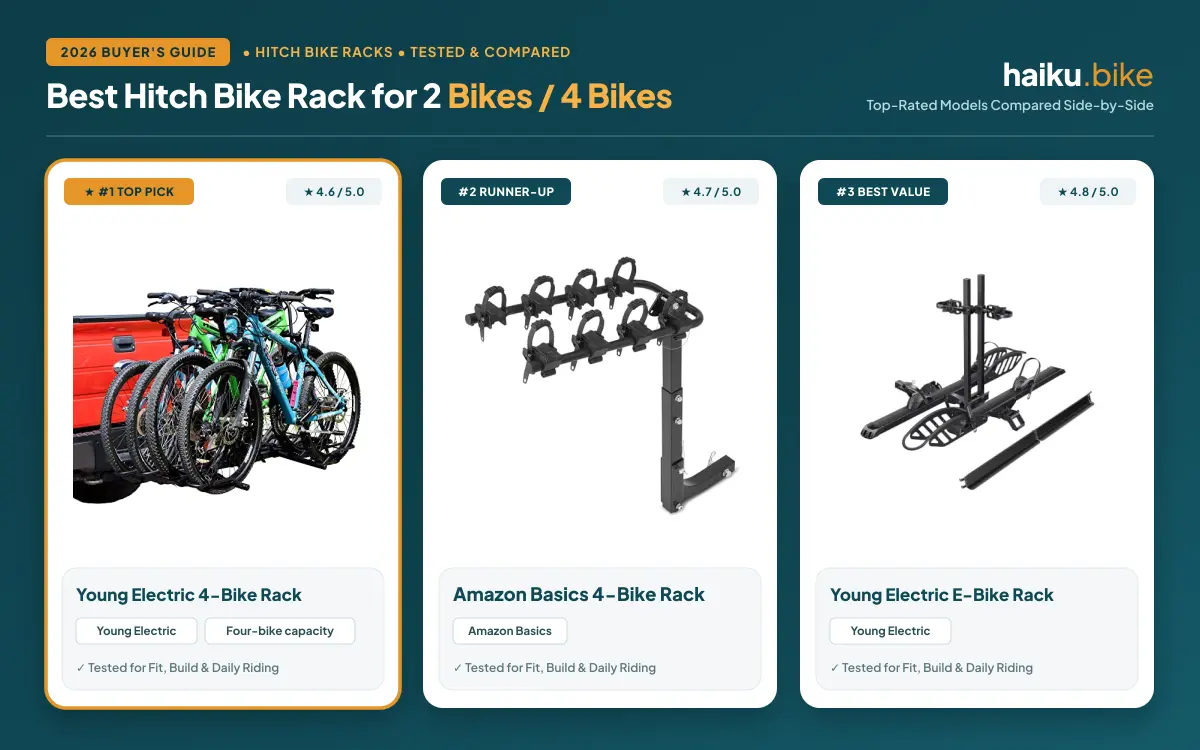
- Best overall: Yakima Hitch Mount Tilting 4-Bike Rack Carrier carries four conventional bikes and fits 1.25-inch or 2-inch receivers, but it is not compatible with e-bikes.
- Best value: Young 4-Bike Rack Hitch Mount Platform Style carries four bikes at up to 40 lb each and folds for storage, but requires a 2-inch receiver.
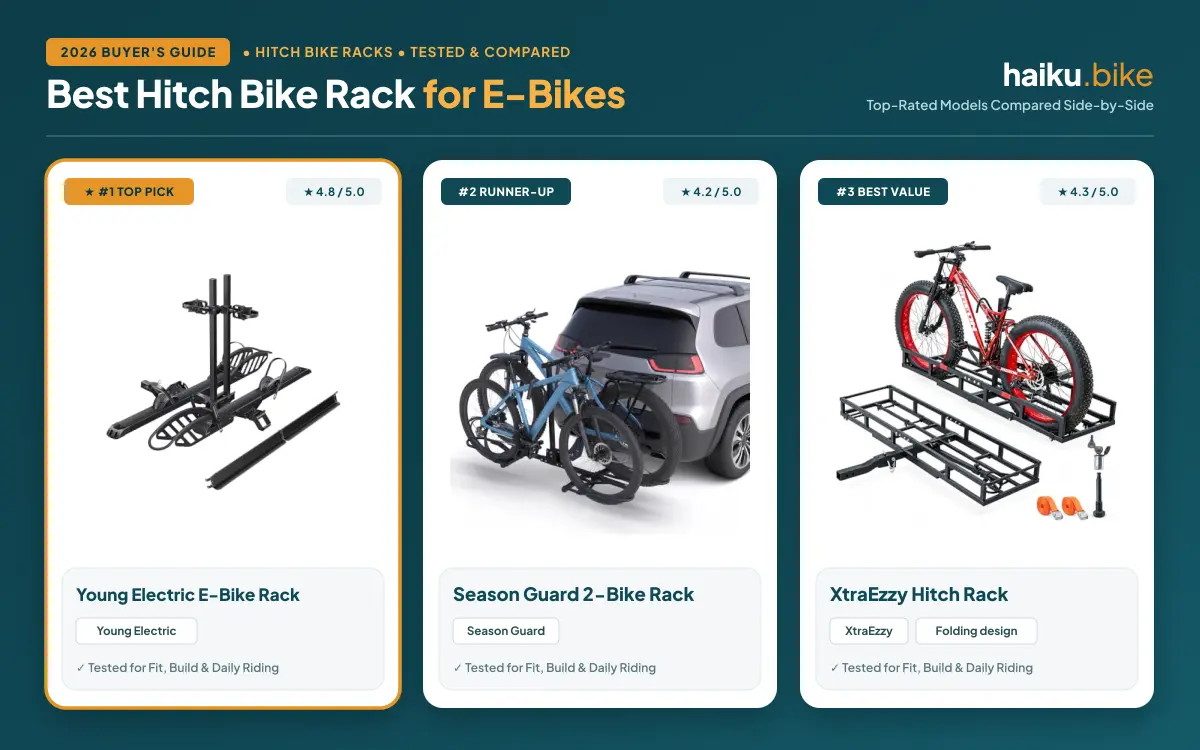
- Best for e-bikes and fat tires: Hitch-Mount Bike Rack for Ebike Heavy-Duty carries two bikes and fits tires up to 5.5 inches wide, though it also requires a 2-inch receiver.

Pros
- Carries up to four bikes
- Fits 1.25-inch and 2-inch hitches
- Tilt-down access
- Optional DeadLock security system
Cons
- Not compatible with e-bikes
- 30 lb maximum per bike
- TubeTop required for some bike frames

Pros
- Four-bike capacity
- Tilt-back trunk access
- Folds for storage
- Padded bike hooks
- Locking hitch pin
Cons
- Fits only 2-inch receivers
- RV capacity limited to 120 lb
- Rack weighs about 66 lb

Pros
- Maker-rated 300 lb total bike capacity
- Fits tires up to 5.5 inches wide
- Converts to cargo carrier
- Three integrated stabilizers
- Folding design
Cons
- Requires 2-inch receiver
- Maximum wheelbase of 51 inches
- No rack weight listed
Side-by-Side Comparison
| Rack | Receiver | Bike capacity | Loading and storage | Fit notes |
|---|---|---|---|---|
| Yakima Hitch Mount Tilting 4-Bike Rack Carrier | 1.25-inch and 2-inch | 4 bikes, 30 lb each, 120 lb total | Tilts down | Not compatible with e-bikes; TubeTop required for some frames |
| Young 4-Bike Rack Hitch Mount Platform Style | 2-inch | 4 bikes, 40 lb each, 160 lb total | Folds and tilts down | 120 lb capacity behind a motor home |
| Hitch-Mount Bike Rack for Ebike Heavy-Duty | 2-inch | 2 bikes, 300 lb total | Converts to cargo carrier | Tires up to 5.5 inches; wheelbases from 38 to 51 inches |
Receiver size and bike weight limits make the biggest difference when choosing among these racks. Yakima fits two receiver sizes but excludes e-bikes, while Young and XtraEzzy require 2-inch receivers and offer different capacity and fit ranges.
Common Mistakes to Avoid
Buying before checking receiver size can leave a rack incompatible with the vehicle. Yakima fits 1.25-inch and 2-inch receivers, while the Young and XtraEzzy racks specify 2-inch receivers. Check the hitch label and rack instructions, and confirm manufacturer approval before using an adapter.
Relying only on total capacity can overload a rack when one bike exceeds its individual limit. Yakima lists a 30 lb limit per bike, and Young lists 40 lb per bike. Weigh each bike with accessories that stay attached, then compare the load with per-bike, total rack, and vehicle limits.
Assuming every hitch rack can carry an e-bike can lead to an unsuitable setup. Yakima is not compatible with e-bikes, while XtraEzzy lists a two-bike capacity and Young’s ramp rack is designed for one bike up to 100 lb. Check the specific rack’s weight and fit restrictions before buying.
Overlooking frame shape and bike dimensions can also cause fit problems. Yakima requires a separately sold TubeTop for step-through, BMX, children’s, and some full-suspension bikes; XtraEzzy lists tire-width and wheelbase ranges. Measure your bike and check the rack maker’s guidance before ordering.
Best Hitch Bike Rack Under $300: Buying Guide
Match Receiver Size and Vehicle Fit
Receiver compatibility determines whether a hitch rack attaches to your vehicle as designed. Check the receiver opening before comparing bike capacity: Yakima fits 1.25-inch and 2-inch receivers, while the Young and XtraEzzy racks specify 2-inch receivers.
Vehicle fit also depends on clearance, installation requirements, and any restrictions in the rack instructions. Confirm that the rack and loaded bikes will not obstruct access you need. Do not assume an adapter makes an incompatible rack suitable; ask the manufacturer whether it approves that setup.
Riders carrying bikes behind a recreational vehicle should check both vehicle and rack restrictions. Young specifies a 120 lb limit for its four-bike rack behind a motor home. Follow the maker’s instructions for your vehicle and load, and observe local laws that apply to transporting bikes.
Calculate Bike Count and Weight
Bike count and weight limits determine whether a rack can carry your regular load safely. Yakima carries up to four bikes, with a 30 lb limit per bike and a 120 lb total limit. Young’s platform rack carries four bikes at up to 40 lb each and 160 lb total.
Compare the weight of every loaded bike with both the individual and total rack limits. Add accessories that remain on the bike during transport, such as bags or locks. The vehicle’s hitch rating also matters, because the lowest applicable limit governs the complete setup.
Capacity does not tell you whether a rack fits each bike’s frame or wheel dimensions. XtraEzzy lists a 300 lb total limit for two bikes, but check its other fit requirements as well. Ask the rack maker about any unclear restriction before you load an unfamiliar bike.
Check Frame, Tire, and Wheelbase Fit
Frame shape and bike dimensions affect whether a rack can secure a bicycle as intended. Yakima requires a separately sold TubeTop for step-through, BMX, children’s, and some full-suspension bikes. Check whether your frame needs an adapter and whether the rack maker approves that combination.
XtraEzzy lists compatibility with tires up to 5.5 inches wide and wheelbases from 38 to 51 inches. Measure both dimensions on your bike and compare them with those stated ranges. Meeting those measurements does not replace checking other frame and loading restrictions.
For a rack without published dimensions for your bike, consult the manufacturer’s fit guidance before buying. Contact points and frame shape can affect secure loading, even when the bike’s weight is within limits. Riders comparing other vehicle setups can read our hitch versus trunk rack guide.
Choose a Loading and Access Design
Loading design matters most when bikes are heavy or vehicle access is part of your routine. A ramp can let you roll a bike onto a rack instead of lifting it, while a tilt feature can create more room to reach the rear of a vehicle.
The Young platform rack folds for storage and tilts down for vehicle access. Yakima also tilts down. These moving features may make daily use more convenient, but they do not guarantee clearance for every vehicle; check the instructions and confirm how the rack sits on your vehicle.
Consider who will load the bikes and where the rack will stay between trips. A ramp suits riders who want to avoid lifting, while a folding design may suit a garage routine. Follow the manufacturer’s directions for moving and securing each mechanism.
Review Security and Stability
Hitch pins, straps, clamps, and stabilizers secure the rack and bikes at different contact points. Young’s platform rack includes padded hooks and a locking hitch pin. XtraEzzy lists soft frame clamps, lashing straps, wheel stoppers, and integrated stabilizers.
Check where a rack contacts your bike and follow its directions for securing each point. Yakima is compatible with the optional DeadLock system, while Young’s rack includes a locking hitch pin. A lock may discourage opportunistic removal, but it does not replace securing the bikes as directed.
Before driving, confirm that the rack is attached correctly and each bike is restrained at its specified points. Recheck straps and fasteners according to the manufacturer’s guidance during travel. Do not carry items other than bicycles on the Young platform rack, which the maker expressly restricts.
Decide Whether Cargo Flexibility Matters
A convertible rack can serve as a cargo carrier when bikes are not on the vehicle. XtraEzzy changes from a two-bike platform into a foldable cargo carrier, giving riders another use for the hitch-mounted setup.
That flexibility may matter to riders who haul gear as well as bikes, but it adds little for someone who only transports bicycles. Yakima instead focuses on carrying up to four conventional bikes and does not support e-bikes. Choose features that match regular trips, not features that distract from fit.
XtraEzzy lists a 66-by-20-inch cargo carrier. Check its instructions for cargo, vehicle, and loading restrictions before changing modes, because bike and cargo setups may have different requirements. Riders without a hitch can compare options in our guide to bike racks for SUVs without a hitch.
How We Chose
We score each rack with the Haiku Ride Score: core performance 30%, build and weather resistance 20%, ease of use 20%, compatibility and fit 15%, and value 15%. For hitch racks, compatibility and fit means receiver size, bike capacity, and published bike dimensions and restrictions.
We compare manufacturer specifications, vehicle and bike compatibility information, and long-term owner feedback when available. We research and draft our guides with software tools, including AI, then run automated checks on product fit, sourcing, and our editorial rules. Our editor spot-checks guides rather than reading each one before publication. Our how we review page explains our editorial approach.
Price and Value: What Each Budget Gets You
Budget
At the lower end of this guide’s budget, riders can prioritize straightforward carrying capacity and useful storage features. The Young 4-Bike Rack Hitch Mount Platform Style carries four bikes, folds, and tilts down, but requires a 2-inch receiver. Buyers give up broader receiver compatibility and must observe its motor-home capacity restriction.
Mid-Range
In the middle of this guide’s budget, the Yakima Hitch Mount Tilting 4-Bike Rack Carrier fits two receiver sizes and tilts down for vehicle access. Its four-bike capacity suits groups carrying conventional bikes. Riders give up e-bike compatibility and must keep every bike within its 30 lb per-bike limit.
Premium
At the upper end, the Hitch-Mount Bike Rack for Ebike Heavy-Duty combines a two-bike platform with a convertible cargo carrier. Its listed tire and wheelbase ranges help riders assess fit for fat-tire bikes. Buyers give up compatibility with smaller receivers, because this rack specifies a 2-inch receiver.
Choosing Something Else
Riders who transport bikes only occasionally may prefer a vehicle-approved trunk rack or a secure setup inside a vehicle. Those options can suit people without a compatible hitch, provided the bikes can be secured without obstructing visibility. Compare the vehicle’s guidance and the rack’s fit requirements before choosing another format.
Final Thoughts
Families carrying conventional bikes can consider the Yakima Hitch Mount Tilting 4-Bike Rack Carrier if their vehicle has a 1.25-inch or 2-inch receiver. It carries four bikes and tilts down, but its 30 lb per-bike limit and e-bike exclusion rule it out for many electric bikes.
Riders who want a folding platform rack for four bikes can consider the Young 4-Bike Rack Hitch Mount Platform Style. Its 40 lb per-bike limit differs from Yakima’s, and its tilt feature can aid rear access. The 2-inch receiver requirement narrows vehicle fit, and motor-home use has a lower capacity limit.
Riders with e-bikes or fat-tire bikes can consider the Hitch-Mount Bike Rack for Ebike Heavy-Duty, which carries two bikes and converts to a cargo carrier. Check tire width, wheelbase, bike weight, and receiver fit before buying. Its broader use does not guarantee compatibility with every electric bike.
Skip these racks if your receiver, bike weight, frame, or dimensions fall outside manufacturer limits. Riders without a suitable hitch can compare other car bike rack styles, while travelers can browse our bike travel case category. Choose a different transport method if no rack fits your setup.
FAQs
Which hitch receiver sizes do these racks fit?
Receiver size depends on the hitch rack. The Yakima Hitch Mount Tilting 4-Bike Rack Carrier fits 1.25-inch and 2-inch receivers; the Young 4-Bike Rack Hitch Mount Platform Style and Hitch-Mount Bike Rack for Ebike Heavy-Duty specify 2-inch receivers. Check your vehicle hitch and the rack maker’s fit instructions before ordering, and verify manufacturer approval before using an adapter.
Can these hitch racks carry e-bikes?
E-bike compatibility varies by hitch rack. Yakima states that its Hitch Mount Tilting 4-Bike Rack Carrier is not compatible with e-bikes. XtraEzzy describes its rack as suitable for electric bikes, while Young’s separate single-bike ramp rack supports one bike up to 100 lb. Check the exact rack’s weight and fit limits against your bike.
How many bikes can these hitch racks carry?
Bike capacity ranges from two to four among the racks compared here. Yakima and the Young platform rack each carry up to four bikes, while XtraEzzy carries two. Capacity alone does not confirm a suitable load: compare each bike’s weight with individual and total rack limits, then check the vehicle’s hitch rating.
Will a tilting hitch rack let me open my trunk?
A tilt feature can improve access behind a vehicle, but clearance depends on the rack and vehicle combination. Yakima and the Young platform rack tilt down, and Young describes its rack as allowing trunk access. Read the installation instructions and confirm that the lowered rack clears your vehicle before relying on this feature.
What should I measure before buying a fat-tire bike rack?
Before buying a fat-tire bike rack, measure tire width and wheelbase, then compare both with the manufacturer’s fit range. XtraEzzy lists tire widths up to 5.5 inches and wheelbases from 38 to 51 inches. Also check receiver size, bike weight, and frame restrictions, because tire fit alone does not confirm overall compatibility.
Can I use the Young platform rack behind a motor home?
The Young 4-Bike Rack Hitch Mount Platform Style has a 120 lb capacity limit when installed behind a motor home. That limit applies to the rack’s stated motor-home use and does not replace checking vehicle and bike restrictions. Read the rack and vehicle instructions for your specific setup, and stay within the lowest applicable limit.
How do I secure bikes on a hitch rack?
Secure each bike at the contact points and with the straps or clamps specified by the rack maker. Young’s platform rack includes padded hooks and a locking hitch pin; XtraEzzy lists frame clamps, straps, wheel stoppers, and stabilizers. Before driving, confirm the rack is attached correctly and recheck fasteners as directed.
Write Your Review
No reviews yet. Be the first to share your experience!