
Long-distance riders need a bike computer that can record a route without running out of charge, while commuters and gravel riders may also want navigation and clear ride data. Published runtime is useful, but screen use, route guidance, and connected accessories can affect how long a unit lasts.
Our Bike Computer Best Battery Life guide compares 6 products for November 2026, including options from CYCPLUS, iGPSPORT, CooSpo and more. Start with the gravel bike computer guide if route surfaces and navigation matter as much as endurance.
At a Glance: Which One Fits You
- Best overall: CYCPLUS Wireless GPS Bike Computer G1, 70g earns this spot because CYCPLUS lists more than 55 hours of operation and GPS ride tracking.
- Best value: iGPSPORT BSC100S GPS Bike Computer earns this spot because iGPSPORT lists up to 40 hours and ANT+ and Bluetooth 5.0 sensor support.
- Best for route guidance: iGPSPORT BSC500 GPS Bike Computer earns this spot because it offers map navigation, automatic rerouting, and voice alerts.
- Best for simple ride recording: BKVTOP Wireless GPS Bike Computer, 50g earns this spot because BKVTOP lists up to 28 hours and GPS tracking without a wheel sensor.

Pros
- Radar and tail light combined
- Seven lighting modes
- USB-C charging
- Quick-release seatpost mount
- IPX7 water resistance
Cons
- Phone alerts require paid Cadence subscription
- First use requires charging for activation
- Fast charging not recommended

Pros
- Touchscreen and button controls
- Up to 12 data fields per page
- Strava and Komoot route imports
- Automatic off-course rerouting
- Voice navigation alerts
Cons
- Battery life not listed
- Water-resistance rating not listed
- Wireless connectivity details not listed

Pros
- More than 55-hour maker-rated runtime
- IPX6 water resistance
- Automatic backlight
- GPS route and altitude data
- About 2.5 oz
Cons
- No listed app connectivity
- No listed sensor pairing

Pros
- Up to 40-hour battery life
- 2.6-inch anti-glare screen
- Strava and Komoot sharing
- ANT+ and Bluetooth 5.0
- IPX7 water resistance
Cons
- Mapping not listed
- Sensor compatibility may be needed for some metrics

Pros
- Routes from Strava, Ride with GPS, and Komoot
- Back to Start navigation
- More than 100 riding data fields
- Up to 25-hour maker-rated battery life
- USB-C charging
Cons
- Water-resistance rating not listed
- Wireless protocols not specified
- Requires iGPSPORT app for route setup

Pros
- GPS tracking without wheel sensor
- Up to 28-hour rated runtime
- Altitude and ascent data
- Automatic backlight and ride recording
- USB-C charging
Cons
- No listed ANT+ or Bluetooth support
- No listed app compatibility
Side-by-Side Comparison
| Product | Maker-listed runtime | Display | Navigation or function | Weather rating | Connectivity |
|---|---|---|---|---|---|
| COOSPO TR70 Bike Radar Tail Light | Up to 40 hours | Not listed | Radar alerts and rear light | IPX7 | Compatible Garmin computers, COOSPO CS500/CS600, COOSPORIDE app |
| iGPSPORT BSC500 GPS Bike Computer | Not listed | 3.3-inch touchscreen | Map navigation, rerouting, voice alerts | Not listed | iGPSPORT app and supported route imports |
| CYCPLUS Wireless GPS Bike Computer G1, 70g | More than 55 hours | 2.0-inch screen | GPS ride tracking | IPX6 | Not listed |
| iGPSPORT BSC200S GPS Bike Computer | Up to 25 hours | 2.4-inch color display | Route navigation and return-to-start | Not listed | iGPSPORT lights and radar |
| iGPSPORT BSC100S GPS Bike Computer | Up to 40 hours | 2.6-inch anti-glare screen | GPS tracking and app data sharing | IPX7 | ANT+ and Bluetooth 5.0 |
| BKVTOP Wireless GPS Bike Computer, 50g | Up to 28 hours | 2.4-inch LCD | GPS ride tracking | IPX7 | Not listed |
Battery claims separate these options, but navigation and sensor support may matter more than maximum runtime for some riders. The CYCPLUS G1 has the longest stated runtime, while the BSC100S combines a 40-hour claim with named sensor protocols; the BSC500 adds route guidance but has no listed runtime.
Common Mistakes to Avoid
One common mistake is treating a maker’s maximum runtime as a guarantee for every ride. The CYCPLUS G1’s stated duration exceeds 55 hours, but the product information does not quantify how navigation, display use, or connected devices change runtime. Compare the claim with your longest ride and leave room to recharge before setting out.
Another mistake is buying a GPS computer for turn guidance without checking its actual route functions. The BSC500 and BSC200S list navigation features, while the CYCPLUS G1 and BKVTOP descriptions focus on ride recording. Confirm route creation, transfer, and guidance details if you depend on directions in unfamiliar areas.
Sensor compatibility can also be easy to assume and hard to fix after purchase. The BSC100S explicitly lists ANT+ and Bluetooth 5.0, but the other computer descriptions do not specify broad sensor protocols. Match your heart-rate, speed, or cadence sensor’s protocol to the computer before ordering.
Finally, the COOSPO TR70 is a radar tail light, not a GPS bike computer. It provides vehicle alerts and rear visibility, with radar data shown on compatible devices or the COOSPORIDE app. Choose it as a safety accessory, not as a replacement for ride recording or route navigation.
Bike Computer Best Battery Life Buying Guide
Battery Runtime and Charging
Battery runtime matters because a computer that loses power cannot record the full ride or continue providing directions. CYCPLUS lists more than 55 hours for the G1, iGPSPORT lists up to 40 hours for the BSC100S, and BKVTOP lists up to 28 hours for its computer.
Use published figures to compare products, not to plan a ride around the final minute of claimed operation. Screen brightness, navigation, satellite reception, and accessories may affect real-world use, but the makers do not quantify those effects here. Check charging-port details and charge fully before a long outing.
The BSC200S description specifies a USB-C port and a 1.5-hour full charge, while the BSC100S and BKVTOP also list USB-C charging. Consider charging access on tours and overnight trips, and keep the maker’s charging guidance available when preparing equipment.
GPS Reception and Ride Tracking
GPS reception affects how a computer records location and supports route features. The BSC500 lists dual-band L1 and L5 reception and five satellite systems, while the BSC100S lists support for GPS, BeiDou, GLONASS, Galileo, and QZSS.
More listed satellite systems do not by themselves establish how a unit will perform on every route. Check the maker’s description for supported systems, ride data, and whether the device records without a wheel sensor. The BKVTOP says its GPS tracking does not require a wheel sensor or spoke magnet.
Riders who mainly want speed, distance, and ride time may not need mapping features. Riders tracking unfamiliar roads should compare the positioning information and route functions separately, because ride recording and turn-by-turn guidance are different capabilities.
Navigation, Routes, and Alerts
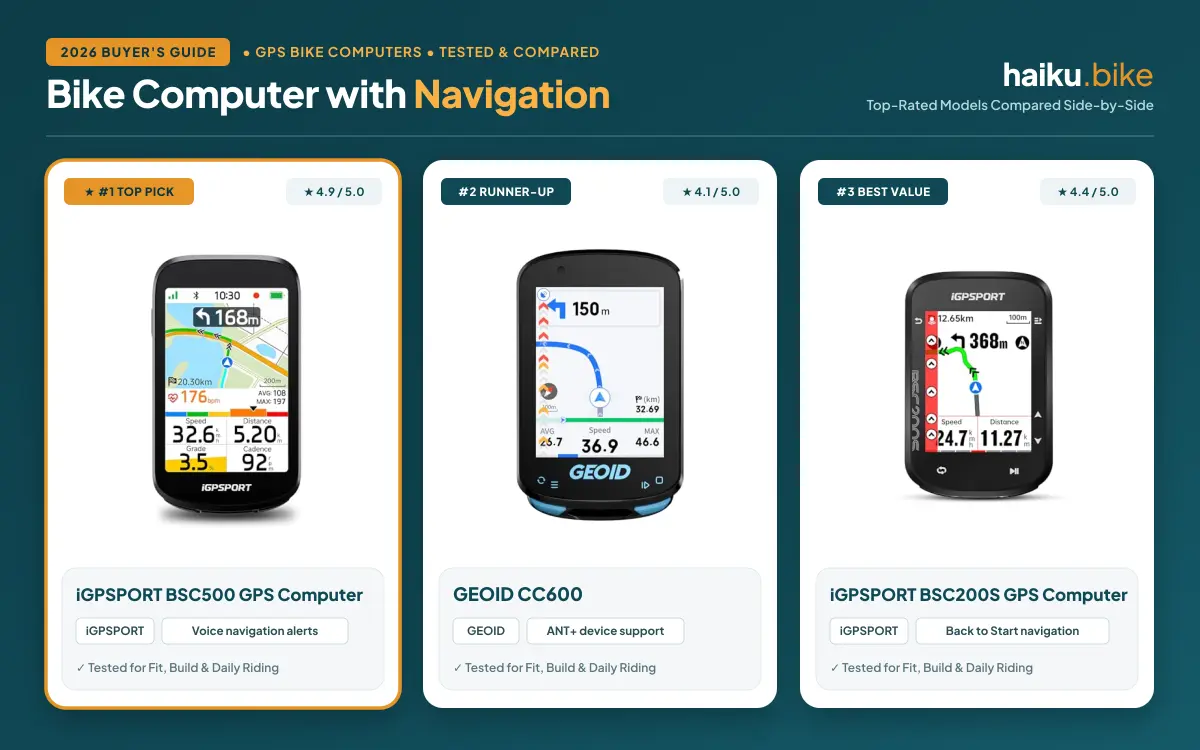
Navigation matters when you follow planned routes or need help returning after a wrong turn. The BSC500 supports map navigation, imported routes, automatic rerouting, turn reminders, and voice navigation; the BSC200S lists route navigation, turn reminders, and return-to-start guidance.
Check whether a computer creates routes, receives them from an app, or only records rides. The BSC500 accepts routes through the iGPSPORT app and supports some third-party route imports. The BSC200S can receive routes created or imported through the iGPSPORT app.
App setup and route transfer can shape how useful navigation feels before a ride. Confirm the phone and app steps in the maker’s instructions, especially if you want to load a route before leaving home. For more route-focused context, compare the GPS computer options for gravel riding.
Sensor and App Compatibility
Sensor compatibility determines whether a computer can display data from accessories you already own. The BSC100S lists ANT+ and Bluetooth 5.0 and names speed, cadence, and heart-rate sensors among compatible devices.
Do not assume that a shared wireless brand or app guarantees a connection. Check the exact protocol named for both computer and sensor, then confirm whether the computer supports the data fields you want. The other computer descriptions here do not specify broad sensor protocols.
App support also affects where ride data goes after a trip. The BSC100S lists data sharing with Strava and Komoot, while the BSC200S supports route imports from services including Strava, Ride with GPS, and Komoot. Review app requirements before choosing a unit for an existing workflow.
Screen Readability and Controls
Screen size and control style affect how quickly you can read ride data without losing attention to the road. The BSC500 has a 3.3-inch touchscreen with button operation, the BSC100S has a 2.6-inch anti-glare screen, and the BSC200S has a 2.4-inch color display.
Think about which fields you need visible at once and whether touch controls suit your riding conditions. The BSC500 can show up to 12 cycling data fields per page, according to iGPSPORT. Compare display layout and button access with your usual riding gloves and route demands.
The CYCPLUS G1 lists an automatic backlight and a glare-free screen, while BKVTOP lists an automatic backlight. A larger screen can make information easier to scan, but it does not replace checking readability, mounting position, or control access for your own setup.
Weather Resistance and Mounting
Weather ratings and mounting affect whether a computer suits exposed rides and fits your cockpit. CYCPLUS lists IPX6 for the G1, while iGPSPORT lists IPX7 for the BSC100S and BKVTOP lists IPX7 for its computer.
The BSC500 and BSC200S descriptions do not state a weather rating, so check the maker’s current guidance if wet-weather use is important. A rating is not a reason to ignore care instructions; follow directions for charging ports and storage after wet rides.
Mounting details deserve a separate check because screen angle and stability affect everyday use. BKVTOP includes a standard mount, while the TR70 radar light uses a quick-release mount described for round, D-shaped, and aero seat posts. Confirm that the included computer mount suits your bars and preferred viewing position.
How We Chose
We evaluate each product with the Haiku Ride Score: core performance 30%, build and weather resistance 20%, ease of use 20%, compatibility and battery 15%, and value 15%. This framework helps us compare runtime claims, navigation, display features, connectivity, and published weather information on consistent terms.
Our evaluation draws on manufacturer specifications, compatibility information, and long-term owner feedback when available. We research and draft our guides with software tools, including AI, then run automated checks on product fit, sourcing, and our editorial rules. Our editor spot-checks guides rather than reading each one before publication. Our how we review page explains the method.
Price and Value: What Each Budget Gets You
Budget
Budget GPS computers tend to focus on core ride recording, readable displays, and useful battery claims rather than extensive mapping. The CYCPLUS G1 emphasizes GPS tracking and a runtime claim exceeding 55 hours, while BKVTOP adds ride data and automatic start and stop. Riders may give up named sensor support or detailed route guidance, so check features against your needs.
Mid-Range
Mid-range options can add broader sensor connections, more ride data, or basic route functions without prioritizing a large touchscreen. The BSC100S combines a stated 40-hour runtime with ANT+ and Bluetooth 5.0, while the BSC200S adds navigation and a stated 25-hour runtime. Compare connectivity and route needs carefully, since those features do not appear equally across models.
Premium
Premium GPS computers tend to offer richer mapping, larger displays, and more ways to receive guidance. The BSC500 has a 3.3-inch touchscreen, map navigation, automatic rerouting, and voice alerts. Its runtime is not listed, so riders who prioritize endurance should compare the available battery information rather than assuming added navigation also means longer operation.
Choosing Something Else
A smartphone in a secure bike mount can suit riders who navigate occasionally and already carry a phone. The phone may use its own battery and screen more heavily during navigation, and it may not offer a dedicated ride-data layout or confirmed sensor compatibility. Riders who only need rear vehicle alerts can consider the COOSPO TR70, but it is a radar light rather than a computer.
Final Thoughts
Riders who prioritize long recording time should compare the CYCPLUS Wireless GPS Bike Computer G1, 70g, which CYCPLUS lists at more than 55 hours. The iGPSPORT BSC100S GPS Bike Computer offers a stated 40-hour runtime and named ANT+ and Bluetooth 5.0 support, making it a better fit when sensor data matters.
Riders who need route guidance can consider the iGPSPORT BSC500 GPS Bike Computer for map navigation, rerouting, and voice alerts, while the iGPSPORT BSC200S GPS Bike Computer pairs route functions with a stated 25-hour runtime. The trade-off is that the BSC500 has no listed runtime, and the BSC200S has a shorter published claim than some alternatives.
The BKVTOP Wireless GPS Bike Computer, 50g suits riders who want essential GPS ride data and a stated 28-hour runtime. The COOSPO TR70 Bike Radar Tail Light serves riders seeking rear visibility and vehicle alerts, but it does not replace a computer.
Skip a dedicated computer if you only need occasional directions and prefer a phone, or choose another unit if your essential sensors are not confirmed compatible. Browse the GPS Bike Computers category or compare budget bike computers to weigh other formats.
FAQs
Which bike computer has the longest stated battery life in this guide?
The CYCPLUS Wireless GPS Bike Computer G1, 70g has the longest stated runtime among the GPS computers here. CYCPLUS lists more than 55 hours of operation, while iGPSPORT lists up to 40 hours for the BSC100S. Manufacturer figures are not guarantees for every ride, so charge before long outings and leave a practical reserve.
Does navigation reduce bike computer battery life?
Navigation may affect bike computer runtime, but the makers do not quantify its effect for these products. Screen use, satellite reception, backlighting, and connected accessories may also influence operation. Treat each published runtime as a reference rather than a promise, and charge the computer before a long ride where continued recording matters.
Which Bike Computer Best Battery Life option supports ANT+?
The iGPSPORT BSC100S GPS Bike Computer explicitly lists ANT+ support alongside Bluetooth 5.0. Its description names compatible speed, cadence, and heart-rate sensors. Confirm that your own sensors use a supported protocol and check the maker’s compatibility information before buying, because the other computer descriptions here do not specify broad sensor support.
Can these GPS bike computers navigate without a phone?
The iGPSPORT BSC500 and BSC200S offer navigation, with route setup involving the iGPSPORT app or imported routes. The BSC500 also lists map guidance, automatic rerouting, and voice alerts. Check the maker’s instructions for phone requirements and route transfer, because app-based setup does not establish that every navigation feature works independently.
Are these GPS bike computers waterproof?
The CYCPLUS G1 lists IPX6, while the iGPSPORT BSC100S and BKVTOP computer list IPX7. The BSC500 and BSC200S descriptions do not state weather ratings. Check the exact model’s current maker guidance, follow charging and care instructions, and do not assume an unstated rating covers wet-weather riding.
Is the COOSPO TR70 a bike computer?
The COOSPO TR70 is a radar tail light, not a standalone GPS bike computer. It combines rear lighting with vehicle alerts and can display radar data on compatible Garmin computers, COOSPO CS500/CS600 devices, or the COOSPORIDE app. Choose a GPS computer for ride recording or navigation, and consider the TR70 for rear visibility and radar alerts.
How do I choose a bike computer screen size?
Choose a bike computer screen based on the ride data you need to read and how you prefer to control the device. The BSC500 has a 3.3-inch touchscreen with button operation, while the BSC100S has a 2.6-inch anti-glare display. Compare layout, backlighting, and mounting position before deciding which screen suits your routes.
Where can I compare more GPS bike computers?
Haiku Bike’s GPS Bike Computers category covers more formats for comparison. Review runtime claims, navigation functions, sensor protocols, weather ratings, and mounting details for each model. Matching those specifics to your route length and accessory setup can narrow choices more effectively than comparing battery figures alone.
Write Your Review
No reviews yet. Be the first to share your experience!