
Riders following unfamiliar roads or long routes need a bike computer that keeps navigation and ride data visible without repeated phone checks. Garmin offers dedicated mapping and training features, while other computers here cover imported routes or straightforward ride recording.
Our Best Garmin Bike Computer guide compares 4 GPS computers from CYCPLUS, Garmin, iGPSPORT in November 2026. Not every option is made by Garmin, so compare navigation, display controls, and sensor compatibility; our gravel bike computer guide covers another route-focused comparison.
At a Glance: Which One Fits You
- Best overall: Garmin Edge® Explore 2, Easy-to-Use GPS Cycling earns this spot because its maps support road, off-road, and e-bike routing.
- Best for advanced navigation and training: Garmin Edge® 1050, Premium Cycling Computer earns this spot because it combines on-device course creation, road-surface details, and personalized coaching with compatible equipment.
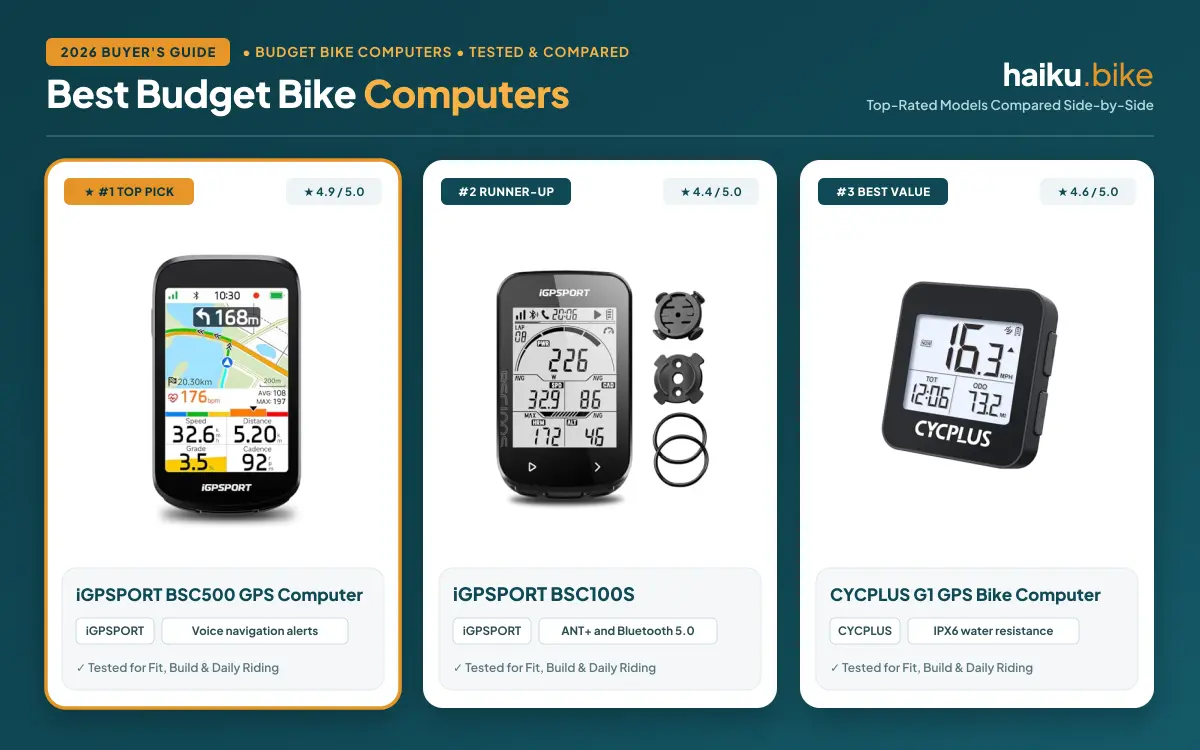
- Best for imported routes: iGPSPORT BSC500 GPS Bike Computer earns this spot because it imports routes from Strava and Komoot and can reroute after you leave course.
- Best for basic ride data: CYCPLUS Wireless GPS Bike Computer G1, 70g earns this spot because it records ride metrics and has an automatically backlit display.

Pros
- Vivid color touchscreen
- On-device course creation
- Up to 60 hours in battery saver mode
- Built-in speaker and bike bell
- ClimbPro ascent and grade data
Cons
- Smartphone required for group features
- Compatible power meter needed for Power Guide
- Garmin Pay requires a supported bank

Pros
- More than 55-hour maker-rated runtime
- IPX6 water resistance
- Automatic backlight
- GPS route and altitude data
- About 2.5 oz
Cons
- No listed app connectivity
- No listed sensor pairing

Pros
- Glove- and rain-friendly touchscreen
- Road, off-road, and indoor profiles
- Maps show popular roads and trails
- E-bike routing and status alerts
- Compatible with Varia devices
Cons
- Sensors sold separately
- Smartphone needed for connected features

Pros
- Touchscreen and button controls
- Up to 12 data fields per page
- Strava and Komoot route imports
- Automatic off-course rerouting
- Voice navigation alerts
Cons
- Battery life not listed
- Water-resistance rating not listed
- Wireless connectivity details not listed
Side-by-Side Comparison
| Feature | iGPSPORT BSC500 GPS Bike Computer | Garmin Edge® 1050, Premium Cycling Computer | CYCPLUS Wireless GPS Bike Computer G1, 70g | Garmin Edge® Explore 2, Easy-to-Use GPS Cycling |
|---|---|---|---|---|
| Display and controls | 3.3-inch touchscreen and buttons | Color touchscreen | 2.0-inch FSTN screen with automatic backlight | 3-inch high-resolution touchscreen |
| Navigation | Maps, route imports, turn reminders, rerouting, voice alerts | Course creation, road-surface map details, navigation prompts | GPS route tracking; guidance not listed | Road, off-road, and e-bike routing; searchable points of interest |
| Satellite support | GPS, BeiDou, GLONASS, Galileo, QZSS; dual-band L1 and L5 | Not listed | Dynamic GPS positioning; systems not listed | Built-in GPS; satellite systems not listed |
| Battery life | Not listed | Garmin lists up to 20 hours in demanding use or up to 60 hours in battery saver mode | CYCPLUS states more than 55 hours | Not listed |
| Other features | Up to 12 cycling data fields per page; continue-last-ride function | Hazard alerts, Garmin Pay, speaker, personalized coaching with compatible equipment | IPX6 water resistance; 1,200 mAh battery | LiveTrack, incident detection, sensor compatibility, e-bike alerts |
Navigation separates these computers more than screen size or brand. Riders who need map guidance can compare the Garmin Edge® Explore 2, Garmin Edge® 1050, and iGPSPORT BSC500, while the CYCPLUS G1 focuses on recording core ride metrics.
Common Mistakes to Avoid
Assuming every GPS computer provides turn-by-turn directions can leave riders without guidance on unfamiliar roads. The CYCPLUS G1 lists route tracking and ride metrics, but not map navigation, so riders who need directions should compare mapped options before buying.
Choosing by screen size alone can overlook control preferences and display behavior. The iGPSPORT BSC500 combines touch and button controls, while Garmin describes the Edge® Explore 2 touchscreen as glove- and rain-friendly. Check whether the layout suits your gloves and how you use maps while stopped.
Assuming battery life or weather protection transfers between models can create avoidable surprises. CYCPLUS states more than 55 hours of working time and IPX6 water resistance for the G1; battery life is not listed here for the Edge® Explore 2.
Expecting every computer to pair with existing sensors or apps can also lead to a poor fit. Garmin lists sensor compatibility for the Edge® Explore 2, and the iGPSPORT BSC500 supports route imports from Strava and Komoot. Confirm compatibility for your exact devices and services.
Best Garmin Bike Computer Buying Guide
Navigation and Maps
Navigation matters most when you follow planned routes, explore unfamiliar roads, or want prompts without checking your phone. Look for maps, route creation or importing, turn cues, and rerouting, because those features determine how the computer responds when your route changes.
The Garmin Edge® Explore 2 includes road, off-road, and e-bike routing, searchable points of interest, and maps highlighting popular roads and trails. The Garmin Edge® 1050 supports on-device course creation and road-surface details, while the iGPSPORT BSC500 imports routes and can plan a new route after you go off course.
Check how a computer receives routes and whether setup depends on a companion app or smartphone. Riders repeating familiar commutes may have little use for detailed maps, while touring and gravel riders may value previews, rerouting, and clear turn reminders. The GPS bike computer category offers more options to compare.
GPS Positioning and Satellite Support
GPS positioning records where you ride and supports navigation, so satellite details can help compare computers for routes with turns or signal interference. Check which satellite systems and frequency bands the manufacturer names, and do not assume every computer uses the same positioning technology.
The iGPSPORT BSC500 lists dual-band L1 and L5 reception with GPS, BeiDou, GLONASS, Galileo, and QZSS support. CYCPLUS describes dynamic GPS positioning for the G1 without naming its satellite systems, while satellite systems are not listed here for either Garmin computer.
Satellite specifications offer a comparison point, but they do not guarantee identical reception on every ride. Consider your usual route environment and the computer’s navigation features together. Riders comparing connected cycling devices can also browse our cycling heart rate monitor guide.
Battery Life and Charging
Battery life determines whether a computer can cover your usual rides and longer outings between charges. Compare the manufacturer’s stated runtime with the features you expect to use, because navigation and display settings can affect how useful a quoted figure is for your routine.
Garmin lists up to 20 hours in demanding use for the Edge® 1050, or up to 60 hours in battery saver mode. CYCPLUS states more than 55 hours for the G1, while runtime is not listed here for the iGPSPORT BSC500 or Garmin Edge® Explore 2.
Before buying, check charging details and whether the manufacturer explains runtime under navigation or battery saver settings. Long-distance riders should consider charging opportunities and avoid treating one mode’s stated runtime as representative of every setting. A computer with unlisted battery life requires closer review of current manufacturer guidance.
Screen Readability and Controls
Screen readability and controls affect how easily you can check ride data without prolonged attention away from the road. Compare display type, backlighting, touch or button operation, and any manufacturer claims about sunlight, rain, or glove use.
The iGPSPORT BSC500 combines a 3.3-inch touchscreen with buttons and displays up to 12 cycling data fields per page. Garmin describes the Edge® Explore 2 screen as high-resolution and glove- and rain-friendly, while the CYCPLUS G1 uses an automatically backlit FSTN display.
Consider whether you adjust screens while riding, wear gloves, or depend on map detail. A touchscreen can make map interaction easier, while physical buttons may suit riders who prefer tactile controls. Review the control layout and stated display features rather than selecting by screen size alone.
Sensor, Phone, and App Compatibility
Compatibility determines whether a computer can work with your sensors, phone, and route-planning routine. Look for named sensor types, connection standards, supported apps, and smartphone requirements. Do not infer a connection standard that the manufacturer does not state.
Garmin says the Edge® Explore 2 is compatible with separately sold heart rate, bike speed, and cadence sensors. The Edge® 1050 has smartphone-connected features through Garmin Connect, while the iGPSPORT BSC500 supports route imports from Strava and Komoot. The CYCPLUS G1’s sensor compatibility details are not listed here.
Compare compatibility information with the devices and services you already use. Check whether your specific heart rate monitor or power meter is supported instead of assuming familiar branding guarantees a connection. Compatibility can decide between computers that otherwise appear similar in navigation and display features.
Weather Protection and Ride-Specific Features
Weather protection and ride-specific features help determine whether a computer suits your conditions and goals. Look for an explicit water-resistance rating, then assess e-bike routing, hazard information, training tools, and audio prompts against features you will use.
CYCPLUS lists IPX6 water resistance for the G1, but a water-resistance rating is not listed here for the other computers. Garmin Edge® Explore 2 offers e-bike routing and alerts when connected to a compatible e-bike, while Garmin Edge® 1050 includes hazard alerts and personalized coaching with compatible equipment.
Follow the manufacturer’s instructions for mounting, care, charging, and wet-weather use. Confirm what comes with the computer and whether your preferred accessories or sensors are compatible; product information does not establish mount fit for every bicycle. Extra features matter when they match your riding and setup.
How We Chose
We assess each computer with the Haiku Ride Score: core performance 30%, build and weather resistance 20%, ease of use 20%, compatibility and battery 15%, and value 15%. Our evaluation compares manufacturer specifications, compatibility information, and long-term owner feedback to explain where each computer fits.
We research and draft our guides with software tools, including AI, then run automated checks on product fit, sourcing, and our editorial rules. Our editor spot-checks guides rather than reading each one before publication. Our how we review page explains how we evaluate features and compare products for riders.
Price and Value: What Each Budget Gets You
Budget
Budget computers usually prioritize core ride recording and a straightforward display over detailed maps, training tools, or broad connectivity. The CYCPLUS Wireless GPS Bike Computer G1, 70g records ride data, has automatic backlighting, and carries an IPX6 rating. Riders give up listed map guidance and named satellite-system details, so it suits people who mainly want ride metrics.
Mid-Range
Mid-range computers can add usable mapping, route imports, and controls that support different riding styles. The iGPSPORT BSC500 GPS Bike Computer offers touch and button operation, voice navigation, dual-band satellite reception, and route rerouting. It may suit riders wanting navigation without the advanced training and connected features of a premium computer, though battery life is not listed here.
Premium
Premium computers often combine richer maps with connected features and training tools. Garmin Edge® 1050 supports course creation, road-surface map details, hazard alerts, Garmin Pay, and coaching when used with compatible equipment. Garmin Edge® Explore 2 offers broad routing and sensor compatibility in a simpler navigation-focused package. Riders should pay for the features they will use, not for an extensive feature list alone.
Choosing Something Else
A smartphone in a secure handlebar mount can suit riders who already navigate by phone and do not need a separate ride-data screen. A dedicated computer may be more suitable when you want cycling metrics or purpose-built navigation at a glance. Consider phone exposure to weather, mount security, and battery demands before choosing a phone-based setup.
Final Thoughts
Riders seeking straightforward navigation across road, off-road, and e-bike routes should consider the Garmin Edge® Explore 2, Easy-to-Use GPS Cycling. Its searchable points of interest and glove- and rain-friendly touchscreen support route-focused use, but battery life is not listed here. Choose another option if a published runtime is essential to your decision.
Riders who want advanced mapping, connected features, and training tools may prefer the Garmin Edge® 1050, Premium Cycling Computer. It supports on-device course creation and road-surface map details, with battery life that Garmin states varies by operating mode. The iGPSPORT BSC500 GPS Bike Computer suits riders wanting imported routes, turn reminders, voice prompts, and rerouting.
Riders prioritizing basic ride metrics, automatic backlighting, and a stated long runtime may prefer the CYCPLUS Wireless GPS Bike Computer G1, 70g. Its listed features do not include map guidance, which makes it a weaker fit for riders navigating unfamiliar routes. Compare more models in our budget bike computer guide.
Riders who need specific sensor support, detailed mapping, or published battery information should verify those points before choosing. Those who only need occasional directions may prefer a phone mount, while riders seeking a different device category can browse our bike computers and GPS category.
FAQs
Which Garmin bike computer is best for navigation?
The Garmin Edge® Explore 2 is a navigation-focused Garmin computer with road, off-road, and e-bike routing, searchable points of interest, and maps highlighting popular roads and trails. The Garmin Edge® 1050 adds on-device course creation and road-surface details. Compare those features with your routes and check smartphone or e-bike requirements before choosing.
Are all computers in this Best Garmin Bike Computer guide made by Garmin?
Not all computers in this Best Garmin Bike Computer guide are made by Garmin. The Garmin Edge® 1050 and Garmin Edge® Explore 2 are Garmin products; the iGPSPORT BSC500 and CYCPLUS G1 are alternatives. Choose a Garmin computer if its brand-specific features suit your needs, or compare the alternatives by navigation, display, and ride-data priorities.
How long does the Garmin Edge® 1050 battery last?
The Garmin Edge® 1050 battery lasts up to 20 hours in demanding use or up to 60 hours in battery saver mode, according to Garmin. Those figures describe different operating conditions, so consider which features you expect to use during a ride. Check Garmin’s current charging and battery guidance before a long outing.
Can these bike computers connect to heart rate monitors?
The Garmin Edge® Explore 2 is listed as compatible with separately sold heart rate sensors, along with bike speed and cadence sensors. Compatibility details for the other computers are less complete here. Check the manufacturer’s current information for your specific monitor and connection standard instead of assuming ANT+ or Bluetooth support.
Can the iGPSPORT BSC500 import routes from Strava?
The iGPSPORT BSC500 GPS Bike Computer supports route imports from third-party apps including Strava and Komoot, and routes can also be sent through the iGPSPORT app. The computer can import some route files directly. Check current app requirements and supported file types before relying on an imported course for a ride.
Which bike computer here has a stated water-resistance rating?
The CYCPLUS Wireless GPS Bike Computer G1, 70g is listed with IPX6 water resistance and described for use in rain. A water-resistance rating is not listed here for the other computers. Check current manufacturer information and follow care and charging instructions before using any computer in wet conditions.
Can a phone replace a bike computer for navigation?
A smartphone in a secure bicycle mount can provide navigation for riders who do not need a dedicated ride-data display. A bike computer may better suit longer rides or riders who want cycling metrics and purpose-built route features. Consider weather exposure, mount security, and phone battery demands; our budget bike computers category covers dedicated alternatives.

Write Your Review
No reviews yet. Be the first to share your experience!