

Home mechanics need both hands free to clean a drivetrain, adjust components, or prepare a bicycle for a ride. A repair stand can lift the bike to a workable height, but the clamp, load limit, and base must suit your bicycle and workspace.
For November 2026, we compare 5 stands from BIKE HAND, CXWXC, CHEPARK and more in the Best Bike Repair Stands Under $100 category. Follow the manufacturer’s setup and clamping instructions, and check local requirements where relevant. See our Tools & Maintenance category for more workshop equipment.
At a Glance: Which One Fits You
- Best overall: ROCKBROS Bike Repair Stand combines an 80 lb capacity, 40 to 63 in height adjustment, a rotating clamp, and a stabilizer rod.
- Best value: CXWXC Bike Repair Stand -Shop Home Bicycle offers a 60 lb capacity and a front-wheel rod to limit wheel movement.
- Best for heavier bikes: CHEPARK Bike Repair Stand (Max 80lbs) pairs an 80 lb capacity with a stated clamp range and adjustable height.
- Best for compact storage: BikeHand Bike Repair Stand folds compactly and includes a magnetic tool plate, though its 55 lb limit is lower.

Pros
- 55 lb maker-rated capacity
- 360-degree rotating head
- 39 to 59-inch height adjustment
- Foldable magnetic tool plate
- 5-year manufacturer warranty
Cons
- Plastic head and clamps
- Weighs about 15.4 lb
- No bike fit dimensions listed
Pros
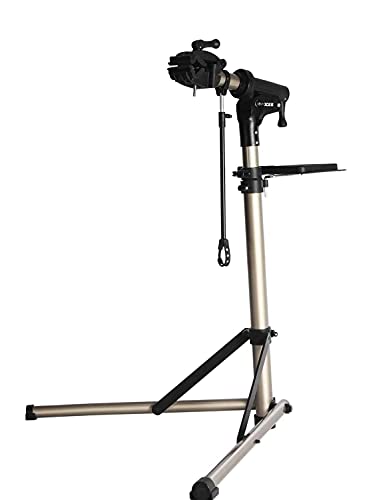
- 60 lb stated bike capacity
- 360-degree rotatable clamp
- Height-adjustable body
- Included front-wheel stabilizer rod
- Rubber feet on triangle base
Cons
- No stated height range
- No stated clamp compatibility range


Side-by-Side Comparison
| Stand | Maximum load | Height range | Clamp details | Storage or support feature |
|---|---|---|---|---|
| ROCKBROS Bike Repair Stand | 80 lb | 40 to 63 in | 360-degree rotation; TPE jaws | Magnetic tray; stabilizer rod; foldable |
| ThinkRider Bike Repair Stand with Adjustable | 65 lb | Not listed | 360-degree rotation; adjustable clamp | Foldable; triangular base |
| CXWXC Bike Repair Stand -Shop Home Bicycle | 60 lb | Not listed | 360-degree rotation | Front-wheel rod; triangle base |
| BikeHand Bike Repair Stand | 55 lb | 39 to 59 in | 360-degree rotation | Folding magnetic tool plate |
| CHEPARK Bike Repair Stand (Max 80lbs) | 80 lb | 41.1 to 66.9 in | 360-degree rotation; 1 to 1.75 in tubes | Magnetic tray; foldable |
Capacity and clamp compatibility are the most consequential differences because they determine whether a stand can support your bicycle at an approved clamping point. ROCKBROS and CHEPARK list the highest capacity here, but CHEPARK provides the clearest clamp diameter range. Riders should still check their bicycle’s weight and manufacturer guidance before choosing.
Common Mistakes to Avoid
Choosing by load capacity alone can lead to a stand that does not fit the bicycle’s frame or approved clamp point. Weigh your bike with accessories that remain attached during maintenance, then compare that weight with the maker’s limit. Confirm the maker permits clamping the frame or seatpost you plan to use.
Assuming every rotating clamp fits every tube is another avoidable mistake. CHEPARK lists compatibility with tubes from 1 to 1.75 in, while the other listings do not give a matching range. Check the product listing and bicycle instructions for clamp dimensions and suitable contact points before ordering.
Ignoring working height and floor space can make routine repairs awkward. Compare a published height range with your preferred posture, and make sure the legs can sit fully supported on a level surface. ROCKBROS, CHEPARK, and BikeHand list numerical ranges, while ThinkRider and CXWXC do not.
Finally, a stabilizer rod or wide base does not replace correct setup. Open the stand fully, secure its closures, and confirm the bicycle is stable before working. For e-bike maintenance, follow the bicycle maker’s guidance and do not treat a stand’s load rating as approval to service electrical components.
Best Bike Repair Stands Under $100 Buying Guide
Load Capacity and Bicycle Weight
Load capacity matters because it states the maximum bicycle weight the stand maker says the stand can support. ROCKBROS and CHEPARK list 80 lb, ThinkRider lists 65 lb, CXWXC lists 60 lb, and BikeHand lists 55 lb. Treat each figure as a limit, not a target for a bicycle that barely fits.
Weigh your bicycle in its maintenance configuration, including bags or accessories that stay attached. If you service several bikes, use the heaviest one to guide your choice. A heavier e-bike may require a different stand or a safer lifting arrangement, even when its weight appears close to a listed capacity.
Capacity does not establish frame compatibility or guarantee stability on every floor. Check the manufacturer’s directions for the permitted bicycle type and clamping point. If the bicycle exceeds the published limit, select a stand with a higher stated capacity rather than relying on a broad base or extra support rod.
Clamp Fit and Frame Protection
Clamp fit determines whether the stand can grip an approved part of your bicycle without harming its finish. CHEPARK lists a 1 to 1.75 in tube range and rubber protectors, while ROCKBROS describes TPE jaws. The other product descriptions do not give a comparable clamp diameter range.
Check your bicycle maker’s instructions before choosing a clamping point, especially when the frame has an unusual shape or finish. Some bicycles may need a seatpost clamp rather than a frame tube. A rotating head helps position a bicycle for access, but it cannot make an unsuitable contact point safe.
Confirm whether the clamp opens far enough for the intended tube and whether its protective surfaces suit your bicycle. ROCKBROS, ThinkRider, CXWXC, BikeHand, and CHEPARK describe rotating heads, but only CHEPARK lists a specific tube range. Ask the stand maker about fit when published dimensions do not answer your question.
Working Height and Adjustment
Working height affects comfort and access during bicycle maintenance. ROCKBROS lists an adjustment range of 40 to 63 in, CHEPARK lists 41.1 to 66.9 in, and BikeHand lists 39 to 59 in. ThinkRider and CXWXC describe adjustable height without publishing numerical ranges.
Compare a stand’s range with your height, the tasks you do, and the space around the bicycle. A higher position can make some adjustments easier to reach, while lower work may suit other tasks. Make sure the legs remain clear of your feet and the stand remains fully supported.
Adjustment mechanisms also affect setup convenience. BikeHand describes quick-release adjustment, and ROCKBROS lists adjustable height; other makers describe adjustable bodies or clamps. Check the maker’s instructions for locking each adjustment before loading the bicycle, since a movable joint must be secured during work.
Base Stability and Wheel Movement
Base stability helps keep a loaded stand upright while you work. ThinkRider and CXWXC describe triangular bases with anti-slip or rubber feet, while ROCKBROS lists a reinforced wide-leg base. CHEPARK describes leg supports that fold, but its listed features do not specify a base shape.
Wheel movement can make drivetrain adjustments less convenient, so a stabilizer rod may matter for some home mechanics. ROCKBROS includes a front-wheel stabilizer rod, as does CXWXC. The other product descriptions do not list one, so check current maker details if controlling handlebar movement is important.
Set the stand on a firm, level surface with all feet supported and enough room to move around the bicycle. A stable design still depends on correct opening and loading. Follow the maker’s directions and confirm the bicycle is secure before applying force to a component.
Portability and Storage
Portability matters when a stand must move between a garage, workshop, or vehicle. ROCKBROS lists a 12.8 lb weight, and CHEPARK lists 12.76 lb. ROCKBROS, ThinkRider, BikeHand, and CHEPARK describe foldable or compact storage, while CXWXC emphasizes easy carrying and storage.
Check folded dimensions if a stand must fit a particular shelf, closet, or vehicle space. The listed descriptions do not provide folded measurements for these models. A stand that folds still needs a suitable storage location, and a portable design does not remove the need to secure all closures before carrying it.
Think about how often you will move or store the stand, rather than treating portability as a universal priority. A home workshop with permanent floor space may value capacity or height range more. For occasional repairs in limited space, foldability and a manageable listed weight can become stronger considerations.
Tool Storage and Useful Accessories
Tool storage keeps small parts close while you work, but it does not change a stand’s load rating. ROCKBROS and CHEPARK include magnetic trays, and BikeHand includes a foldable magnetic tool plate. ROCKBROS also lists a wheel stabilizer rod, while CXWXC includes a rod to limit front-wheel movement.
Choose accessories based on the jobs you perform and the tools you use. A magnetic surface can help keep small metal parts nearby, while larger tools may need a separate bench. ThinkRider’s listed features do not mention a tray, so check the maker’s current package details if storage is important.
Warranty information can also affect long-term value. BikeHand states a five-year warranty and says it maintains parts for claims. Review current coverage conditions and the claim process before ordering. Other product descriptions here do not state warranty terms, so check with their makers if support coverage affects your decision.
For other workshop needs, browse our Tools & Maintenance guide collection. Riders who also need a portable frame bag can compare options in our bike frame bag guide.
How We Chose
We score each option with the Haiku Ride Score: core performance counts for 30%, build and weather resistance for 20%, ease of use for 20%, compatibility and fit for 15%, and value for 15%. For repair stands, compatibility and fit means published load capacity, clamp details, adjustment, and whether features suit common bicycle maintenance needs.
We evaluate manufacturer specifications, compatibility information, and long-term owner feedback, then compare how each stand serves home workshop needs. We research and draft our guides with software tools, including AI, then run automated checks on product fit, sourcing, and our editorial rules. Our editor spot-checks guides rather than reading each one before publication. Our how we review page explains our approach.
Price and Value: What Each Budget Gets You
Budget
At the lower end of this guide’s budget, stands cover basic home maintenance with adjustable height, a rotating clamp, and a stable base. The CXWXC Bike Repair Stand -Shop Home Bicycle adds a front-wheel rod, but its maker does not list a numerical height range. Buyers give up the higher stated capacities and detailed fit information available on some other options.
Mid-Range
Near the middle of this budget, buyers can weigh capacity against folding and workshop convenience. The ThinkRider Bike Repair Stand with Adjustable lists a 65 lb limit, a rotating clamp, and a foldable design, but no numerical height range. BikeHand offers a published height range and magnetic tool plate, with a lower stated load limit.
Premium
At the top of this budget, the ROCKBROS Bike Repair Stand and CHEPARK Bike Repair Stand (Max 80lbs) both list an 80 lb capacity. ROCKBROS adds a 40 to 63 in range and stabilizer rod; CHEPARK lists a 41.1 to 66.9 in range and clamp tube dimensions. Buyers still need to confirm their bicycle’s approved clamping point.
Choosing Something Else
Riders who perform occasional cleaning or simple adjustments may not need a clamp-style repair stand. A suitable floor-level bicycle support or a stable work surface can serve limited tasks if the bicycle maker permits that setup. This alternative saves storage space, but it does not provide adjustable working height or hold the bike hands-free.
Final Thoughts
The ROCKBROS Bike Repair Stand suits home mechanics who want a high stated capacity, a defined height range, and a stabilizer rod. Its magnetic tray keeps small parts nearby, and the foldable design helps with storage. Its listing does not specify clamp tube dimensions, so riders with unusual frames should confirm fit before buying.
The ThinkRider Bike Repair Stand with Adjustable may suit riders seeking a foldable stand with a 65 lb capacity and rotating clamp. Its triangular base and rubber feet are useful listed features, but the maker does not publish a numerical height range. Choose another option if exact height measurements or a stated clamp diameter are essential.
The CXWXC Bike Repair Stand -Shop Home Bicycle offers a 60 lb limit and front-wheel rod for riders who want to reduce wheel movement. The BikeHand Bike Repair Stand suits buyers who value compact folding, a defined height range, and a magnetic tool plate, but its 55 lb limit is lower.
The CHEPARK Bike Repair Stand (Max 80lbs) offers an 80 lb capacity, defined height range, and stated tube dimensions. Skip these stands if your bicycle exceeds their limits or the maker does not approve your clamping point. Compare our maintenance equipment guides for alternatives suited to other workshop needs.
FAQs
What load capacity should a bike repair stand have?
A bike repair stand should have a published load limit above the fully equipped weight of the bicycle you plan to lift. Include accessories that stay attached during maintenance, and consider the heaviest bike if you service several. Capacity alone does not confirm frame fit, so check the maker’s approved clamping points and setup directions.
How do I know if a repair stand clamp fits my bike?
A repair stand clamp fits only when its opening suits the tube and the bicycle maker permits that clamping point. CHEPARK lists a 1 to 1.75 in tube range, while the other stands do not give a matching diameter range here. Check current product details and bicycle instructions before clamping a frame or seatpost.
Can a bike repair stand hold an e-bike?
A bike repair stand can hold an e-bike only if the bicycle’s weight and clamping point meet the stand maker’s directions. ROCKBROS and CHEPARK list 80 lb limits, but that does not establish fit for every e-bike. Follow the bicycle and stand makers’ handling instructions, and use suitable help when lifting a heavy bicycle.
Are bike repair stands adjustable in height?
Most stands in this guide describe adjustable height, but only ROCKBROS, CHEPARK, and BikeHand list numerical ranges. Their stated ranges are 40 to 63 in, 41.1 to 66.9 in, and 39 to 59 in, respectively. Compare those measurements with your workspace and preferred position, and confirm adjustment locks before loading.
Do bike repair stands fold for storage?
Several bike repair stands in this guide describe folding or compact storage, including ROCKBROS, ThinkRider, BikeHand, and CHEPARK. Their product details do not provide folded dimensions, so measure your storage space and check current maker information if fit matters. Secure closures and follow setup directions whenever you open or fold a stand.
Do bike repair stands include tool trays?
Some bike repair stands include tool storage, but accessories differ by model. ROCKBROS and CHEPARK list magnetic trays, while BikeHand lists a foldable magnetic tool plate. The ThinkRider and CXWXC descriptions do not mention a tray. Check current package details if keeping small parts close to the bicycle matters.
How should I set up a bike repair stand safely?
Set a bike repair stand on a firm, level surface, open it fully, and follow the maker’s instructions for clamping and loading. Confirm the bicycle is within the stated capacity and held at an approved point before working. For additional workshop gear, browse our Tools & Maintenance category.





Write Your Review
No reviews yet. Be the first to share your experience!