
Commuters who want a record of close passes need a camera that saves footage, while riders who want to monitor traffic need a live rear-view display. Some compact cameras also capture wearable point-of-view video, but they do not all offer the same view, recording features, or runtime.
This guide compares 6 options in the best bike camera under $100 category for November 2026, including models from PARKVISION, AKEEYO, HUPEJOS and more. Follow each manufacturer’s instructions and local laws. Riders deciding between a camera and a traditional mirror can also compare our bike mirror guide.
At a Glance: Which One Fits You
- Best overall: Spedal 4K Bike Camera with GPS Tracking combines 4K recording, GPS ride data, a headlight, and a listed recording runtime of up to 5.5 hours.
- Best value: AKY-710S Bike Camera with Mount, 4K 28fps includes a 32 GB card and offers 2K at 55 frames per second or 4K at 28 frames per second.
- Best for rear visibility: PARKVISION Bicycle Rear View Camera shows a live 1080P rear view on a 4.3-inch monitor and lists about nine hours of operation.
- Best for wearable footage: acgiewo 4K Mini Body Camera with EIS 6-Axis weighs 35 g and includes wearable and bike-mounting options, but lists up to 150 minutes of recording.

Pros
- 2K at 55 fps
- 142-degree lens
- 32GB card included
- Quick-release bike mount
- Loop and emergency recording
Cons
- Conflicting IP66 and IP67 ratings
- Battery runtime stated only for 1080p
- Wi-Fi setup requires privacy consent

Pros
- 110° wide-angle view
- 1080P real-time video
- About 9-hour rated runtime
- Tool-free installation
- Detachable monitor
Cons
- Wired camera connection
- Runtime varies with brightness and use
- No water-resistance rating listed

Pros
- 4K recording at 30 frames per second
- Six-axis electronic stabilization
- Lightweight 35 g design
- Cycling and helmet mounts included
- Built-in preview screen
Cons
- No water-resistance rating specified
- Up to 150 minutes of battery life
- No mounting compatibility dimensions specified
Pros
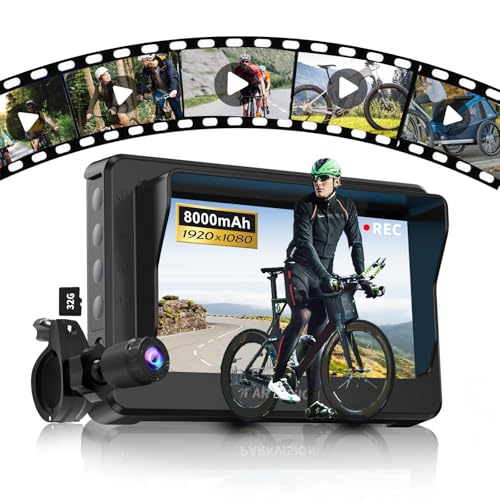
- 9-hour maker-rated battery life
- IP68-rated waterproof housing
- 32GB TF card included
- Tool-free installation
- Detachable display
Cons
- No audio recording
- Not for cargo bikes
- Screen saver can turn off display

Pros
- 4K video with 6-axis stabilization
- GPS speed, distance, and route recording
- Three-mode built-in headlight
- Up to 5.5 hours of recording
- 64GB SD card included
Cons
- No stated ANT+ or Bluetooth support
- Wi-Fi app range limited to 20 feet
- IP65 rating, not described as submersible
Pros
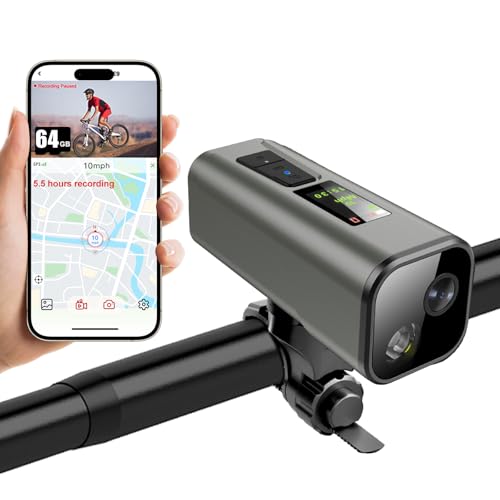
- 4K recording at 30 fps
- GPS speed and route tracking
- Built-in three-mode headlight
- 64GB card included
- USB-C charging
Cons
- Not suitable for immersion
- GPS needs open outdoor location
- Handlebar circumference limited to 5.5 inches
Side-by-Side Comparison
| Product | Primary use | Video or display | Maker-listed runtime | Weather protection | Included storage |
|---|---|---|---|---|---|
| AKY-710S Bike Camera with Mount, 4K 28fps | Forward recording | 4K at 28 fps; 2K at 55 fps | Over 4.5 hours at 1080P | IP66 | 32 GB card |
| PARKVISION Bicycle Rear View Camera | Live rear view | 4.3-inch 1080P monitor | About 9 hours | Not listed | Not listed |
| acgiewo 4K Mini Body Camera with EIS 6-Axis | Wearable point-of-view footage | 4K at 30 fps; 1.5-inch screen | Up to 150 minutes | Waterproof case included | Not listed |
| PARKVISION Bicycle Rear View Camera Recorder | Rear view and recording | Rear view; recording resolution not listed | 9 hours | IP68 | 32 GB card |
| Spedal 4K Bike Camera with GPS Tracking | Recording, GPS, headlight | 4K at 30 fps; 0.96-inch screen | Up to 5.5 hours recording | IP65 | 64 GB SD card |
| HUPEJOS Action Camera for Bike 4K 30fps with GPS | Recording, GPS, headlight | 4K at 30 fps; 0.96-inch screen | Up to 5.5 hours recording | IP65 | 64 GB card |
The key difference is whether a camera saves footage, shows a live rear view, or does both. The PARKVISION Bicycle Rear View Camera provides a live image, while its Recorder version adds loop recording; forward cameras capture a different view altogether.
Common Mistakes to Avoid
Buyers can mistake a rear-view monitor for a recording camera because both use a camera and display. The PARKVISION Bicycle Rear View Camera is designed for live viewing, while the PARKVISION Bicycle Rear View Camera Recorder supports loop recording and includes a 32 GB card.
Mount fit can also cause trouble when a camera and screen attach at different points on the bicycle. PARKVISION lists separate seatpost and handlebar diameter ranges for its systems, so measure both mounting points and check the product’s fit information before ordering.
Riders should not treat a water-resistance rating as permission to submerge a camera. Spedal and HUPEJOS list IP65, and HUPEJOS describes its camera as rainproof but not suitable for immersion; follow each maker’s care instructions for wet rides.
Runtime claims also depend on operating mode, so compare the stated figure with the way you plan to use the device. The AKY-710S figure applies to 1080P recording, while the Spedal and HUPEJOS figures describe recording operation.
Best Bike Camera Under $100 Buying Guide
Choose Recording, Live Rear View, or Both
Recording and live rear viewing solve different problems, so decide which function matters before comparing camera specifications. A recording camera saves video for later review, while a rear-view display helps you monitor approaching traffic as you ride.
The PARKVISION Bicycle Rear View Camera supplies a live image, while the PARKVISION Bicycle Rear View Camera Recorder adds loop recording. Forward-facing cameras such as the AKY-710S capture the road ahead rather than traffic behind.
Read product details for explicit information about recording, audio, loop recording, and file storage. The PARKVISION Recorder records video without audio, according to its product details; riders who need sound should confirm microphone and audio options before choosing.
Compare Resolution, Frame Rate, and Stabilization
Resolution describes image dimensions, while frame rate describes how many frames a camera records each second. Higher resolution can create larger files, so storage capacity and file-transfer options matter alongside the resolution number.
The AKY-710S offers 2K at 55 frames per second or 4K at 28 frames per second. Spedal and HUPEJOS list 4K at 30 frames per second with six-axis stabilization; acgiewo lists electronic image stabilization and 4K at 30 frames per second.
Look for sample footage when a manufacturer provides it, especially if you ride rough pavement or need detail in moving scenes. Check which recording modes include stabilization, since a resolution label alone does not establish whether footage will suit your needs.
Check Runtime, Charging, and Storage
Battery runtime helps determine whether a camera can cover a commute or longer ride without interruption. Published figures vary by device and mode, so compare the manufacturer’s stated runtime with your planned recording settings and ride duration.
Spedal lists up to 5.5 hours of recording, and HUPEJOS lists up to 5.5 hours with recording only. PARKVISION lists about nine hours for its rear-view systems, while acgiewo lists up to 150 minutes of recording.
Storage matters because longer or higher-resolution recordings use more card space. The AKY-710S and PARKVISION Recorder include 32 GB cards, while Spedal and HUPEJOS include 64 GB cards; check maximum card support and transfer options before buying.
Verify Mounting Fit and Screen Placement
Mount fit and screen placement determine whether a camera system works on your bicycle without obstructing controls. Identify where each component attaches, then compare listed clamp ranges with your seatpost and handlebar dimensions.
PARKVISION lists a 17 to 38 mm seatpost fit and an 18 to 38 mm handlebar fit for its rear-view camera. Its Recorder lists a 17 to 38 mm seatpost range and an 18 to 42 mm handlebar range, and the manufacturer says the Recorder is not for cargo bikes.
Forward cameras may use a dedicated mount, strap, magnetic attachment, or wearable clip, each with different placement needs. Confirm that the package includes your preferred mount and that a screen or camera position leaves controls accessible.
Assess Weather Protection and Night Use
Weather ratings describe a manufacturer’s stated dust and water protection, but they do not mean every device can be submerged. Match the rating to your riding conditions and follow maker guidance for wet rides, charging, cleaning, and storage.
The AKY-710S lists IP66, the PARKVISION Recorder lists IP68, and Spedal and HUPEJOS list IP65. The PARKVISION rear-view camera without recording has no weather rating listed here, so check its current product information if rain exposure matters.
Night visibility also varies by system. PARKVISION describes low-light viewing for its rear-view products, while Spedal and HUPEJOS list an IMX335 sensor and built-in headlight; riders should not assume a camera light replaces a dedicated light suited to their route.
Decide Whether GPS and App Features Matter
GPS and smartphone features can add ride data and simplify file access, but they matter only if you want those functions. Check the specific data recorded, phone connection method, and transfer options rather than relying on a general smart-device label.
Spedal and HUPEJOS list GPS tracking for speed, distance, and routes, plus phone app access. The AKY-710S uses Wi-Fi for preview and playback, and its setup instructions say to select the privacy consent option for connection.
App-dependent cameras may require pairing and file transfers before footage is ready to share. Confirm whether the camera records without a phone connection and whether its app works with your device. Riders focused on ride data can also explore our smart cycling technology coverage.
How We Chose
We score bike cameras with the Haiku Ride Score: core performance 30%, build and weather resistance 20%, ease of use 20%, compatibility and fit 15%, and value 15%. For this category, compatibility and fit cover mounting dimensions, app and phone support, charging, and published battery life.
We compare manufacturer specifications, compatibility information, and long-term owner feedback when available. We research and draft our guides with software tools, including AI, then run automated checks on product fit, sourcing, and our editorial rules. Our editor spot-checks guides rather than reading each one before publication. Our how we review page explains the method.
Price and Value: What Each Budget Gets You
Budget
At the lower end of this guide’s budget, riders can find forward recording, bundled memory, and basic wireless access. The AKY-710S includes a 32 GB card, loop recording, Wi-Fi preview, and multiple video modes. Buyers may give up an integrated headlight, GPS ride tracking, or a dedicated rear-view display, so choose around the function you will use most.
Mid-Range
In the middle of this budget, options can prioritize live rear visibility or hands-free point-of-view footage rather than combining every feature. The PARKVISION Bicycle Rear View Camera adds a monitor and lists about nine hours of operation, while the acgiewo camera offers stabilization and wearable mounting. These products serve different needs, and neither replaces the other’s main function.
Premium
At the upper end of this under-$100 guide, riders can find bundled GPS, lighting, stabilization, or a larger included card. Spedal and HUPEJOS combine recording with ride data and a headlight, while the PARKVISION Recorder pairs rear viewing with loop recording. These combinations reduce separate devices, but bring distinct mounting, runtime, and weather limitations.
Choosing Something Else
A phone in a secure handlebar mount can suit riders who mainly want navigation or occasional casual footage. A phone does not provide the same dedicated rear-view display, and video or navigation can use its battery. Riders who mainly need visibility may prefer a purpose-built bike light and reflective clothing instead.
Final Thoughts
Commuters who want footage, route data, and a headlight in one device should consider the Spedal 4K Bike Camera with GPS Tracking. It combines those functions and lists up to 5.5 hours of recording, but its IP65 rating calls for following the manufacturer’s weather guidance. Riders who prefer a simpler forward camera with an included card can consider the AKY-710S Bike Camera with Mount, 4K 28fps, which has a shorter stated runtime at 1080P.
Riders who want a live view behind them can choose the PARKVISION Bicycle Rear View Camera, which has a 4.3-inch display and lists about nine hours of operation. Choose the PARKVISION Bicycle Rear View Camera Recorder if saved rear-view footage matters, while noting that the manufacturer excludes cargo bikes and says recordings do not include audio.
The acgiewo 4K Mini Body Camera with EIS 6-Axis suits riders seeking wearable point-of-view footage and stabilization, but its listed runtime is shorter than the rear-view systems. The HUPEJOS Action Camera for Bike 4K 30fps with GPS combines recording, GPS, and a headlight, but its IP65 housing is not suitable for immersion.
Riders who need only route guidance may prefer a bike computer, while those seeking traffic awareness may find a mirror simpler. Explore our bike camera category and mirrors and bells coverage to compare adjacent options. Skip these cameras if you do not need recording or a live rear image, since extra devices bring mounting, charging, and file-management tasks.
FAQs
What is the difference between a bike camera and a rear-view camera?
A bike camera usually records video, while a rear-view camera sends a live image of traffic behind the rider to a display. Some rear-view systems also save footage, but others provide only a live image. Check product details for recording, storage, and audio features if you need saved video for later review.
Which bike camera records the rear view?
The PARKVISION Bicycle Rear View Camera Recorder combines a rear-view display with loop recording, according to its product details. The PARKVISION Bicycle Rear View Camera shows a live rear view but does not list recording. Riders who need saved footage should confirm that recording and storage are included rather than relying on the phrase rear-view camera.
How long do bike cameras run on one charge?
Bike camera runtime depends on the device and operating mode. Spedal lists up to 5.5 hours of recording, and HUPEJOS lists up to 5.5 hours with recording only; PARKVISION lists about nine hours for its rear-view systems. acgiewo lists up to 150 minutes, so compare each figure with your ride duration and intended settings.
Can bike cameras handle rain?
Some bike cameras list water-resistance ratings, but those ratings do not mean a device can be submerged. The AKY-710S lists IP66, the PARKVISION Recorder lists IP68, and Spedal and HUPEJOS list IP65. Check each manufacturer’s instructions for rain, charging, cleaning, and storage before riding in wet conditions.
Will a rear-view camera fit my bike?
A rear-view camera fits only when its camera and display mounts suit your bicycle’s seatpost and handlebar dimensions. PARKVISION lists separate diameter ranges for its systems, and its Recorder is not intended for cargo bikes. Measure both mounting points and compare them with the exact product specifications before ordering.
Do bike cameras record audio?
Bike camera audio support varies by product, so check each device’s description instead of assuming video includes sound. The PARKVISION Bicycle Rear View Camera Recorder is described as recording video without audio. If sound matters, confirm whether a microphone is included and whether the camera allows audio recording in its settings.
Can a bike camera replace a bike light?
A bike camera should not automatically replace a dedicated bike light, even when the camera includes a headlight. Spedal and HUPEJOS list built-in lights, but suitability depends on your route and visibility needs. Check the light’s modes and maker guidance, and compare other safety gear in our Helmets and Safety category.

Write Your Review
No reviews yet. Be the first to share your experience!