

Commuters and recreational riders shopping for the Best MIPS Helmet Under $100 need more than a rotational-impact system. Secure fit, useful ventilation, and features suited to your route all affect whether a helmet works for daily riding.
We compare 5 helmets in November 2026, including options from Triple Eight, SMITH, MET and more, with a guide to the differences that matter. Follow the manufacturer’s instructions and local laws, check product listings for CPSC certification, and browse our road and commuter helmet category for other styles.
Safety note: Bicycle helmets sold for use in the United States must meet CPSC 16 CFR Part 1203. Check each helmet’s product listing and label for certification, then follow the manufacturer’s fit, care, and replacement instructions.
At a Glance: Which One Fits You
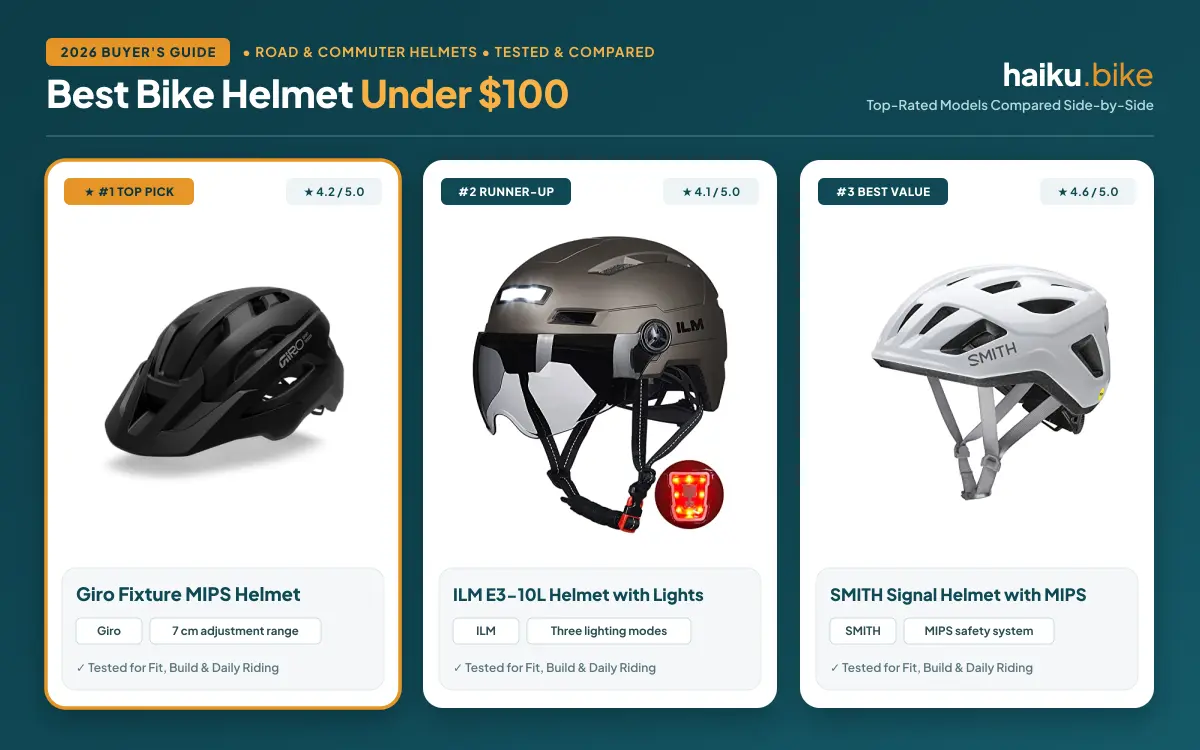
- Best overall: Giro Fixture MIPS Bike Helmet – Matte Black/Grey pairs MIPS with one-handed Roc Loc Sport adjustment and reflective details.
- Best value: Triple Eight Gotham MIPS Helmet offers three listed size ranges, adjustable fit pads, and multiple stated safety standards.
- Best for eyewear users: SMITH Signal Cycling Helmet, Black, Medium combines AirEvac integration for SMITH eyewear with dial-adjustable VaporFit.
- Best for add-on visibility: Lumos Road Bike Helmet MIPS with Magnetic Light has magnetic compatibility with Lumos Firefly mini lights and a dedicated sunglass dock.

Pros
- Integrated MIPS slip plane
- One-handed fit adjustment
- 7 cm adjustment range
- Reflective details
- Ponytail-compatible fit system
Cons
- Fit range limited to 54 to 61 cm
- Safety certification not specified

Pros
- MIPS rotational impact protection
- Adjustable dial and two pad sets
- Vented ABS shell
- Bicycle and skating certifications
Cons
- Listed weight: 1.5 lb
- Selected size is Small-Medium
- Who should skip it: riders whose heads fall outside 21.7 to 22.8 inches

Pros
- MIPS safety system
- Zonal Koroyd coverage
- 21 fixed vents
- 270-degree dial fit adjustment
- Smith eyewear integration
Cons
- Fixed, non-adjustable vents
- Listing shown in medium

Pros
- MIPS-C2 protection system
- Twist-adjust fit system
- Vertical fit adjustment
- Adjustable strap divider
Cons
- CPSC certification not specified
- Listed weight is 1.3 lb
- Who should skip it: riders needing documented certification

Pros
- Magnetic light compatibility
- Integrated MIPS system
- Fourteen ventilation channels
- Built-in sunglass dock
- Approx. 12.3 oz
Cons
- Only listed in size L
- Light runtime not specified
- No certification listed
Side-by-Side Comparison
| Helmet | Fit and sizing | Ventilation | Visibility or eyewear | Safety information |
|---|---|---|---|---|
| Giro Fixture MIPS Bike Helmet – Matte Black/Grey | Roc Loc Sport, Universal Fit, 54-61 cm | Construction designed to boost airflow | Reflective details | Integrated MIPS; check listing and label for CPSC certification |
| Triple Eight Gotham MIPS Helmet | Fit dial, three sizes from 48-61 cm | Vented ABS shell | Reflective dial | Manufacturer states CPSC, ASTM F1447, and ASTM F1492 compliance |
| SMITH Signal Cycling Helmet, Black, Medium | VaporFit, 270-degree adjustment; Medium | 21 fixed vents | AirEvac for SMITH eyewear | Manufacturer states U.S. CPSC, CE EN 1078, and AS/NZS 2063 compliance |
| MET Downtown MIPS Helmet, Black Glossy | Safe-T Twist 2, 360-degree head belt and vertical adjustment; Medium/Large | Not listed | Not listed | MIPS-C2; check listing and label for CPSC certification |
| Lumos Road Bike Helmet MIPS with Magnetic Light | Not listed | 14 ventilation channels | Magnetic compatibility with Lumos Firefly mini lights; OptiGrip eyewear dock | Integrated MIPS; check listing and label for CPSC certification |
Fit information creates the most important distinction: the Gotham lists three size ranges, while the Fixture gives a 54-61 cm range. The SMITH and MET options identify size labels but provide less circumference detail here, and Lumos does not list sizing.
Common Mistakes to Avoid
Choosing by size label alone can leave a helmet loose, tight, or unstable because brands and shell shapes differ. Measure around the widest part of your head, compare the measurement with the manufacturer’s current chart, and confirm the listing’s exact size before ordering.
Treating MIPS as a substitute for certification or fit is another mistake. MIPS is designed to help manage rotational motion in certain impacts, but riders should separately check the helmet label and listing for CPSC 16 CFR Part 1203 information.
Reflective details and light mounts are not equivalent to active lighting. The Fixture’s reflective details return light from an outside source, while the Lumos helmet is compatible with separate magnetic lights; use suitable lights when your route and conditions require them.
Buyers can also overlook intended use and fit adjustments. The Gotham is described for cycling and other wheeled activities, while each helmet has distinct adjustment features; verify the selected model, size, and intended use in its current product information.
Best MIPS Helmet Under $100: Buying Guide
Fit, Sizing, and Retention
Fit matters most because a helmet needs to sit level and remain stable to serve its intended protective role. Measure your head circumference and compare it with the maker’s sizing chart, rather than assuming that a familiar size label transfers across brands.
The Triple Eight Gotham lists three ranges spanning 48-61 cm, and Giro lists the Fixture at 54-61 cm. SMITH identifies the Signal as Medium, MET identifies the Downtown as Medium/Large, and Lumos does not list a size range here, so confirm those listings before purchase.
Adjustment systems fine-tune retention but cannot correct a shell shape that does not suit your head. Giro lists one-handed Roc Loc Sport operation, while SMITH lists 270-degree VaporFit adjustment and MET lists a 360-degree head belt with vertical adjustment.
Position the helmet level, adjust its straps and retention system as the manufacturer directs, and check for movement when you turn your head. If the helmet rocks, pinches, or sits unevenly after adjustment, consider another size or model instead of forcing the fit.
CPSC Certification and MIPS
CPSC certification and MIPS describe separate helmet attributes, so check them independently. Bicycle helmets sold for use in the United States must meet CPSC 16 CFR Part 1203; verify certification information on the exact product listing and helmet label.
MIPS systems are designed to help manage rotational forces in certain impacts, but they do not guarantee injury prevention or replace secure fit. Giro lists Integrated MIPS, SMITH lists its MIPS Safety Protection System, and MET identifies its MIPS-C2 system.
Triple Eight states that the Gotham meets the U.S. CPSC bicycle helmet standard for people age five and older, ASTM F1447, and ASTM F1492. SMITH states that the Signal complies with U.S. CPSC, CE EN 1078, and AS/NZS 2063; check current details for the chosen helmet.
Replace a helmet after an impact according to manufacturer instructions, even when damage is not obvious. Riders comparing rotational-impact systems can read our MIPS versus non-MIPS helmet guide for a broader explanation of the distinction.
Ventilation and Riding Conditions
Ventilation affects airflow through a helmet and can influence comfort during warm commutes, climbs, and slower rides. SMITH lists 21 fixed vents, while Lumos lists 14 ventilation channels; Giro describes the Fixture’s construction as supporting airflow.
The Gotham has a vented ABS shell, while the MET product information does not list a ventilation detail. Vent count alone does not establish which helmet will feel coolest, since head shape, riding pace, weather, and fit also affect comfort.
Consider the conditions you ride in and whether you wear a cap beneath your helmet. Compare the maker’s ventilation description with those habits, and avoid choosing solely by the largest stated vent count.
Visibility, Lights, and Eyewear
Visibility features can support low-light riding, but reflective surfaces do not produce their own illumination. Giro lists reflective details on the Fixture, and Triple Eight lists a reflective dial on the Gotham; both depend on an outside light source.
The Lumos helmet has magnetic compatibility with Lumos Firefly mini lights, which are separate accessories. Its OptiGrip dock provides a place for sunglasses, while SMITH’s AirEvac system is intended to integrate with SMITH eyewear.
Check whether a feature suits your existing gear, and use suitable bike lights when route conditions require them. AirEvac does not establish compatibility with every frame, so try your usual glasses with a helmet when possible.
Riders considering integrated signaling can compare a different feature set in our bike helmet turn-signal guide. Reflectors, eyewear docks, and light compatibility each solve different needs, so match the feature to your commute.
Shell Construction and Intended Use
Shell construction and intended use help explain how a helmet is built and where its maker positions it. Giro describes the Fixture’s outer shell as fused to impact-absorbing foam, while MET lists an in-mold polycarbonate shell with an EPS liner.
Triple Eight describes the Gotham as having a vented ABS shell and positions it for biking, skateboarding, skating, and roller derby. Riders should still check that the chosen helmet’s stated standards and intended use match their activity.
SMITH lists zonal Koroyd coverage, described by the maker as lightweight, energy-absorbing, and ventilated. Lumos describes its helmet for everyday road and commuter cycling; compare these construction details as context, not as a substitute for fit or certification checks.
Follow manufacturer directions for cleaning and storage, and avoid modifying the shell, straps, or retention system. Use only cleaning products the maker approves, and replace the helmet as directed after an impact or when its condition warrants replacement.
Budget, Features, and Listing Details
Within this guide’s $100 ceiling, compare useful fit and visibility features before choosing a color or extra. The Gotham offers multiple size ranges and fit pads, the MET lists vertical adjustment, and the Lumos adds magnetic light compatibility and an eyewear dock.
Product listings can change, so confirm the selected size, color, included components, and current certification details before ordering. Do not assume that two helmets with similar features have identical fit, accessories, or intended use.
Riders who wear SMITH eyewear may value the Signal’s AirEvac integration, while riders who want a stated size range may favor Giro or Triple Eight. In-person fitting can help identify shell-shape differences when that option is available.
How We Chose
We compare helmets using the Haiku Ride Score: core performance counts for 30%, build and weather resistance for 20%, ease of use for 20%, compatibility and fit for 15%, and value for 15%. For helmets, compatibility and fit means adjustment options, stated sizing, eyewear integration, and visibility features relevant to riding.
We evaluate manufacturer specifications, compatibility information, and long-term owner feedback when available. We research and draft our guides with software tools, including AI, then run automated checks on product fit, sourcing, and our editorial rules. Our editor spot-checks guides rather than reading each one before publication. Our how we review page explains our method.
Price and Value: What Each Budget Gets You
Budget
At the lower end of this guide’s budget, the Triple Eight Gotham combines MIPS, an adjustable dial, reflective detail, and three stated size ranges. Its multi-activity positioning may appeal to riders who also skate, but buyers should confirm that the helmet’s fit and stated standards suit their particular activity.
Mid-Range
Options around the middle of this guide’s budget add distinct adjustment or construction features rather than a single universal upgrade. The MET Downtown lists a 360-degree head belt and vertical adjustment, while the Giro Fixture pairs MIPS with one-handed adjustment and reflective details. Check each model’s sizing information carefully.
Premium
At the upper end, the SMITH Signal adds 21 fixed vents, VaporFit adjustment, zonal Koroyd coverage, and AirEvac integration for SMITH eyewear. The Lumos helmet adds magnetic compatibility with separate lights and an eyewear dock. These features may help particular riders, but do not replace choosing a helmet that fits.
Choosing Something Else
Riders who already own a properly fitting, appropriately certified helmet may not need another helmet for visibility. A compatible bike light and reflective clothing can address low-light visibility without relying on helmet reflectors or a helmet-mounted accessory. Replace an impacted helmet according to maker guidance rather than keeping it for convenience.
Final Thoughts
Commuters who want reflective details and one-handed adjustment can consider the Giro Fixture MIPS Bike Helmet – Matte Black/Grey. Its listed 54-61 cm range gives a useful measurement to compare, but the Universal Fit label does not guarantee that its shape suits every rider.
The Triple Eight Gotham MIPS Helmet suits riders who want several listed size ranges, a fit dial, and a helmet positioned for multiple wheeled activities. Its broader intended-use description does not remove the need to check certification and fit for your specific riding.
Eyewear users may prefer the SMITH Signal Cycling Helmet, Black, Medium for its stated AirEvac integration and 21 fixed vents. Riders interested in fit adjustment can also consider the MET Downtown MIPS Helmet, Black Glossy, which lists vertical adjustment and a 360-degree head belt.
Riders seeking magnetic compatibility with separate lights may find the Lumos Road Bike Helmet MIPS with Magnetic Light more relevant, though its sizing is not listed here. Skip these options if none fits securely or meets your needs; browse the helmets and safety category for alternatives.
FAQs
What does MIPS do in a bike helmet?
MIPS is a helmet system designed to help manage rotational motion in certain impacts. Giro lists Integrated MIPS, SMITH lists its MIPS Safety Protection System, and MET lists MIPS-C2 on these options. MIPS does not guarantee injury prevention, replace a secure fit, or confirm that a helmet meets U.S. certification requirements.
How do I check whether a bike helmet is CPSC certified?
Check the exact helmet’s product listing and label for information on CPSC 16 CFR Part 1203. Bicycle helmets sold for use in the United States must meet this standard. Do not infer certification from a MIPS label or another standard; confirm the details for the model and size you plan to buy.
How should I choose a MIPS helmet size?
Measure your head circumference and compare it with the manufacturer’s current size chart before choosing a MIPS helmet. Giro lists the Fixture at 54-61 cm, and Triple Eight gives three ranges from 48-61 cm. Follow the maker’s adjustment instructions and select another model if the helmet will not sit level and stable.
Which helmet has the most listed vents?
The SMITH Signal lists 21 fixed vents, while the Lumos helmet lists 14 ventilation channels. Giro describes the Fixture’s construction as supporting airflow, and Triple Eight describes the Gotham as vented. Those descriptions do not establish which helmet feels coolest; fit, pace, weather, and head shape also matter.
Do reflective helmet details replace bike lights?
Reflective helmet details do not replace bike lights because they return light from an outside source rather than producing illumination. Giro lists reflective details on the Fixture, and Triple Eight lists a reflective dial on the Gotham. Use suitable lights when conditions require them, and follow local laws for your route.
Can I wear glasses with a MIPS helmet?
Most important is whether your glasses and helmet fit comfortably together, since listed eyewear features do not promise universal compatibility. SMITH describes AirEvac as integrating with SMITH eyewear, and Lumos lists an OptiGrip sunglass dock. Try your usual glasses with the helmet and check that the temples do not interfere with fit.
Can I use a bike helmet after an impact?
Follow the helmet maker’s replacement instructions after an impact, even if visible damage is not obvious. A helmet’s shell, liner, straps, or retention system may not remain suitable after a crash. Check the manufacturer’s guidance for care and replacement, and do not modify the helmet to extend its use.
Are reflective helmet details useful for commuting?
Reflective details can help return light toward its source when headlights illuminate them, so they may support a commuter’s visibility. They do not create light or replace active bike lights. Riders who want another feature set can compare our guide to helmets with turn signals.
Write Your Review
No reviews yet. Be the first to share your experience!