

Riders who want a steady indoor workout need an exercise bike that fits their body, available space, and preferred riding position. This guide compares upright and recumbent options, with attention to fit, resistance, comfort, and tracking rather than features that may not support your routine.
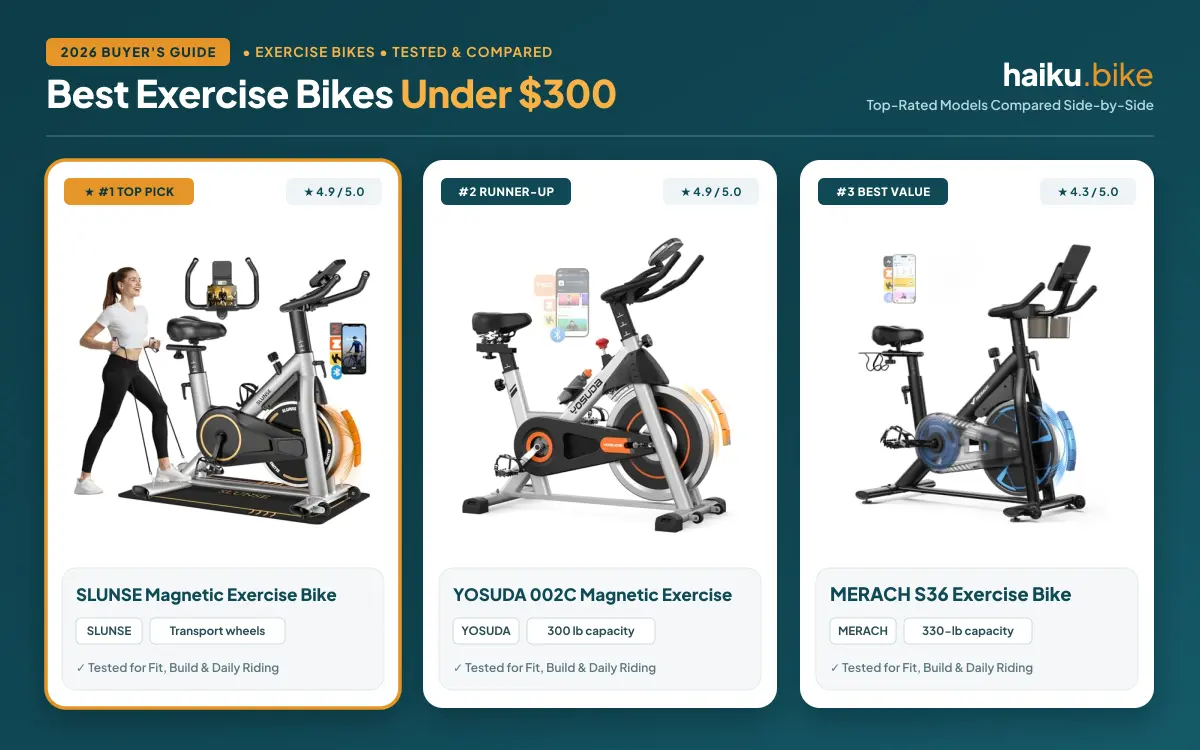
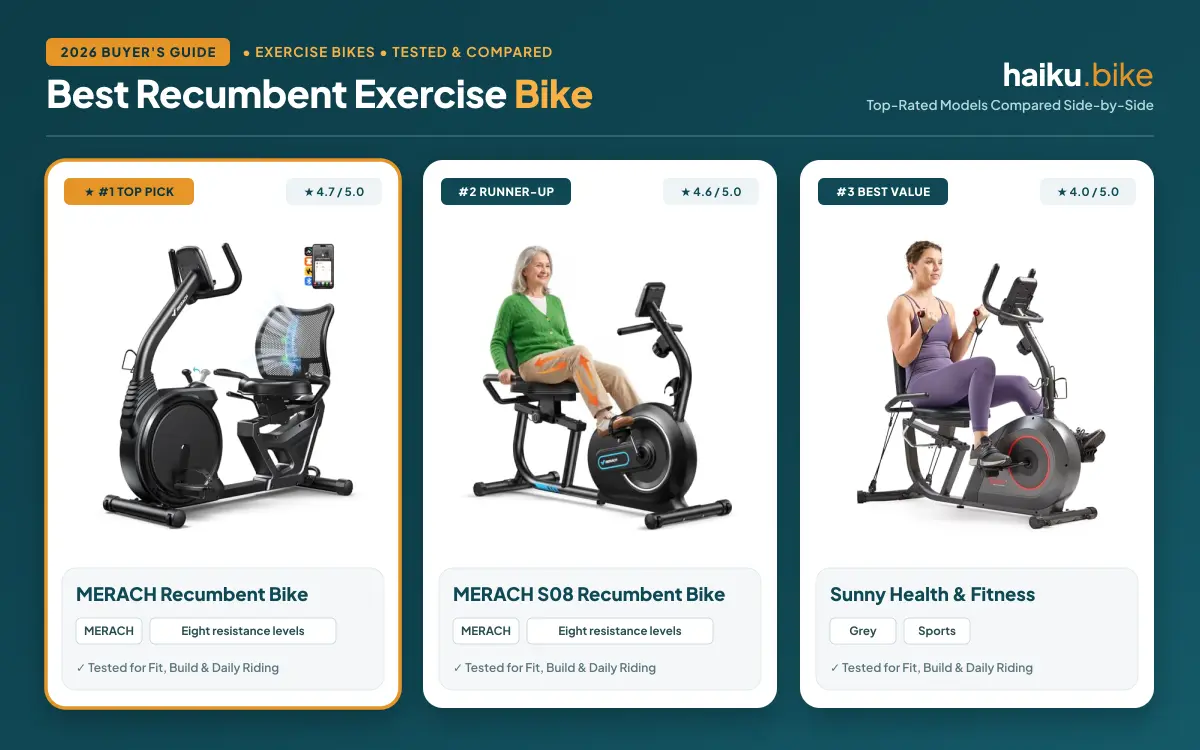
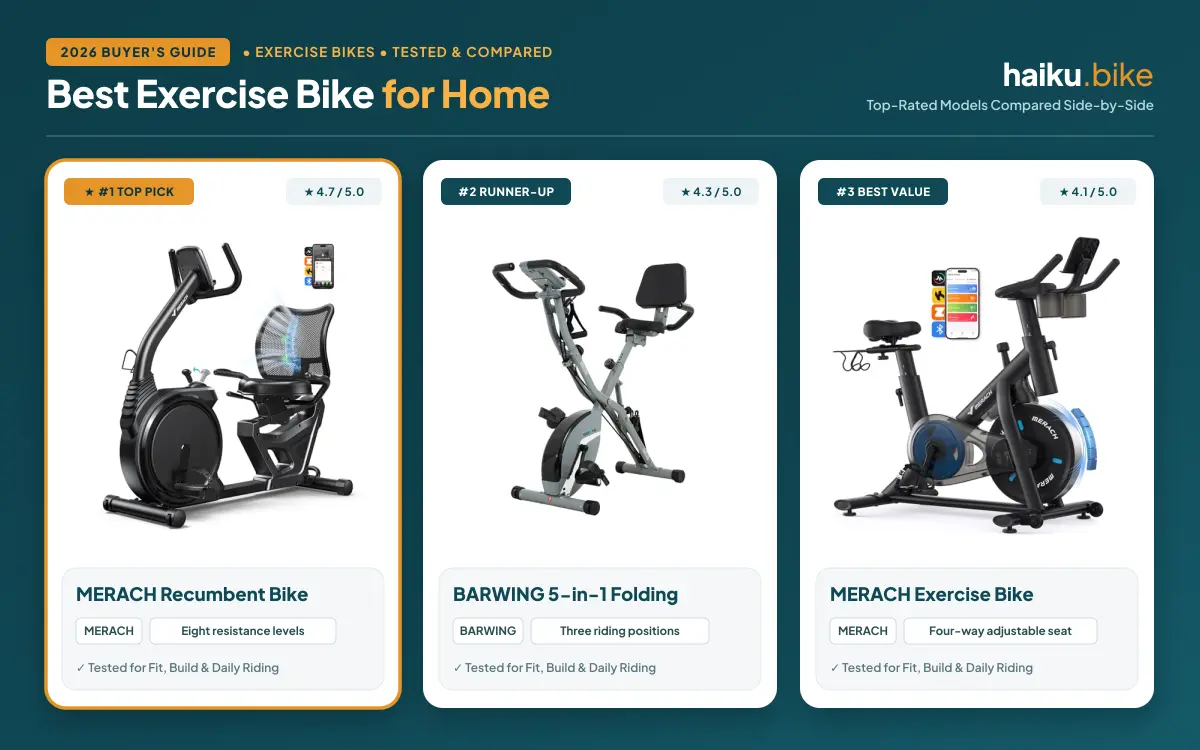
We compare 3 exercise bikes from MERACH, YOSUDA, XVGVSV for November 2026, all within the guide’s stated budget. Follow each manufacturer’s instructions and local laws when setting up or using exercise equipment. Riders comparing indoor options can also browse our indoor training category.
Health and safety note: Haiku Bike does not give medical advice. Readers with balance, joint, heart, or vision concerns should ask their doctor whether cycling suits them, and a bike shop should check fit, assembly, and brakes.
At a Glance: Which One Fits You
- Best overall: MERACH Exercise Bike, Friction Stationary Bike combines adjustable resistance, app connections, and a published fit range from 4 ft 8 in to 6 ft 2 in.
- Best value: YOSUDA Recumbent Exercise Bike for Home pairs a padded seat and backrest with 16 resistance levels and an adjustable seat.
- Best for higher stated capacity: Recumbent Exercise Bike for Home lists a 400 lb capacity, 16 resistance levels, and an LCD display with pulse sensors.

Pros
- Zwift and KINOMAP compatibility
- Google Fit and Apple Health syncing
- Quiet belt drive, maker-rated below 25 dB
- Fit range for riders 4 feet 8 inches to 6 feet 2 inches
- 300 lb weight capacity
Cons
- Friction resistance
- No cadence or heart-rate metrics listed
- Assembly required

Pros
- 16 resistance levels
- Quiet workout design
- Adjustable seat for 4-foot-9 to 6-foot-2 users
- Padded seat and backrest
- Supports up to 350 lb
Cons
- 55.23-inch length needs floor space
- 58.4 lb frame may take effort to move

Pros
- Padded seat and ergonomic backrest
- 16 resistance levels
- 400 lb stated weight capacity
- LCD workout metrics
- Front transport wheels
Cons
- 66 lb weight
- 48.3 x 45 x 25.4-inch footprint
Side-by-Side Comparison
| Exercise bike | Position | Resistance | Fit and capacity | Tracking |
|---|---|---|---|---|
| MERACH Exercise Bike, Friction Stationary Bike | Upright | Infinite adjustment | 4 ft 8 in to 6 ft 2 in; 300 lb | LED monitor; app and health-platform connections |
| YOSUDA Recumbent Exercise Bike for Home | Recumbent with backrest | 16 levels | 4 ft 9 in to 6 ft 2 in; 350 lb | Not listed |
| Recumbent Exercise Bike for Home | Recumbent with backrest | 16 levels | Fit range not listed; 400 lb | LCD screen and pulse sensors |
Riding position is the clearest distinction: recumbent frames add a backrest, while MERACH uses an upright cycling-style posture. Choose based on the position you can use comfortably, then compare fit range and capacity because a capacity figure alone cannot establish a suitable fit.
Common Mistakes to Avoid
Choosing by resistance count alone can overlook posture and seat comfort, which shape whether a bike suits repeated sessions. Decide whether you prefer an upright or reclined position first, then compare resistance controls within that frame style.
Relying on weight capacity without checking fit can leave a rider uncomfortable even when the stated limit seems adequate. Compare the maker’s height range and adjustment points, and note that the Recumbent Exercise Bike for Home does not list a fit range.
Assuming every display or app provides the same information can create a mismatch with your tracking needs. MERACH lists app and health-platform connections, while the Recumbent Exercise Bike for Home lists heart rate readings and ride metrics; YOSUDA does not list connected tracking for its recumbent bike.
Skipping room measurements or assembly planning can make delivery and setup harder than expected. MERACH and the Recumbent Exercise Bike for Home describe partial pre-assembly, but riders should still check current dimensions, doorway access, and the space needed to mount and dismount.
Best Exercise Bike Under $200: Buying Guide
Choose a Riding Position
Riding position determines how your body sits during exercise, so it should guide your decision before display features. Upright bikes use a cycling-style posture, while recumbent bikes place the rider in a reclined seat with back support.
The YOSUDA and XVGVSV recumbent options list padded seating and backrests, while MERACH has an upright frame with adjustable seat and handlebars. Consider how you will mount, dismount, and settle into your usual session before choosing either layout.
Seat and handlebar adjustments affect how closely an upright bike can match your preferred posture. Check which components move and how they adjust; for a recumbent bike, look for a clear seat adjustment method and enough legroom at your pedaling position.
Check Fit Range and Weight Capacity
Published fit range and weight capacity help you decide whether an exercise bike may accommodate its intended rider. Capacity describes a stated load limit, but it does not show whether the seat and handlebars adjust to your body.
MERACH lists a fit range from 4 ft 8 in to 6 ft 2 in and a 300 lb capacity. YOSUDA lists a range from 4 ft 9 in to 6 ft 2 in for its recumbent bike, with a 350 lb capacity.
The Recumbent Exercise Bike for Home lists a 400 lb capacity, but its fit range is not listed. Compare your height with each maker’s adjustment information, and ask the maker for clarification if a missing measurement affects your decision.
Understand Resistance and Progression
Resistance determines how much effort pedaling requires, and the adjustment method affects how you change workout intensity. Multiple levels provide defined steps, while an infinitely adjustable system allows changes without fixed increments.
The YOSUDA and XVGVSV recumbent bikes list 16 resistance levels. MERACH describes infinite adjustment, which lets the rider change resistance continuously, but the available details do not provide a directly comparable maximum effort figure.
A resistance level count does not prove that one bike offers more intensity than another. Check how the resistance is adjusted and look for the maker’s explanation of the range when a particular training effort matters to your routine.
Decide Which Tracking and Apps Matter
Displays and app connections determine which workout information you can see and where activity data can go. Decide whether basic screen metrics meet your needs or whether app-based tracking is important for your routine.
MERACH lists time, speed, distance, and calorie tracking on its LED monitor, plus compatibility with KINOMAP and Zwift. MERACH also lists data syncing with Google Fit and Apple Health, which may suit riders who already use those services.
The Recumbent Exercise Bike for Home lists speed, time, distance, calories, odometer, and heart rate on its LCD screen. YOSUDA lists no connected tracking for its recumbent bike, so check current product details if app support is essential.
Account for Noise, Space, and Mobility
Noise, room access, and mobility matter when an exercise bike shares space with household activities. Check the maker’s drive or resistance description, listed transport features, and any leveling components before deciding where the bike will stand.
MERACH describes a belt drive designed for quiet riding and lists transport wheels and leveling knobs. YOSUDA describes its recumbent bike as quiet, and the Recumbent Exercise Bike for Home lists magnetic resistance and front transport wheels.
Product descriptions cannot replace measuring your workout area and delivery route. Check the current listing for dimensions, leave room to mount and dismount safely, and confirm the assembled frame can pass through doorways on its way to the chosen space.
Review Setup, Stability, and Support
Assembly instructions, frame construction, and support terms affect how manageable a home exercise bike may be after delivery. Check what arrives assembled, whether setup instructions are available, and what warranty the maker describes.
MERACH says its bike arrives 80% pre-assembled and lists a one-year warranty. The Recumbent Exercise Bike for Home is described as 85% pre-assembled, while YOSUDA says most parts of its recumbent model come pre-installed.
MERACH describes an alloy-steel frame, and YOSUDA describes a steel frame for its recumbent bike. Compare those construction descriptions with stated capacity and stability features, but do not treat any single specification as a guarantee of fit or stability in every home.
Before assembly, read the maker’s instructions and place the bike on a suitable, stable floor. Check that supplied components are present and that the frame sits securely after setup; contact the maker when instructions or parts are unclear.
How We Chose
We score exercise bikes with the Haiku Ride Score, weighting core performance at 30%, build and weather resistance at 20%, ease of use at 20%, compatibility and fit at 15%, and value at 15%. For stationary bikes, compatibility and fit focus on published rider ranges, seat and handlebar adjustment, app support, and listed workout features.
We research manufacturer specifications, compatibility information, and long-term owner feedback when available, then compare the details that matter for indoor use. We research and draft our guides with software tools, including AI, then run automated checks on product fit, sourcing, and our editorial rules. Our editor spot-checks guides rather than reading each one before publication. Our how we review page explains our method.
Price and Value: What Each Budget Gets You
Budget
At the lower end of this guide’s budget, riders can get a recumbent layout with a padded seat, backrest, and several resistance settings. The YOSUDA Recumbent Exercise Bike for Home adds an adjustable seat and a published fit range. Riders give up listed app connections and an included workout display, so choose it when supported seating matters more than connected tracking.
Mid-Range
In the middle of this guide’s budget, the Recumbent Exercise Bike for Home combines 16 resistance levels, an LCD display, and pulse sensors. Its maker also lists a 400 lb capacity and describes partial pre-assembly. The fit range is not listed, so riders who need a published height measurement should seek clarification before choosing this frame.
Premium
At the upper end of this guide’s budget, MERACH offers app and health-platform connections, adjustable resistance, transport wheels, and leveling knobs. Its upright posture differs from the back-supported recumbent choices, and riders give up that reclined seating style. Choose it if connected tracking and a cycling-style position matter more than a backrest.
Choosing Something Else
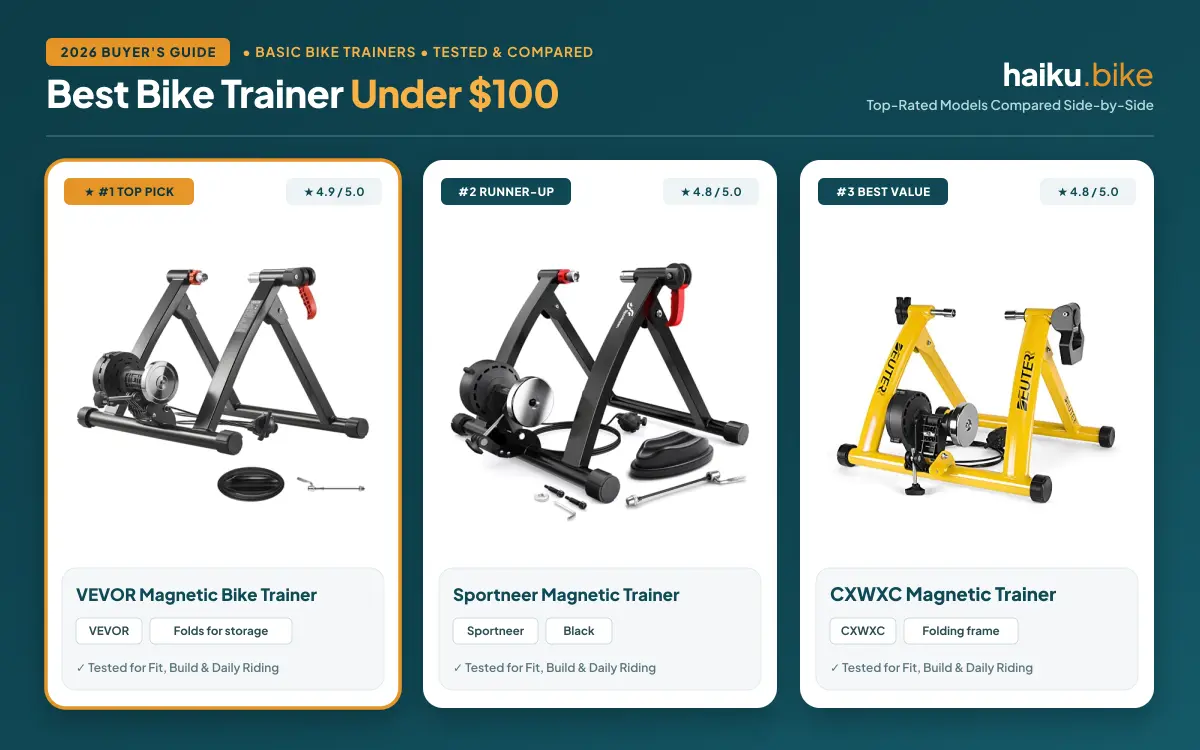
A regular bicycle paired with an indoor trainer may suit riders who already own a compatible bike and want to use its familiar fit. That setup can require checking bike and trainer compatibility, plus storage and installation space. A dedicated exercise bike is more direct for riders who prefer a stationary frame that remains ready for home workouts.
Final Thoughts
Riders who want an upright posture and connected tracking should consider MERACH Exercise Bike, Friction Stationary Bike. Its listed app links and adjustable resistance suit riders who want workout data across services, but the upright position does not provide a recumbent backrest.
For supported seating and a stated fit range, YOSUDA Recumbent Exercise Bike for Home pairs an adjustable seat with a padded backrest and 16 resistance levels. Riders who prioritize the highest listed capacity can consider Recumbent Exercise Bike for Home, though its fit range is not listed and its tracking details differ.
Choose based on fit and position before comparing extra features, because a display cannot make an unsuitable frame comfortable. Review the maker’s current fit details and instructions, and ask for clarification when a measurement you need is missing.
Skip these exercise bikes if your main goal is outdoor transportation, or if none of their stated fit details and riding positions suit you. Riders who already own a bicycle can compare options in our bike trainer guide, while riders considering different indoor equipment can browse the indoor training category.
FAQs
Which riding position should I choose on an exercise bike?
An exercise bike’s riding position should match your posture preference and the support you want during indoor sessions. Upright bikes use a cycling-style position, while recumbent bikes place you in a reclined seat with a backrest. Compare adjustment points and the maker’s fit range before deciding which frame may suit your body and routine.
Are recumbent exercise bikes suitable for older adults?
Recumbent exercise bikes provide a reclined position with back support, but comfort and suitability vary by rider. The YOSUDA and XVGVSV recumbent options list padded seats and backrests. Haiku Bike does not give medical advice; readers with health concerns should ask their doctor whether cycling suits them and follow the manufacturer’s instructions.
Do exercise bikes connect to fitness apps?
Some exercise bikes list fitness app connections, but support varies by product. MERACH lists compatibility with KINOMAP and Zwift, plus syncing with Google Fit and Apple Health. The YOSUDA recumbent bike does not list app support, so check the current product information for the specific apps and functions you want.
How can I tell whether an exercise bike will fit me?
An exercise bike’s published height range and adjustment points help you judge whether its frame may fit. Compare the range with your height, then consider seat position, legroom, and the posture you prefer. The Recumbent Exercise Bike for Home does not list a fit range, so ask the maker if that measurement matters to your choice.
How many resistance levels do I need on a stationary bike?
A stationary bike’s resistance options should match how much control you want over workout effort. The YOSUDA and XVGVSV recumbent bikes list 16 levels, while MERACH describes infinite adjustment. A level count alone does not establish maximum resistance, so check the maker’s explanation if your routine calls for a particular effort range.
Can I move an exercise bike around my home?
Some exercise bikes include transport wheels that can help move a frame between rooms. MERACH and the Recumbent Exercise Bike for Home list transport wheels, but doorway access and assembled dimensions still matter. Measure the route and workout area before ordering, and leave space to mount and dismount safely.
What should I check before assembling an exercise bike?
Before assembling an exercise bike, review the maker’s instructions, included parts, and recommended setup location. Check that the floor is stable and that the bike sits securely after assembly. MERACH lists leveling knobs, and riders should contact the maker if instructions or components are unclear.
Where can I compare other indoor cycling equipment?
Riders comparing a dedicated exercise bike with other indoor equipment can explore options by setup and intended use. Our smart trainer versus exercise bike guide explains the main format differences. Compare available space, compatibility, and preferred riding position before choosing equipment.





Write Your Review
No reviews yet. Be the first to share your experience!