
Commuters and recreational riders use wireless bike computers to track speed, distance, and ride time without routing a cable along the handlebar. GPS models can also record routes, display navigation prompts, or share ride data, while simpler sensor computers focus on essential measurements.
Our guide compares 9 computers from brands including CATEYE, SY, CYCPLUS and more, spanning the $14.98 – $149.99 range. Riders who want more options for route planning can also browse our bike computers for gravel riding guide.
At a Glance: Which One Fits You
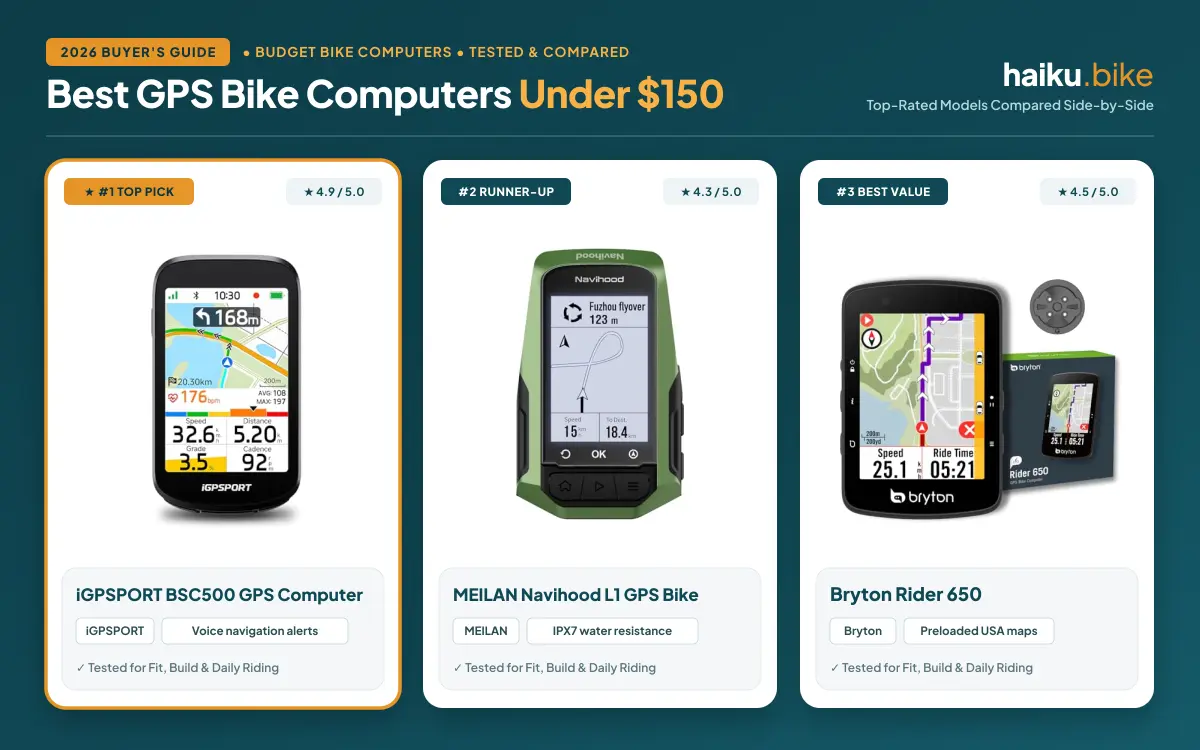
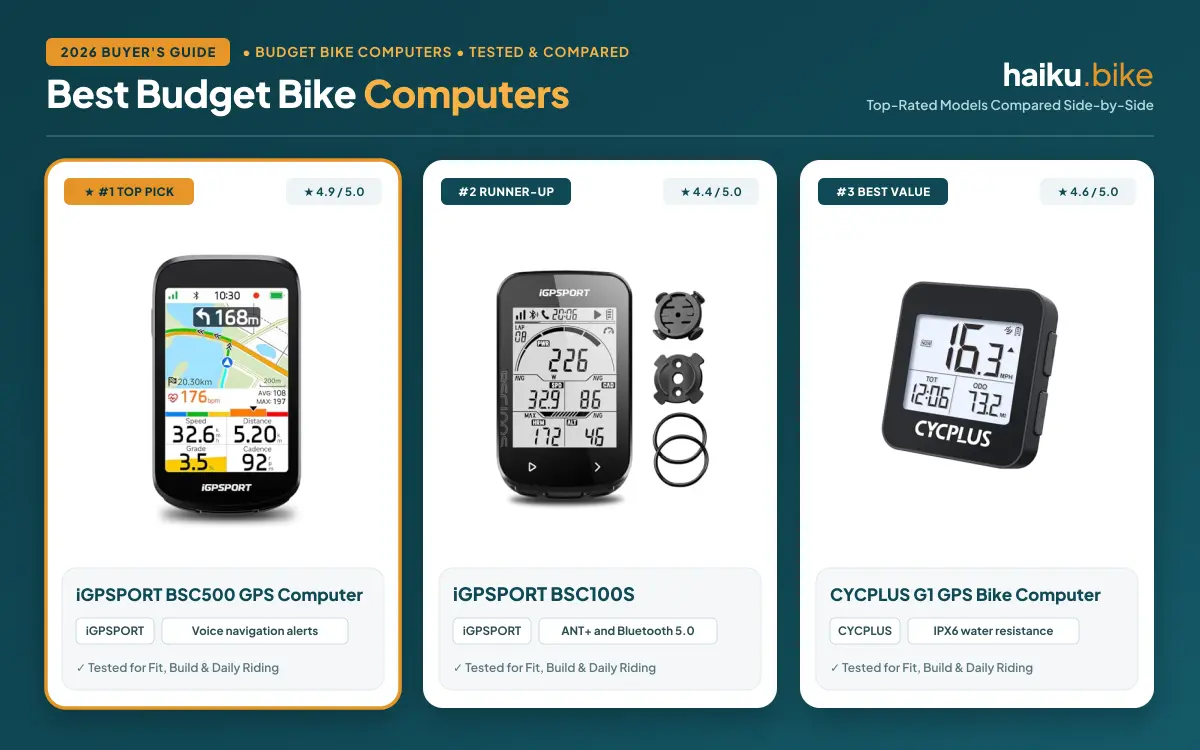
- Best overall: iGPSPORT BSC500 GPS Bike Computer earns this spot because it combines dual-band, five-satellite positioning with imported routes, automatic rerouting, and voice navigation.
- Best value: SY Bicycle Speedometer and Odometer earns this spot because its wireless display covers speed, distance, and ride time with automatic wake-up.
- Best for simple ride stats: CATEYE Padrone Wireless Bike Computer (Black) earns this spot because ClickTec controls provide core metrics without GPS or navigation menus.
- Best for long rides: CYCPLUS Wireless GPS Bike Computer G1, 70g earns this spot because CYCPLUS lists more than 55 hours of operating time.

Pros
- Touchscreen and button controls
- Up to 12 data fields per page
- Strava and Komoot route imports
- Automatic off-course rerouting
- Voice navigation alerts
Cons
- Battery life not listed
- Water-resistance rating not listed
- Wireless connectivity details not listed

Pros
- Tracks speed, distance, and riding time
- Vibration-activated auto wake
- Nighttime backlight
- Two-button interface
- Customizable tire-size settings
Cons
- May not work with some electric-assist bikes
- Wireless unit may make a slight rattle

Pros
- More than 55-hour maker-rated runtime
- IPX6 water resistance
- Automatic backlight
- GPS route and altitude data
- About 2.5 oz
Cons
- No listed app connectivity
- No listed sensor pairing

Pros
- Wireless speed sensor
- Current, max, and average speed
- Tool-free FlexTight bracket
- Automatic stop detection
- Simple ClickTec controls
Cons
- No GPS or navigation
- No heart-rate tracking
- Speed sensor for front wheel use only

Pros
- GPS ride data without wheel sensor
- Altitude, gradient, and ascent readings
- Up to 28 hours of runtime
- IPX7 waterproof rating
- Automatic start-stop recording
Cons
- App connectivity not listed
- Mount details not listed
- Charging port not listed

Pros
- Automatic stop detection
- Manual odometer setting
- FlexTight hand-adjustable bracket
- Calorie tracking
- Core ride stats
Cons
- Battery runtime not listed
- Connectivity details not listed

Pros
- Built-in GPS
- No wheel sensor or spoke magnet needed
- Maker-rated 28-hour runtime
- IPX7 water resistance
- Altitude and climbing data
Cons
- No listed app or sensor compatibility
- Charging port not specified

Pros
- Up to 40-hour battery life
- 2.6-inch anti-glare screen
- Strava and Komoot sharing
- ANT+ and Bluetooth 5.0
- IPX7 water resistance
Cons
- Mapping not listed
- Sensor compatibility may be needed for some metrics

Pros
- GPS tracking without wheel sensor
- Up to 28-hour rated runtime
- Altitude and ascent data
- Automatic backlight and ride recording
- USB-C charging
Cons
- No listed ANT+ or Bluetooth support
- No listed app compatibility
Side-by-Side Comparison
| Product | Tracking method | Display | Stated runtime | Water protection | Notable features |
|---|---|---|---|---|---|
| CATEYE Padrone Wireless Bike Computer (Black) | Wireless speed sensor | Not listed | Not listed | Not listed | ClickTec; auto stop |
| iGPSPORT BSC500 GPS Bike Computer | Dual-band GPS; five satellite systems | 3.3-inch touchscreen | Not listed | Not listed | Route import; rerouting; voice navigation |
| CATEYE Urban Wireless Bike Computer | Wireless speed sensor | Not listed | Not listed | Not listed | Calories; manual odometer setting |
| Bikevee Wireless GPS Bike Computer, 2.4" Screen | Built-in GPS | 2.4-inch; green backlight | Up to 28 hours | IPX7 | Altitude; gradient; accumulated ascent |
| Bikevee GPS Bike Computer, 2.4" Screen, Altitude | Built-in GPS | 2.4-inch; automatic backlight | Up to 28 hours | IPX7 | Altitude; gradient; accumulated ascent |
| SY Bicycle Speedometer and Odometer | Wireless speed sensor | LCD with backlight | Not listed | Described as waterproof; rating not listed | Auto wake-up; two-button interface |
| CYCPLUS Wireless GPS Bike Computer G1, 70g | GPS | 2.0-inch backlit screen | More than 55 hours | IPX6 | Altitude; sleep mode |
| iGPSPORT BSC100S GPS Bike Computer | Five satellite systems | 2.6-inch anti-glare screen | Up to 40 hours | IPX7 | ANT+; Bluetooth 5.0; app sharing |
| BKVTOP Wireless GPS Bike Computer, 50g | Built-in GPS | 2.4-inch; green auto backlight | Up to 28 hours | IPX7 | Altitude; gradient; accumulated ascent |
Tracking method is the key difference: sensor-based CATEYE and SY computers need a wireless speed sensor, while GPS models record rides through satellite positioning. Riders choosing GPS should then compare navigation, stated runtime, water ratings, and sensor connections, since those features vary across the listed computers.
Common Mistakes to Avoid
Buyers sometimes assume every wireless bike computer has GPS, but wireless describes communication and does not identify how a device measures speed. The CATEYE Padrone, CATEYE Urban, and SY use wireless speed sensors, while GPS computers use satellite positioning; confirm the tracking method before choosing.
Route recording also does not guarantee route guidance. The iGPSPORT BSC500 lists route imports, turn reminders, automatic rerouting, and voice alerts, while several other GPS computers focus on ride data instead. Check for explicit navigation features if you need directions on unfamiliar roads.
Sensor and app compatibility can be easy to overlook when comparing feature lists. The iGPSPORT BSC100S lists ANT+ and Bluetooth 5.0 connections for compatible accessories, but the other computers do not all specify the same support. Match the computer’s listed protocol to your cadence or heart-rate sensor.
Finally, do not treat missing runtime or water-resistance details as a promise. CATEYE does not list those specifications for the Padrone or Urban in its product features here, and the SY has no specific water rating. Check the manufacturer’s instructions for details that matter to your rides.
Best Wireless Bike Computer Buying Guide
Tracking Method and GPS Positioning
Tracking method determines whether a computer relies on a wheel sensor or satellite positioning to record speed and distance. The CATEYE Padrone, CATEYE Urban, and SY use wireless speed sensors, while the GPS models do not require a wheel sensor or spoke magnet for ride tracking.
GPS positioning features also vary, so compare satellite support rather than assuming all GPS computers offer the same reception. The iGPSPORT BSC500 receives L1 and L5 signals and supports GPS, BeiDou, GLONASS, Galileo, and QZSS; the BSC100S lists those five satellite systems. Check each device’s setup instructions and consider whether your routes make satellite tracking useful.
Navigation and Route Features
Navigation features matter when you need directions, rather than only a record of where you rode. The iGPSPORT BSC500 imports routes through its app, from Strava or Komoot, or from compatible route files; it also provides turn reminders, automatic rerouting, and voice alerts.
Other GPS computers in this guide emphasize ride statistics and do not list the BSC500’s route guidance. Before ordering, check how routes reach the computer and whether the device provides maps, prompts, or only recorded ride data. Riders comparing route-focused options can see our GPS bike computer category.
Battery Life and Charging
Battery runtime affects how often a GPS computer needs charging and whether its stated endurance fits your longest rides. CYCPLUS lists more than 55 hours for the G1, iGPSPORT lists up to 40 hours for the BSC100S, and Bikevee and BKVTOP list up to 28 hours for their GPS models.
Manufacturer runtime figures do not guarantee identical performance during every ride, so leave a margin for longer outings. The BSC100S specifies a Type-C charging port, while charging details are not listed for every computer. Check charging connections and the maker’s instructions before relying on a device for extended trips.
Sensor Support and App Compatibility
Sensor compatibility matters when you want one computer to show data from accessories such as cadence or heart-rate sensors. The iGPSPORT BSC100S lists ANT+ and Bluetooth 5.0 support for compatible devices, along with app-based ride analysis and sharing to services such as Strava and Komoot.
App connectivity and accessory support are separate features, so confirm both before buying. The BSC500 lists route transfers from Strava and Komoot, but does not list the same accessory connections in its stated features. Check the protocol used by each sensor and whether the computer displays the particular data you want.
Screen Readability and Controls
Screen size, backlighting, and controls determine how easily you can read ride information while moving. The iGPSPORT BSC500 has a 3.3-inch touchscreen with button operation, while the BSC100S lists a 2.6-inch anti-glare screen. The CYCPLUS G1 has a backlit 2.0-inch screen, and several other GPS units list 2.4-inch displays.
Control style can matter as much as screen size when you want to change views during a ride. CATEYE’s ClickTec design changes the Padrone display when you press the unit’s base, while the SY uses two buttons. Compare the screen layout and controls with the data you want visible at a glance.
Weather Protection and Ride Data
Water ratings help you compare models with a stated protection level, but not every computer lists one. The iGPSPORT BSC100S and several GPS computers list IPX7, while the CYCPLUS G1 lists IPX6. The SY is described as waterproof without a specific rating, and CATEYE does not list one for these models.
Ride-data fields can distinguish computers beyond speed and distance. CATEYE Urban includes calories and a pace arrow, while Bikevee and BKVTOP list temperature, altitude, gradient, and accumulated ascent. Choose fields that suit your routes, and follow the manufacturer’s care instructions rather than assuming an unlisted water rating.
How We Chose
We evaluate each computer with the Haiku Ride Score: core performance counts for 30%, build and weather resistance for 20%, ease of use for 20%, compatibility and battery for 15%, and value for 15%. This framework lets us compare sensor-based computers and GPS models without treating their different feature sets as interchangeable.
Our evaluation draws on manufacturer specifications, compatibility information, and long-term owner feedback where available. We research and draft our guides with software tools, including AI, then run automated checks on product fit, sourcing, and our editorial rules. Our editor spot-checks guides rather than reading each one before publication. Our how we review page explains the method.
Price and Value: What Each Budget Gets You
Budget
At the budget end, expect essential speed, distance, and ride-time data, often with a wireless sensor rather than built-in GPS. The SY Bicycle Speedometer and Odometer has an automatic wake-up function, backlight, and two-button interface, while the CATEYE Urban adds calories and a pace arrow. These computers suit familiar commutes, but they do not provide the route features found on the BSC500.
Mid-Range
Mid-range choices can add GPS tracking, elevation data, longer stated runtimes, or connections to phone apps and sensors. The CYCPLUS G1 lists more than 55 hours of operation, while the iGPSPORT BSC100S adds app sharing and ANT+ and Bluetooth 5.0 support. These options broaden ride tracking, but riders seeking route prompts should confirm navigation features before choosing.
Premium
At the high end of this guide, the iGPSPORT BSC500 adds a touchscreen, route imports, turn reminders, automatic rerouting, and voice navigation. That feature set suits riders who want directions on the computer rather than a separate phone display. Riders who only need speed and distance may not benefit from the extra navigation functions, so a simpler sensor unit can be a better fit.
Choosing Something Else
A phone in a secure handlebar mount can replace a bike computer for riders who already navigate with an app and want a larger map display. That setup depends on the phone, mount, and app, while a dedicated computer can keep ride data separate from phone use. Choose a computer instead when you want a purpose-built display or simpler speed tracking.
Final Thoughts
Riders who want route guidance should consider the iGPSPORT BSC500 GPS Bike Computer. Dual-band positioning, route imports, rerouting, and voice alerts make it the most navigation-focused choice here, but its features may be unnecessary for familiar commutes centered on speed and distance.
For basic wireless stats, the CATEYE Padrone Wireless Bike Computer (Black) offers ClickTec controls and automatically pauses time and average-speed calculations when stopped. Riders seeking a GPS computer with a long stated runtime can consider the CYCPLUS Wireless GPS Bike Computer G1, 70g, though it does not list the BSC500’s route guidance.
The iGPSPORT BSC100S GPS Bike Computer suits riders who want app sharing and compatible sensors. The SY Bicycle Speedometer and Odometer focuses on simple ride measurements, while the CATEYE Urban Wireless Bike Computer adds calories and a pace arrow. Compare broader options in our bike computers and GPS category.
Choose a different category if you need detailed maps or a specific sensor connection that a computer does not list. Bikevee and BKVTOP GPS models include elevation data, but their stated features do not match the BSC500’s navigation functions. Riders who prioritize routes for gravel can also consult our gravel bike computer guide.
FAQs
Which Best Wireless Bike Computer should I choose in 2026?
The Best Wireless Bike Computer for your riding depends on whether you want simple metrics or GPS navigation. The iGPSPORT BSC500 includes route imports, turn reminders, rerouting, and voice alerts, while the CATEYE Padrone focuses on core ride data. Compare tracking method, screen controls, battery information, and connections before deciding.
Do wireless bike computers need a wheel sensor?
Wireless bike computers may use a wheel sensor or built-in GPS, depending on the model. The CATEYE Padrone, CATEYE Urban, and SY use wireless speed sensors, while GPS models record rides through satellite positioning without a wheel sensor or spoke magnet. Check the tracking method and installation instructions before choosing a computer.
Can bike computers send rides to Strava?
Some bike computers support sharing ride data with Strava, but the feature is not listed for every model. The iGPSPORT BSC100S connects with its app for ride analysis and sharing to Strava and Komoot; the BSC500 supports route imports from those services. Confirm app requirements and sharing support before purchase.
How long does a wireless GPS bike computer battery last?
Wireless GPS bike computer runtime varies by model, and manufacturers do not list a figure for every device. CYCPLUS lists more than 55 hours for the G1, iGPSPORT lists up to 40 hours for the BSC100S, and Bikevee and BKVTOP list up to 28 hours. Allow a charging margin on longer rides.
Can I use a bike computer in the rain?
Some bike computers list a water-resistance rating, while others do not provide a specific figure. The iGPSPORT BSC100S and several GPS models list IPX7, and the CYCPLUS G1 lists IPX6. Follow the manufacturer’s care instructions, since an unlisted rating does not establish a device’s water protection.
Which bike computer works with cadence or heart-rate sensors?
The iGPSPORT BSC100S lists ANT+ and Bluetooth 5.0 support for compatible cadence, speed, and heart-rate sensors. Other computers in this guide do not all list the same accessory connections. Check your sensor’s protocol and the computer’s compatibility details, because wireless operation alone does not confirm that two devices will connect.
Do I need GPS for a bike computer?
You do not need GPS if your main goal is basic ride statistics and a wireless speed sensor meets your needs. The CATEYE Padrone and CATEYE Urban provide speed, distance, and time functions without GPS. Satellite tracking becomes useful when you want ride recording without a wheel sensor or features such as navigation.
Can a phone replace a wireless bike computer?
A phone can replace a wireless bike computer for navigation when it is secured in a handlebar mount and paired with a suitable app. A dedicated computer may suit riders who want a separate ride-data display or prefer not to rely on a phone during a ride. Compare mount stability and phone battery needs; our bike computer category covers dedicated options.
Write Your Review
No reviews yet. Be the first to share your experience!