

Riders flying or taking trains with a bicycle need a travel case that protects the frame without making packing and airport handling harder than necessary. The choice between a hard shell and a soft case depends on how much structure you want, where you will store it, and whether your bike fits its dimensions.
Our Bike Travel Case Hard Shell vs Soft guide compares 5 options from CyclingDeal, Exquimac, CONFUTURY and more for different bikes and travel routines. Start with the bike travel case comparison if you want to compare cases by use, then check each maker’s fit details before ordering.
At a Glance: Which One Fits You
- Best overall: VEVOR Bike Travel Case, Bicycle Travel Bag earns this spot because its EVA hard shell comes with wheel bags, protective components, wheels, and a TSA-approved lock.
- Best value: Bike Travel Bag 900D Bicycle Transport Case earns this spot because its fabric construction has separate bike and wheel compartments, reinforced lining, and three fixed buckles.
- Best for broad bike fit: Exquimac Bike Travel Case & Bike Travel Bag earns this spot because it accommodates 700c road bikes and several mountain-bike wheel sizes.
- Best for compact storage: VEVOR Bike Travel Bag, Transport Universal Bicycle earns this spot because its fabric case folds for storage and includes support plates and wheel compartments.

Pros
- Rigid EVA shell
- Two wheel bags included
- Protective covers included
- Wheels and cushioned handle
- TSA-approved lock
Cons
- Fits 700c road bikes only
- Bike parts must be removed for packing
- Weighs 22.05 lb

Pros
- Separate frame and wheel compartments
- Three fixed buckles
- Adjustable shoulder straps
- Front accessory pocket
- Includes reusable cable ties and fork holder
Cons
- No listed bag weight
- Bike fit depends on measuring before purchase
- No hard-shell construction listed

Pros
- Two dedicated wheel compartments
- Fork mounts and support plates
- TSA-approved lock
- Smooth-rolling wheels
- Protective covers included
Cons
- Bike disassembly required
- Maximum 51-inch wheelbase
- 21.34 lb empty weight

Pros
- Fits several road and mountain bike sizes
- Four aluminum support bars
- Layered frame and wheel protection
- Wheels and eight grab handles
- Folds for storage
Cons
- Weight not listed
- Large 55.12-inch length
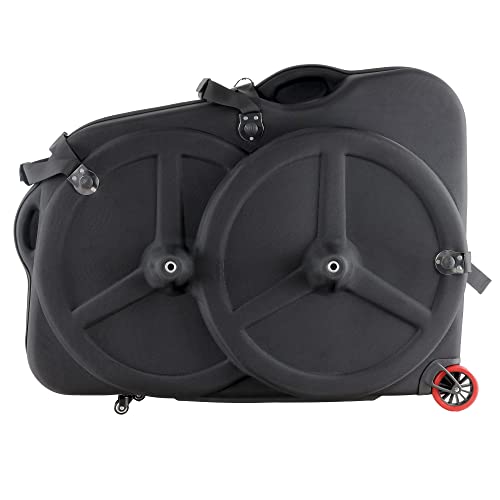
Pros
- Padded wheel bags included
- QR and thru-axle compatibility
- 360-degree front wheels
- Top and side handles
- 2-year warranty
Cons
- Not compatible with MTBs
- Not compatible with integrated seatposts
- 18.3 lb case weight
Side-by-Side Comparison
| Product | Construction | Stated bike fit | Wheel protection | Handling and security |
|---|---|---|---|---|
| VEVOR Bike Travel Case, Bicycle Travel Bag | EVA hard shell | 700c road bikes | Two wheel bags and protective components | Wheels, cushioned handle, TSA-approved lock |
| Bike Travel Bag 900D Bicycle Transport Case | 900D Oxford fabric, reinforced lining | 26 to 29-inch mountain bikes, 700c road bikes, folding models | Separate wheel compartment | Three fixed buckles, adjustable shoulder straps |
| Exquimac Bike Travel Case & Bike Travel Bag | Waterproof fabric, foam, PE panels, honeycomb padding | 700c road bikes, 26, 27.5, and 29-inch mountain bikes | Wheel protection tubes | Wheels, eight grab handles, two-year warranty |
| VEVOR Bike Travel Bag, Transport Universal Bicycle | Durable fabric with support plates | Road bikes with wheelbase up to 51 inches | Two wheel compartments | Wheels, cushioned handle, TSA-approved lock |
| CyclingDeal Bike Travel Case – 700c Bikes | EVA hard case | 700c road bikes with QR or thru-axle wheels | Two padded wheel bags | Swiveling front wheels, two-year warranty |
Construction and fit make the biggest difference: a hard case provides a rigid outer structure, while padded fabric cases can fold or offer broader stated fit ranges. Check the exact bike compatibility first, then weigh case protection against storage space, lifting, and airport maneuvering.
Common Mistakes to Avoid
Buyers can mistake a listed wheel size for a guarantee that every frame will fit. Frame shape, wheelbase, handlebar position, and parts removed during packing all affect fit, so compare your bicycle’s measurements with the maker’s dimensions before purchase.
Another common mistake is assuming that a soft bag offers no structure or that every hard case suits every bike. The Exquimac bag combines fabric with foam, PE panels, and honeycomb padding, while the CyclingDeal case is limited to specified 700c road bikes and excludes mountain bikes and integrated seatposts.
Travelers can also overlook packing and transport details. Confirm whether wheel bags, fork protection, straps, or support components are included, and consider whether you can manage a large case through stations or airports. Read the maker’s packing instructions and secure loose components to reduce movement inside the case.
Bike Travel Case Hard Shell vs Soft: Buying Guide
Bike Fit and Case Dimensions
Bike fit matters first because an incompatible case cannot protect a bicycle it cannot contain. Check the maker’s stated wheel size, bike type, wheelbase limit, and external dimensions against your own bike before comparing materials or travel features.
The VEVOR hard case is listed for 700c road bikes, while the CyclingDeal case also specifies 700c road bikes and excludes mountain bikes and integrated seatposts. By contrast, the Exquimac bag lists several mountain-bike wheel sizes as well as 700c road bikes. Confirm axle and frame details directly with the maker when the listing does not address your exact setup.
Hard Shell or Padded Fabric
A hard shell creates a rigid outer barrier, while a soft case relies on fabric and internal padding or reinforcement. Choose based on the protection structure you need and whether the case must be stored between trips.
The VEVOR and CyclingDeal cases use EVA construction. The Exquimac soft case adds foam, PE panels, and honeycomb padding, while the VEVOR fabric case includes support plates. Those details matter more than the soft-versus-hard label alone, so check how the maker protects the frame, fork, and wheels.
Wheel and Component Separation
Separate storage helps keep wheels and bike components from rubbing against each other during transport. Look for dedicated wheel bags or compartments, fork protection, chain guards, and padding around contact points.
Both VEVOR options include separate wheel storage, and the CyclingDeal hard case includes padded wheel bags. Exquimac lists wheel protection tubes and chain guards, while the CONFUTURY bag separates the frame and wheels internally. Before packing, follow the maker’s directions for removing and securing parts, and check whether your pedals, saddle, or handlebars need separate protection.
Moving the Case Through Airports
Wheels, handles, and carrying straps determine how manageable a loaded case is during transfers. Consider your route, stairs, vehicle space, and ability to lift the packed case, not only its rolling features.
The VEVOR cases and CyclingDeal case include wheels, while the Exquimac case lists wheels and multiple grab handles. The CONFUTURY bag uses adjustable shoulder straps rather than listed rolling wheels. If you expect long terminal walks, compare those handling options and consider how you will carry the case when rolling is impractical.
Closures, Locks, and Travel Security
Closures keep packed parts inside the case, and a lock can add a layer of access control. Check what kind of closure the maker specifies and whether the lock is included, while recognizing that no case feature guarantees careful handling.
The VEVOR options list TSA-approved locks, and the CONFUTURY bag uses three fixed buckles alongside its zipper. CyclingDeal describes buckles, straps, and industrial-strength zippers. These features differ, so check how each case closes and whether you need a separate lock for your travel plans.
Storage, Warranty, and Ownership
Storage and support affect how practical a case remains between trips. A rigid case can take more dedicated storage space, while Exquimac says its soft case folds compactly when not in use.
Warranty details also differ: Exquimac and CyclingDeal list two-year warranties. Confirm warranty terms with the maker and check how the case should be cleaned, dried, and stored after travel. The Bike Travel Cases category can help you compare other case styles when your storage needs point away from a rigid shell.
How We Chose
We score each option with the Haiku Ride Score: core performance 30%, build and weather resistance 20%, ease of use 20%, compatibility and battery 15%, and value 15%. For travel cases, we focus on stated bike fit, protective construction, packing organization, handling features, and maker support.
Our evaluation draws on manufacturer specifications, compatibility information, and long-term owner feedback when available. We researched and drafted this guide with software tools, including AI, then reviewed and edited it before publication. Read about how we review for details on our editorial method.
Price and Value: What Each Budget Gets You
Budget
At the lower end of this category, a rider can find fabric construction, internal separation, shoulder straps, and protective coatings. The Bike Travel Bag 900D Bicycle Transport Case adds reinforced lining and three fixed buckles. Buyers give up a rigid outer shell and listed rolling wheels, so this style suits riders who prioritize lower-cost transport and can carry the packed bag.
Mid-Range
Middle-tier cases can combine fabric flexibility with more structure and easier handling. VEVOR Bike Travel Bag, Transport Universal Bicycle includes support plates, wheel compartments, rolling wheels, and a TSA-approved lock, while its stated fit is limited by wheelbase. Riders gain organization and mobility compared with a basic soft bag but should still check frame compatibility and storage needs.
Premium
Higher-tier options emphasize rigid construction, fuller padding, included protection, or broader stated bike fit. VEVOR Bike Travel Case, Bicycle Travel Bag uses an EVA hard shell and includes wheel bags; Exquimac adds layered padding and lists a two-year warranty. These cases offer more protective structure or support, but can demand more storage space and careful fit checks.
Choosing Something Else
For a road trip where the bicycle stays inside your own vehicle, a travel case may be unnecessary if you can secure the bike and protect it from other cargo. A reusable bike box from a shop may suit an occasional trip, but availability and packing support vary. Riders who fly regularly or need repeated protection should compare those trade-offs with a purpose-built case.
Final Thoughts
Riders seeking a rigid shell, rolling wheels, wheel bags, and a TSA-approved lock should consider VEVOR Bike Travel Case, Bicycle Travel Bag. Its stated fit is limited to 700c road bikes, so owners of mountain bikes or other wheel sizes should choose a case whose compatibility explicitly matches their bicycle.
Riders who prefer a soft bag with broad stated wheel-size compatibility can compare Exquimac Bike Travel Case & Bike Travel Bag. Riders with a road bike within the 51-inch wheelbase limit may prefer VEVOR Bike Travel Bag, Transport Universal Bicycle for its support plates and rolling wheels.
Choose Bike Travel Bag 900D Bicycle Transport Case if separate compartments and shoulder straps fit your travel routine. The CyclingDeal Bike Travel Case – 700c Bikes suits riders with compatible 700c road bikes who want an EVA case and padded wheel bags.
Skip these cases if you do not need to transport a bicycle or cannot store a large travel bag between trips. A case that does not fit your frame or that you cannot move comfortably can add hassle rather than solve it. Compare the broader Racks & Storage category for alternatives suited to local transport and home storage.
FAQs
Is a hard-shell or soft bike travel case better for flying?
A hard-shell bike case offers a rigid exterior, while a soft case can use padding, panels, or support bars for structure. Neither construction alone guarantees protection from mishandling. Compare frame and wheel protection, internal organization, and your storage needs, then follow the maker’s packing directions. Check airline baggage rules separately because case dimensions and handling policies can vary.
How do I know whether a bike travel case fits my bike?
A bike travel case fits only when its stated compatibility and dimensions accommodate your bicycle after the required parts are removed. Check wheel size, frame type, wheelbase limits, axle details, and any seatpost restrictions. Measure your bike and compare those measurements with the maker’s specifications before ordering. Ask the maker about any fit detail the listing does not address.
Can a soft bike travel bag protect a bicycle?
A soft bike travel bag can protect a bicycle when its padding, internal supports, and component separation match your travel needs. The Exquimac bag lists foam, PE panels, and honeycomb padding, while the VEVOR fabric bag lists support plates. Pack parts as directed and secure them to limit movement. A soft case does not provide the same rigid outer shell as an EVA hard case.
Do bike travel cases include wheel bags?
Some bike travel cases include wheel bags, but included wheel protection differs by product. The VEVOR hard case and CyclingDeal case list two wheel bags, while other options describe separate wheel compartments or protection tubes. Check the included accessories before buying, because a dedicated compartment is not necessarily a removable wheel bag. Use the maker’s packing instructions to keep wheels separated from frame parts.
Are bike travel cases waterproof?
Water resistance depends on the materials and construction of each bike travel case. Exquimac describes its fabric as waterproof, and the CONFUTURY bag lists a protective coating against rain. Those descriptions do not establish that every seam or closure stays dry in every condition. Check the maker’s care and weather guidance, and protect sensitive components according to the bicycle manufacturer’s instructions.
Which Bike Travel Case Hard Shell vs Soft options suit mountain bikes?
Mountain-bike compatibility depends on the exact case, frame, and wheel size rather than whether the case is hard or soft. The CONFUTURY bag lists 26 to 29-inch mountain bikes, and Exquimac lists 26, 27.5, and 29-inch mountain bikes. The CyclingDeal case excludes mountain bikes. Review the bike travel case guide and confirm fit with the maker before purchase.
How should I pack and store a bike travel case?
Pack a bike travel case according to its maker’s instructions, using included guards, bags, straps, or supports to secure removed components. Keep wheels and frame parts separated where the case provides dedicated compartments. After a trip, follow the maker’s cleaning and drying guidance before storage. Exquimac says its soft case folds compactly, while rigid cases may need more room.




Write Your Review
No reviews yet. Be the first to share your experience!