

Road riders who pace climbs, intervals, and long rides with power need a meter that fits their cleats and connects to their bike computer. Pedal-based meters can move between compatible bikes, but single-sided and dual-sided measurement provide different training detail.
Our guide compares 8 pedal power meters from FAVERO, Magene, RiseUP and more for November 2026. Start with pedal and cleat compatibility, then decide whether left-right data, longer stated battery life, or modular parts matter. Our gravel bike computer guide can help you choose a display for your power data.
At a Glance: Which One Fits You
- Best overall: Garmin Rally™ RS210, Dual-Sensing Power Meter reports left-right balance and cycling dynamics, though advanced force data requires compatible Garmin devices.
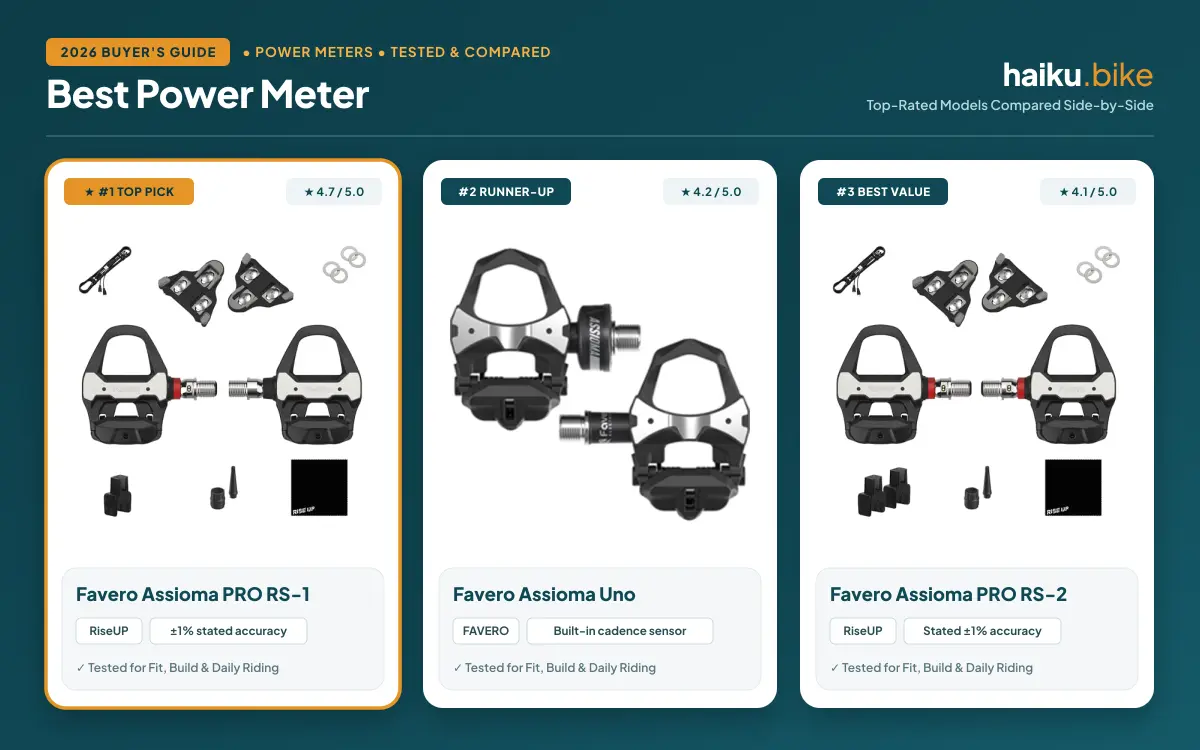
- Best value: Favero Assioma UNO Single-Sensing Pedal Based Road offers left-sided power, ±1% stated accuracy, and Bluetooth and ANT+ support, but does not measure both legs separately.
- Best for long rides: Favero Assioma PRO RS-1 Single-Sensing Pedal Based lists at least 160 hours of use per charge, but its power sensor measures only the left side.
- Best for dual-sided road data: Favero Assioma Duo Dual-Sensing Pedal Based Road combines left-right measurement with Look Keo-compatible cleats, though its stated runtime is shorter than PRO RS models.

Pros
- Maker-rated ±1% power accuracy
- Up to 120-hour battery life
- ANT+ and Bluetooth
- IPX7 water resistance
- 157 g per pedal
Cons
- No app compatibility details provided
- Charging port type not specified
- Crank compatibility details not provided

Pros
- Dual-sided power measurement
- Shimano SPD-SL cleat compatibility
- Up to 90 hours per charge
- 15-minute quick charge
- Transferable between bikes
Cons
- Limited to Shimano SPD-SL cleats
- Advanced data requires compatible Garmin devices
- No wireless protocol details provided

Pros
- ANT+ and Bluetooth connectivity
- Built-in cadence sensor
- IAV Power Phase metric
- IAV Rider Position metric
- ±1% angular velocity accuracy
Cons
- Measures power from left pedal only
- Road cycling pedal

Pros
- Tool-free bike-to-bike transfer
- ANT+ and Bluetooth connectivity
- At least 50 hours per charge
- Maker-rated ±1% accuracy
- Cleats included
Cons
- Power sensor on left pedal only
- Look Keo-compatible cleat system
- No stated weight for pedal alone

Pros
- Dual-sided power measurement
- ±1% rated accuracy
- Up to 50-hour battery life
- Bluetooth and ANT+
- Built-in cadence sensor
Cons
- Road-focused design
- Cleat compatibility not specified
- Charging connector not specified

Pros
- Dual-sensing pedal power measurement
- Bluetooth and ANT+ connectivity
- Tool-free bike-to-bike transfer
- At least 50 hours per charge
- Look Keo-compatible cleats included
Cons
- Look Keo-compatible cleat system
- No weight specification provided
- No app compatibility details provided

Pros
- Single-sided power measurement
- Precise, consistent power data
- Works with standard pedal systems
- Integrates with cycling computers and training apps
Cons
- Measures power on one side only
- No specific computer or app compatibility listed

Pros
- At least 160 hours per charge
- ANT+ and Bluetooth connectivity
- Installation needs no special tools
- ±1% stated accuracy
- Includes SPD-SL-compatible cleats
Cons
- Power sensing on left pedal only
- No independent right-leg power reading
Side-by-Side Comparison
| Product | Measurement | Cleat system | Connectivity | Stated runtime | Stated accuracy |
|---|---|---|---|---|---|
| Favero Assioma PRO RS-1 Single-Sensing Pedal Based | Single-sided | SPD-SL | Bluetooth and ANT+ | At least 160 hours | ±1% |
| Garmin Rally™ RS210, Dual-Sensing Power Meter | Dual-sided | Shimano SPD-SL | Not listed | Up to 90 hours | ±1% |
| Favero Assioma PRO MX-1 Single Sided Power Meter | Single-sided | Not listed | Not listed | Not listed | Not listed |
| Favero Assioma Duo Dual-Sensing Pedal Based Road | Dual-sided | Look Keo compatible | Bluetooth and ANT+ | At least 50 hours | ±1% |
| Magene P715 S Power Meter Pedals – ±1% Precision | Not listed | Not listed | Bluetooth and ANT+ | 120 hours | ±1% |
| Favero Assioma Uno Power Meter Pedal | Left-pedal sensor | Not listed | Bluetooth and ANT+ | Not listed | ±1% |
| Favero Assioma UNO Single-Sensing Pedal Based Road | Single-sided | Look Keo compatible | Bluetooth and ANT+ | At least 50 hours | ±1% |
| Favero Assioma Duo Power Meter Pedal | Dual-sided | Not listed | Bluetooth and ANT+ | 50 hours | ±1% |
Measurement type and cleat fit create the biggest practical differences across these pedals. Dual-sided systems can provide left-right information, while single-sided systems measure one leg; confirm the exact cleat standard before ordering.
Common Mistakes to Avoid
Choosing by brand instead of cleat system can leave a new pedal incompatible with your shoes. The Favero Assioma PRO RS-1 uses SPD-SL, while the Favero Assioma UNO Single-Sensing Pedal Based Road supports Look Keo-compatible cleats. Garmin Rally RS210 also specifies Shimano SPD-SL.
Expecting single-sided measurement to provide separate readings for both legs is another costly mismatch. A left-pedal sensor measures one side, while dual-sided pedals can report left-right balance; choose based on the data you will use and whether your computer displays it.
Assuming that runtime and features carry across every model can lead to poor fit. Favero lists at least 160 hours for PRO RS-1, while Garmin lists up to 90 hours for Rally RS210 and Magene lists 120 hours for P715 S.
Buyers can also overlook connection support, charging, and product-specific details. Confirm that your computer or phone accepts the meter’s protocol, then check the exact model’s cleat, charging, and feature information before purchase.
Best Pedal Power Meter Buying Guide
Cleat Compatibility and Pedal Fit
Cleat compatibility matters first because a pedal power meter must match your shoes and preferred pedal interface. The Favero Assioma PRO RS-1 specifies SPD-SL, while the Favero Assioma Duo Dual-Sensing Pedal Based Road and Assioma UNO Single-Sensing Pedal Based Road support Look Keo-compatible cleats.
Check the exact model rather than assuming products from one brand share a system. Garmin Rally RS210 specifies Shimano SPD-SL, and Magene does not specify a cleat system for the P715 S here. Confirm the supplied cleats and compatibility details on the model you plan to buy.
Transferability helps riders who use multiple bikes, but each bike still needs a compatible pedal interface. Favero says PRO RS pedals install like regular pedals and move between bikes without special tools. Follow the manufacturer’s installation instructions and local laws, and use an appropriate service professional if you are unsure about fit or installation.
Single-Sided or Dual-Sided Measurement
Single-sided meters measure one leg, while dual-sided systems measure both and can report left-right balance. A single-sided pedal can suit riders who want power for pacing and structured training without separate readings for each leg.
Garmin Rally RS210 lists left-right balance, seated versus standing, platform center offset, and power phase. Favero identifies the Assioma Duo products as dual-sensing. Those fields are useful only when your computer or app receives and displays them.
Choose dual-sided measurement when per-leg information will inform your training decisions. If you mainly need overall power, a single-sided meter may meet that need with fewer data features. Remember that a single-sided reading does not provide separate measurements for both legs.
Accuracy and Training Features
Published accuracy describes the maker’s stated measurement precision, but it does not determine whether a meter suits your training. Favero lists ±1% accuracy for specified Assioma models, and Garmin lists ±1% for Rally RS210.
Favero describes IAV power and a gyroscope on several Assioma models. Garmin lists a strain gauge, gyroscope, and Pedal IQ smart calibration for Rally RS210. These features may matter to riders who analyze detailed ride data, but compatible devices remain necessary.
Start with the metrics you will use, then compare each model’s stated features. Riders focused on overall power may not need cycling dynamics, while riders analyzing power phase may value a compatible dual-sided system. Check your computer’s supported data fields before choosing.
Connectivity and Device Support
Connectivity determines whether a pedal meter can send ride data to your computer, phone, or training app. Favero lists Bluetooth and ANT+ for its Assioma models described here, and Magene lists both protocols for the P715 S.
Garmin describes force data support with compatible Garmin cycling computers and smartwatches, but general connection protocols are not listed here for Rally RS210. Riders using another head unit should confirm pairing and data-field support before buying.
Pairing and displaying advanced metrics are separate capabilities: a device may receive power but omit some dynamics fields. Compare bike computers and GPS devices against the protocols and data fields your meter supports.
Battery Runtime and Charging
Stated battery runtime affects charging frequency and suitability for long events or frequent training. Favero lists at least 160 hours for PRO RS-1, Magene lists 120 hours for P715 S, and Garmin lists up to 90 hours for Rally RS210.
Favero lists at least 50 hours for the Assioma UNO and Duo models described here, and 50 hours for Assioma Duo Power Meter Pedal. Compare each maker’s stated figure with your riding schedule, noting whether it is a minimum or an upper limit.
Charging design also affects daily convenience. Favero describes magnetic charging for several models, while Garmin says a 15-minute charge provides up to 12 hours of ride time for Rally RS210. Check model-specific charging instructions and battery status before a long ride.
Transferability, Construction, and Weather
Transferability matters when you share a meter across bikes or maintain road and off-road setups. Favero says the PRO RS spindle can use compatible PRO RS and PRO MX pedal bodies, while Garmin says its removable sensor works with Rally XC210 off-road pedal bodies.
Weather and construction claims vary by product. Favero describes Assioma Duo sensors as waterproof, Magene lists IPX7 water resistance for P715 S, and Garmin describes redesigned carbon pedal bodies for Rally RS210. Apply each claim only to the specified model.
Maintenance should follow the maker’s charging, cleaning, and calibration guidance. Garmin’s Pedal IQ feature alerts riders when calibration is needed based on factors including temperature changes, while Favero describes automatic temperature compensation on several models.
How We Chose
We score each option with the Haiku Ride Score: core performance counts for 30%, build and weather resistance for 20%, ease of use for 20%, compatibility and fit for 15%, and value for 15%. For pedal power meters, compatibility and fit cover cleat systems, device support, charging, and published battery runtime.
We research maker specifications, compare compatibility information, and assess long-term owner feedback where available. We research and draft our guides with software tools, including AI, then run automated checks on product fit, sourcing, and our editorial rules. Our editor spot-checks guides rather than reading each one before publication. Our how we review page explains our approach.
Price and Value: What Each Budget Gets You
Budget
Budget-oriented pedal meters generally prioritize core power measurement and connection support over separate readings for both legs. The Favero Assioma UNO Single-Sensing Pedal Based Road offers left-sided measurement, Bluetooth and ANT+, and stated ±1% accuracy. Riders give up dual-sided data, so this tier suits training centered on power pacing rather than leg-balance analysis.
Mid-Range
Mid-range options can add longer stated runtime, dual-sided readings, or modular construction, depending on the model. Favero Assioma PRO RS-1 lists at least 160 hours per charge, while Favero Assioma Duo Dual-Sensing Pedal Based Road provides dual-sided measurement. Riders still need to choose between longer runtime and the extra information from measuring both legs.
Premium
Premium pedal meters can combine dual-sided measurement with cycling dynamics, transferable components, or enhanced charging features. Garmin Rally™ RS210 reports several dynamics fields and has a removable sensor for compatible off-road pedal bodies. Riders who only need overall power may not use these added capabilities, and Garmin’s advanced force data calls for compatible Garmin devices.
Choosing Something Else
A cadence sensor or heart-rate monitor can support basic ride tracking for riders who do not need power-based pacing or structured power data. Neither measures cycling power, so neither replaces a meter for training plans built around power zones. Riders seeking another way to track effort can compare cycling heart rate monitors.
Final Thoughts
Road riders who want dual-sided data and advanced dynamics should compare Garmin Rally™ RS210, Dual-Sensing Power Meter. It reports left-right balance and power phase, and its removable sensor supports compatible off-road pedal bodies. Its trade-offs are the need to confirm device support and the fact that its cleat standard is Shimano SPD-SL.
Riders prioritizing long stated runtime and a modular road system can consider Favero Assioma PRO RS-1 Single-Sensing Pedal Based. Favero lists at least 160 hours per charge and Bluetooth and ANT+ connectivity, but the sensor measures one side. For dual-sided road readings with Look Keo-compatible cleats, consider Favero Assioma Duo Dual-Sensing Pedal Based Road, which lists at least 50 hours of use.
Riders seeking a simpler left-sided road setup can compare Favero Assioma UNO Single-Sensing Pedal Based Road. The Magene P715 S Power Meter Pedals – ±1% Precision lists 120 hours of runtime and Bluetooth and ANT+ support, but its cleat system is not listed here.
Skip pedal power meters if you do not use power data, cannot match the cleat system, or prefer not to manage rechargeable sensors. A cadence sensor or heart-rate monitor may better suit simpler ride tracking. Browse our power meter category and gravel bike computer guide to compare related equipment.
FAQs
Which cleats fit pedal power meters?
Pedal power meter cleat fit depends on the exact model, not only the brand. Favero Assioma PRO RS-1 specifies SPD-SL, while Favero Assioma UNO Single-Sensing Pedal Based Road and Assioma Duo Dual-Sensing Pedal Based Road support Look Keo-compatible cleats. Garmin Rally RS210 specifies Shimano SPD-SL. Confirm your shoe and cleat setup before ordering.
Should I choose single-sided or dual-sided power?
Single-sided power meters measure one leg, while dual-sided meters can provide left-right information. A single-sided system can suit riders who need power for pacing but do not use leg-balance data. Choose dual-sided measurement when per-leg information matters to your training, and confirm your computer or app supports the fields you want to view.
How long do pedal power meter batteries last?
Pedal power meter runtime varies by product and by how the maker states its figure. Favero lists at least 160 hours for PRO RS-1, Magene lists 120 hours for P715 S, and Garmin lists up to 90 hours for Rally RS210. Compare the stated runtime with your riding schedule and charging habits.
Do pedal power meters connect to phones and bike computers?
Several pedal power meters in this guide list Bluetooth and ANT+ connectivity, including the Favero Assioma models and Magene P715 S. Your phone, computer, or training app must support the same protocol. Garmin describes force data with compatible Garmin devices, so confirm model-specific support if advanced fields matter to you.
Can I move a pedal power meter between bikes?
Some pedal power meters are designed to move between compatible bikes. Favero says PRO RS models transfer like regular pedals without special tools, while Garmin describes Rally pedals as quick to transfer. Check each bike’s pedal interface and follow the maker’s installation instructions before moving a meter or changing pedal bodies.
Can pedal power meters handle wet rides?
Water protection depends on the specific pedal model. Magene lists IPX7 water resistance for P715 S, and Favero describes Assioma Duo sensors as waterproof. These claims do not automatically apply to every pedal in either brand’s range. Follow the model’s cleaning and water-exposure instructions to protect its electronics.
How do I choose a pedal power meter for training?
Choose a pedal power meter by matching cleats, measurement style, device support, and battery needs to your riding setup. Decide whether you will use left-right balance, then confirm your computer displays the relevant data. Riders comparing displays can browse our bike computer and GPS category for compatible ride equipment.




Write Your Review
No reviews yet. Be the first to share your experience!