

Cyclists who find chest straps restrictive may prefer an armband heart rate monitor for road rides, indoor sessions, or other workouts. The right sensor still needs to pair with your bike computer, watch, or training app, and its band should stay comfortable during movement.
Our guide to the Best Armband Heart Rate Monitor for November 2026 compares 5 options from brands including Wahoo Fitness, Scosche, POLAR and more. Start with your receiver’s Bluetooth and ANT+ support, then compare fit and intended use. Our armband monitor versus chest strap guide explains how the two formats differ.
At a Glance: Which One Fits You
- Best overall: Polar Verity Sense – Optical Heart Rate Monitor earns this spot because it supports dual Bluetooth channels and ANT+ connections.
- Best value: Scosche Rhythm+ 2.0 Heart Rate Monitor Armband earns this spot because it pairs through Bluetooth or ANT+ and offers up to 24 hours of battery life.
- Best for automatic wear detection: COROS Heart Rate Monitor, Auto-wear Detection earns this spot because it powers on and off based on whether it is worn.
- Best for heart rate zone cues: COOSPO HW9 Heart Rate Monitor Bluetooth ANT earns this spot because its five-color LED indicates heart rate zones.

Pros
- Upper- or lower-arm wear
- Dual Bluetooth channels
- ANT+ connectivity
- One-button operation
- Session recording
Cons
- Requires snug skin contact
- Battery-life details not provided
- Who should skip it: riders seeking a wrist-worn monitor


Pros
- Bluetooth and ANT+ connectivity
- Up to 24 hours of battery life
- Adjustable fit for three arm positions
- RR interval data for HRV apps
- IP68 water resistance
Cons
- Requires a compatible Bluetooth or ANT+ device
- Charging method not specified

Pros
- Bluetooth pairing with up to three devices
- Automatic wear detection
- 38-hour operating time
- Soft, breathable fabric band
- Removable sensor for cleaning
Cons
- No ANT+ compatibility
- Not intended for daily heart rate tracking
- USB charging cable included, Type-C adapter not included

Side-by-Side Comparison
| Product | Connectivity | Battery information | Fit or use details | Additional features |
|---|---|---|---|---|
| Polar Verity Sense – Optical Heart Rate Monitor | Dual Bluetooth, ANT+ | Not listed | Upper or lower arm; goggles clip option | Records sessions for later transfer |
| Wahoo TICKR FIT Armband Heart Rate Monitor | Bluetooth, ANT+ | 30-hour rechargeable battery | Two adjustable bands, small and large | LED connection indicator |
| Scosche Rhythm+ 2.0 Heart Rate Monitor Armband | Bluetooth, ANT+ | Up to 24 hours | Forearm, bicep, or tricep | HRV and RRi data; IP68 |
| COROS Heart Rate Monitor, Auto-wear Detection | Bluetooth only | 38 hours operating; 80 days standby, according to COROS | Large band fits 9.4 to 16.9 inches, according to COROS | Pairs with up to three devices |
| COOSPO HW9 Heart Rate Monitor Bluetooth ANT | Bluetooth 5.0, ANT+ | Up to 35 hours | Soft, adjustable band | Zone lights, vibration alert, HRV |
Connectivity is the key difference for riders whose bike computers rely on a particular sensor protocol. The Polar, Wahoo, Scosche, and COOSPO options list Bluetooth and ANT+, while the COROS monitor uses Bluetooth only. Check your receiver’s heart rate sensor support before choosing, especially if your current setup depends on ANT+.
Common Mistakes to Avoid
Buying an armband monitor before checking receiver protocols can leave you with a sensor your computer cannot use. Confirm that your bike computer, watch, or app accepts Bluetooth heart rate sensors or ANT+, as applicable. COROS states that its monitor does not support ANT+, while the other four products list both protocols.
Choosing a band without considering placement can lead to shifting or uncomfortable pressure during exercise. Check each maker’s fit guidance and wear position, then secure the sensor against skin as instructed. Polar allows upper or lower arm placement, while Scosche lists forearm, bicep, and tricep placement.
Assuming every armband supports everyday tracking can create a mismatch with your routine. COROS describes its monitor for sports and activities, not daily tracking, and other products also focus on workout data. Review each maker’s stated purpose if you want continuous wellness information rather than session-based readings.
Overlooking charging and care details can interrupt workouts or shorten the useful life of a wearable. Compare stated runtime and charging method, and follow the maker’s instructions for cleaning and moisture exposure. Scosche lists IP68 protection, but that specification should not be applied to the other models.
Best Armband Heart Rate Monitor Buying Guide
Bluetooth and ANT+ Compatibility
Protocol compatibility determines whether an armband can send heart rate readings to the device recording your ride. Check the computer or watch manual for explicit support for Bluetooth heart rate sensors, ANT+, or both. General Bluetooth support alone does not guarantee that a device can receive heart rate data.
Polar Verity Sense, Wahoo TICKR FIT, Scosche Rhythm+ 2.0, and COOSPO HW9 list Bluetooth and ANT+ connectivity. COROS Heart Rate Monitor, Auto-wear Detection is Bluetooth only. Polar also lists two simultaneous Bluetooth channels and limitless ANT+ connections, while COOSPO lists two simultaneous Bluetooth connections.
Pair the sensor with your intended computer and app before relying on it for a training session. Riders comparing phone-based and dedicated recording setups can also read our bike computer versus phone guide. That comparison can help clarify which receiver features matter for your rides.
Band Fit and Sensor Placement
Band fit matters because a sensor needs steady skin contact without distracting pressure during exercise. Check the product’s stated wearing positions, adjustment method, and any listed size range. If a maker does not publish a circumference range, do not assume that a strap will fit every arm.
Polar describes upper-arm and lower-arm placement, and it can also clip to goggles. Scosche lists forearm, bicep, or tricep placement. Wahoo includes two adjustable bands in small and large sizes, while COROS lists its large band for arm sizes from 9.4 to 16.9 inches.
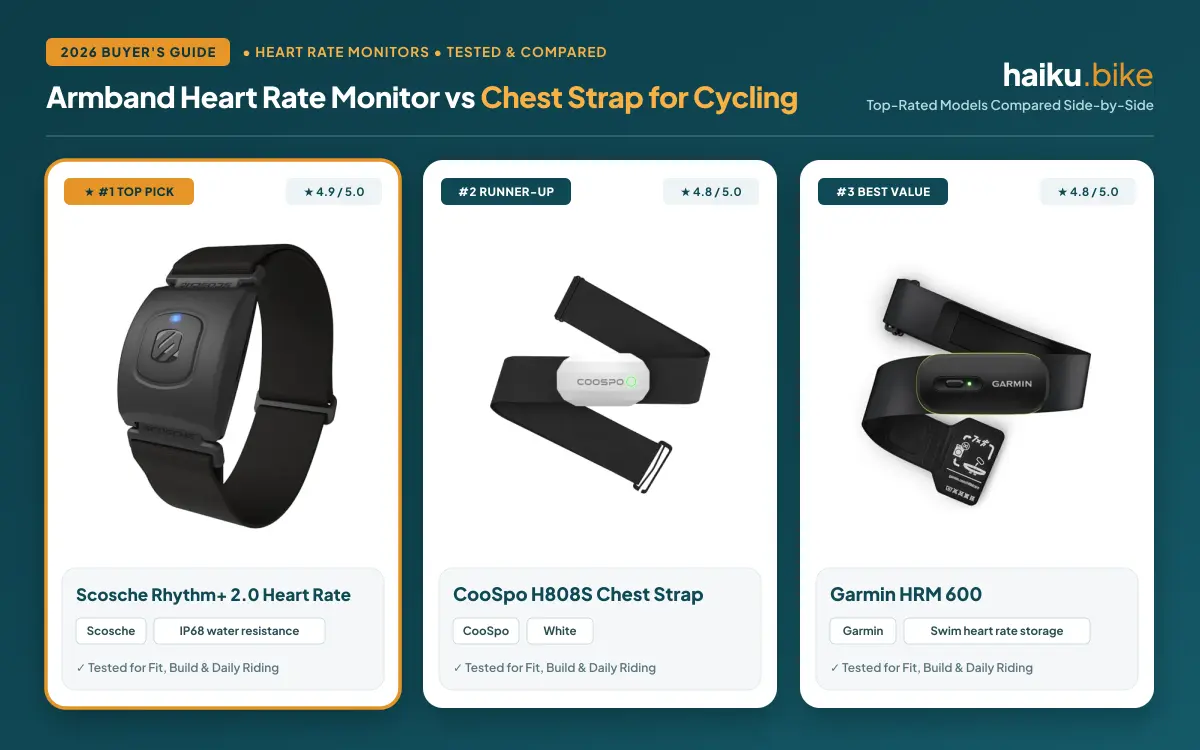
Follow the manufacturer’s positioning instructions and check that the strap remains secure while you move. A loose sensor may shift, while excessive tension may feel uncomfortable. Riders who dislike chest straps can compare the fit trade-offs in our guide to armbands and chest straps.
Battery Life and Charging
Battery specifications help you estimate how often a rechargeable armband needs attention between workouts. Compare the maker’s stated runtime with your ride schedule, and check whether the package or product details explain its charging method. Runtime figures are manufacturer claims, not a guarantee of identical results for every routine.
Scosche lists up to 24 hours of continuous battery life, Wahoo lists a 30-hour rechargeable battery, and COOSPO lists up to 35 hours. COROS lists 38 hours of full operation and 80 days of standby, with a magnetic cable recharge time of two hours. Polar battery information is not listed here.
Check charging requirements before your first ride, especially if the monitor uses a dedicated cable. COROS includes a USB charging cable but no Type-C adapter, according to its product information. Keep the charging instructions available, and do not assume that one model’s cable or adapter works with another.
Workout Features and Intended Use
Workout features determine whether a monitor supplies the cues and data you want during training. Compare live heart rate broadcasting, zone indicators, session recording, and recovery-related functions against the capabilities of your app or computer. A feature is useful only when your intended receiver or app supports the data.
COOSPO HW9 uses a five-color LED for heart rate zones and supports a vibration warning above a selected maximum heart rate. Scosche Rhythm+ 2.0 supports HRV mode and RRi data for compatible apps. Polar can record a session and transfer data to a phone later.
COROS says its monitor is designed for sports and activities rather than daily tracking, and automatic wear detection powers it on or off based on wear. Decide whether you need workout readings, in-session cues, or after-session transfer before buying. These functions differ, so do not treat them as interchangeable.
Weather Resistance and Care
Weather and care information helps you judge whether an armband suits the conditions in which you ride. Look for a stated water-resistance rating and follow the maker’s cleaning instructions. If a product description does not list a rating, treat that specification as unlisted rather than assuming rain protection.
Scosche lists an IP68 rating and describes its Rhythm+ 2.0 as suitable for sweat and rain. The other products in this comparison do not include a water-resistance rating in their stated features. COROS says its sensor can be removed for quick fabric-band cleaning.
Follow each maker’s care instructions before washing a strap or exposing its sensor to moisture. A rating on one product does not establish the same protection for another. If you ride in wet conditions, check the specific model’s instructions and listed rating before purchase.
Multi-Device Pairing and Data Handling
Multi-device pairing matters when you want one sensor to feed a bike computer and another compatible receiver. Check how many simultaneous connections the maker lists and whether those connections use Bluetooth, ANT+, or both. Then confirm that each receiver can accept heart rate sensor data.
COROS lists pairing with up to three devices, while COOSPO lists two simultaneous Bluetooth connections. Polar lists two simultaneous Bluetooth channels and limitless ANT+ connections. Wahoo and Scosche list both protocols, but simultaneous device counts are not listed in their product details here.
Polar also offers session recording with later transfer to a phone, which may suit workouts where a receiver is not used continuously. Verify the data path in your preferred app before buying. Device pairing counts do not confirm that every app can display or store every available data type.
How We Chose
We assess each armband with the Haiku Ride Score: core performance counts for 30%, build and weather resistance for 20%, ease of use for 20%, compatibility and battery for 15%, and value for 15%. Our comparisons consider manufacturer specifications, compatibility information, and long-term owner feedback where available.
We research and draft our guides with software tools, including AI, then run automated checks on product fit, sourcing, and our editorial rules. Our editor spot-checks guides rather than reading each one before publication. Our how we review page explains our evaluation approach and scoring criteria.
Price and Value: What Each Budget Gets You
Budget
Budget armbands can cover core workout heart rate tracking and common wireless connections without adding elaborate data features. Scosche Rhythm+ 2.0 offers Bluetooth, ANT+, and a stated 24-hour battery, while COOSPO HW9 adds zone lights and a vibration alert. Buyers may give up broader session-recording options or more detailed multi-device specifications, so confirm which functions matter.
Mid-Range
Mid-range options can balance everyday ride compatibility with useful wearing or pairing conveniences. Wahoo TICKR FIT includes two adjustable band sizes and lists Bluetooth and ANT+, while COROS adds wear detection and pairing with up to three devices. Riders may give up a wider set of data-handling choices, so compare the specific connection and recording features rather than relying on tier labels.
Premium
Premium armbands may offer more flexible data handling and a wider range of connection choices. Polar Verity Sense supports two simultaneous Bluetooth channels, ANT+ connections, live broadcasting, and session recording for later transfer. Riders pay for flexibility in how they capture workouts, but may not need those features if one compatible bike computer already records their sessions.
Choosing Something Else
A sports watch with a heart rate sensor may be enough for riders who already own one and only need workout readings. That approach avoids adding another strap and charging routine, but may not suit riders who want a separate sensor feeding a bike computer. Compare the watch’s receiver and app compatibility before deciding that an additional armband is unnecessary.
Final Thoughts
Polar Verity Sense – Optical Heart Rate Monitor suits riders who want flexible placement, dual Bluetooth channels, ANT+, and session recording for later transfer. Its broad data options may be more than a rider needs for a single bike computer, so confirm that your apps can use the features you plan to rely on.
Scosche Rhythm+ 2.0 Heart Rate Monitor Armband makes sense for riders seeking Bluetooth and ANT+ support, workout-focused HRV and RRi data, and a stated IP68 rating. COOSPO HW9 Heart Rate Monitor Bluetooth ANT may suit riders who value visible heart rate zones and a vibration warning. Both require checking app compatibility for their additional data features.
Wahoo TICKR FIT Armband Heart Rate Monitor offers dual-protocol connectivity and two adjustable bands. COROS Heart Rate Monitor, Auto-wear Detection suits Bluetooth users who want automatic wear detection and multi-device pairing, but riders with ANT+-only receivers should choose another option. Compare related heart rate monitor coverage and our gravel bike computer guide when planning your setup.
Skip an armband if your existing watch already records the workout data you need, or if the band format does not suit your preferred fit. Riders who need daily tracking should choose a device designed for that purpose. Before buying, verify receiver compatibility, band placement, charging requirements, and the maker’s intended use.
FAQs
Can an armband heart rate monitor connect to a bike computer?
An armband heart rate monitor can connect to a bike computer when both support a shared heart rate sensor protocol. Several models here list Bluetooth and ANT+, while COROS Heart Rate Monitor, Auto-wear Detection uses Bluetooth only. Check your computer’s instructions for sensor compatibility, then pair the devices and confirm that the computer receives readings.
Do armband heart rate monitors support ANT+?
Some armband heart rate monitors support ANT+, but COROS Heart Rate Monitor, Auto-wear Detection does not. Polar Verity Sense, Wahoo TICKR FIT, Scosche Rhythm+ 2.0, and COOSPO HW9 list ANT+ connectivity. Check the specifications for your exact model and receiver, because a Bluetooth-only sensor will not serve an ANT+-only computer.
Where should I wear an armband heart rate monitor?
An armband heart rate monitor should be worn in the position specified by its manufacturer, with the sensor placed securely against skin. Polar lists upper-arm or lower-arm placement, and Scosche lists forearm, bicep, or tricep placement. Follow the model’s fit instructions and adjust the band so it stays secure without distracting pressure during exercise.
How long do armband heart rate monitor batteries last?
Armband heart rate monitor battery life varies by model and use. Scosche lists up to 24 hours, Wahoo lists 30 hours, and COOSPO lists up to 35 hours. COROS lists 38 hours of full operation and 80 days of standby. Follow each maker’s charging instructions, since runtime claims are not identical across products.
Are armband heart rate monitors waterproof?
Armband heart rate monitor water protection depends on the specific model. Scosche Rhythm+ 2.0 lists an IP68 rating, while water-resistance ratings are not listed for the other products in this guide. Check the maker’s instructions before riding in rain or cleaning a sensor, and do not assume another model shares Scosche’s stated rating.
Can an armband monitor track heart rate all day?
An armband monitor’s suitability for all-day heart rate tracking depends on its stated purpose. COROS says its monitor is designed for sports and activities, not daily tracking. Check the maker’s description for any model you consider, and choose a device intended for continuous daily data if that is your goal.
Which Best Armband Heart Rate Monitor features matter in 2026?
Important Best Armband Heart Rate Monitor features in 2026 include receiver compatibility, secure fit, battery information, and intended use. Riders may also value zone cues, session recording, or simultaneous pairing, depending on their setup. Compare the features against your computer and apps, and browse our Bike Computers & GPS category for related equipment coverage.

Write Your Review
No reviews yet. Be the first to share your experience!