

An eight-year-old may be ready for a first geared bike, a simpler neighborhood model, or a bicycle with training wheels. The right choice depends on height, inseam, balance, brake reach, and where the child rides, not age alone. The bikes here range from 18-inch to 20-inch wheels, with different brake layouts and riding features.
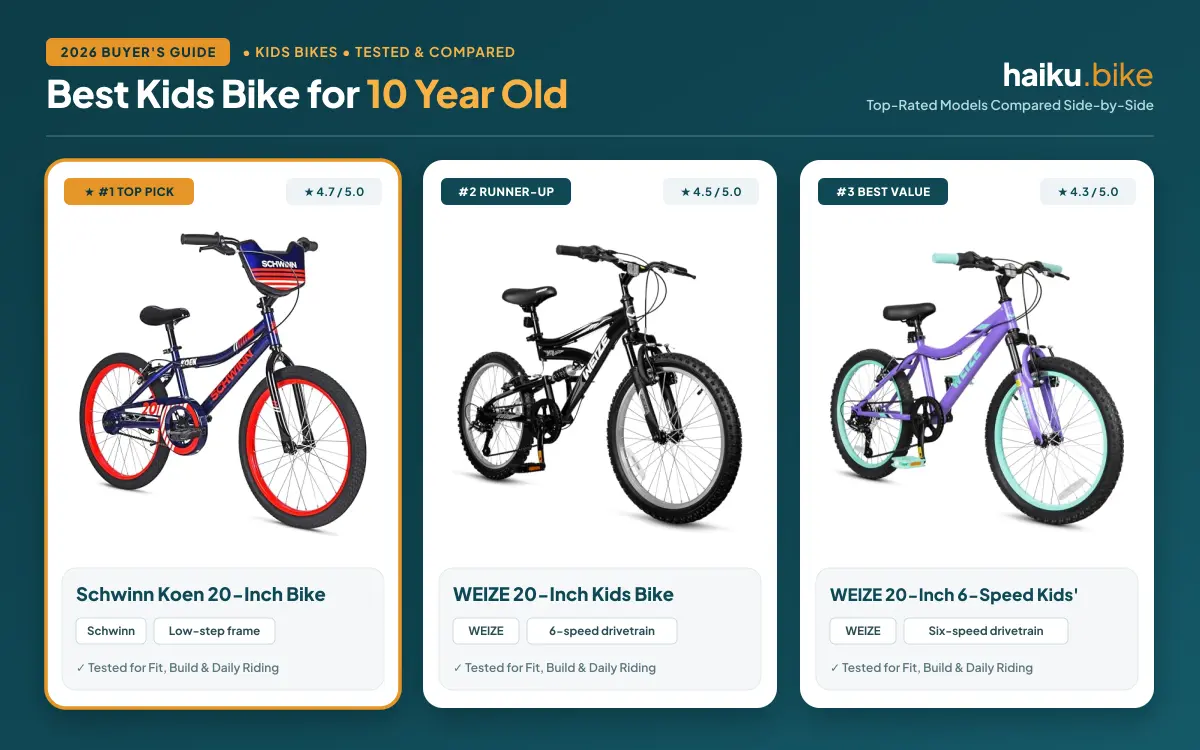
We compare 7 options from RoyalBaby, Huffy, JOYSTAR and more for families weighing fit, control, and assembly. Follow the manufacturer’s instructions and local laws, and check that any bicycle helmet meets CPSC 16 CFR Part 1203. For more age-specific guidance, see our guide to bikes for ten-year-olds.
At a Glance: Which One Fits You
- Best overall: Schwinn Elm 20-Inch Bike for Kids Ages 7-10 earns this spot because its low-step frame, dual brakes, and stated rider-height range support a confident transition to a larger bike.
- Best value: WEIZE 20 Inch Kids Bike for Boys, Ages 7-13 earns this spot because its tool-free seat adjustment and hand and coaster brakes suit everyday riding.
- Best for rougher paths: Glerc 20 Inch Kids Mountain Bike for Boys earns this spot because it combines a suspension fork, disc brakes, and 21 speeds.
- Best for newer riders: Huffy 20" Upshot Boys’ Bike, Ages 5-9 Years Old earns this spot because its coaster brake and single-speed setup keep controls straightforward.

Pros
- Rear coaster and hand brakes
- Tool-free adjustable seatpost
- Low-step frame
- Kid-sized touchpoints
- Kickstand included
Cons
- 25.87 lb bike weight
- Rear hand brake only
- Rider height range limited to 47 to 53 inches

Pros
- Hand brake and coaster brake
- Tool-free saddle adjustment
- Adjustable handlebar
- Enclosed chain guard
- Kickstand included
Cons
- No training wheels included
- Riders must already balance independently
- Who should skip it: riders outside the recommended height range

Pros
- Rear coaster brake
- Adjustable padded saddle
- EZ Build assembly system
- Limited lifetime frame warranty
Cons
- Only coaster brake described
- Fit limited to 44 to 56 inches
- Who should skip it: riders outside stated height range

Pros
- Front caliper and rear coaster brakes
- Wide 2.4-inch pneumatic tires
- 95% assembled, tools included
- Bell and DIY decals included
- Seat handle for lifting
Cons
- 27 lb may be heavy to lift
- Only 18-inch size listed here
- Who should skip it: children who need another bike size

Pros
- 21-speed drivetrain
- Front suspension fork
- Disc brakes
- Clear height and inseam guidance
- High-carbon steel frame
Cons
- 30 lb bike weight
- Fit limited to listed height and inseam ranges
- Who should skip it: riders outside listed fit range

Pros
- Front hand brake and rear coaster brake
- Training wheels included
- Adjustable seat and handlebars
- Single-speed drivetrain
- Basket and kickstand included
Cons
- 26.5 lb weight
- Adult assembly required
- Who should skip it: riders seeking a lighter bike

Pros
- Training wheels included
- Front and rear V-brakes
- Adjustable seat and handlebars
- Kickstand included
- Tools included for assembly
Cons
- Single-speed drivetrain
- Front wheel, pedals, handlebar, kickstand, and saddle need installation
- Who should skip it: children outside the stated height range
Side-by-Side Comparison
| Bike | Wheel size and fit guidance | Brakes | Gearing | Suspension or added features | Assembly |
|---|---|---|---|---|---|
| Schwinn Elm 20-Inch Bike for Kids Ages 7-10 | 20 inches; 47 to 53 inches tall | Rear coaster and hand brake | Not listed | Low-step frame; adjustable seatpost; kickstand and handlebar bag | One-tool assembly |
| WEIZE 20 Inch Kids Bike for Boys, Ages 7-13 | 20 inches; 48 to 62 inches tall | Hand and coaster brakes | Not listed | Five-inch tool-free seat adjustment; enclosed chain guard | 85% pre-assembled |
| Huffy 20" Upshot Boys’ Bike, Ages 5-9 Years Old | 20 inches; 44 to 56 inches tall | Coaster brake | Not listed | Adjustable padded saddle | EZ Build system |
| RoyalBaby Freestyle Kids Bike | 18-inch version; use maker’s size chart | Front caliper and rear coaster | Not listed | 2.4-inch tires; bell; handle and chainguard | 95% assembled |
| Glerc 20 Inch Kids Mountain Bike for Boys | 20 inches; 45 to 55 inches tall; 21 to 25-inch inseam | Disc brakes | 21-speed | Front suspension fork; 30 lb | Not listed |
| JOYSTAR Fantasy 20 inch Kids Bike with Training | 20 inches; 47 to 62 inches tall | Front hand and rear coaster | Single speed | Training wheels; basket; adjustable handlebar and seat | 85% assembled |
| AVASTA Bilbo 18 Inch Kids Road Bike for Boys Girls | 18-inch version; 41 to 53 inches tall | Front and rear V-brakes | Single speed | Training wheels included with 18-inch size | 85% assembled |
Fit guidance and brake type create the most consequential differences. The Glerc lists both height and inseam ranges, while the Schwinn gives a narrower height range and a low-step frame. Families should still check actual standover clearance, saddle position, and brake reach with the child before deciding.
Common Mistakes to Avoid
Choosing by age alone can leave a child unable to reach the ground or controls comfortably. The listed bikes span different wheel sizes and height ranges, so compare the maker’s guidance with the child’s height and inseam. Have the rider stand over the frame and reach both brake controls before purchase.
Assuming more gears or suspension always helps can create a poor match for neighborhood riding. The Glerc has 21 speeds and a suspension fork, while the Huffy uses a coaster brake and a simpler setup. Match features to the child’s experience and usual surfaces, rather than treating a longer feature list as an automatic advantage.
Families can also underestimate assembly and brake adjustment. The WEIZE, RoyalBaby, JOYSTAR, and AVASTA describe partial assembly, but none should be treated as ready to ride without following its maker’s instructions. An adult should confirm that fasteners, wheels, saddle, and brakes are secure and working before the first ride.
Best Kids Bike for 8-Year-Old: Buying Guide
Fit, Wheel Size, and Standover
Fit matters more than birthday because a child needs room to control the bike and reach its controls. The options include 18-inch and 20-inch wheels, but wheel size alone cannot confirm that a frame suits an individual rider. Use the manufacturer’s height and inseam guidance as a starting point, not a final fit decision.
Check that the child can stand over the frame and reach the handlebars and brake levers without stretching. The Glerc lists an inseam range, while the Schwinn lists a rider-height range and a low-step frame. The WEIZE offers tool-free seat adjustment, but adjustability cannot fix a frame that is fundamentally too large or small.
Ask the child to sit on the bike and place hands naturally on the grips. The saddle should allow a comfortable pedaling position while leaving the rider able to mount, dismount, and control the bike. If a listing lacks a measurement you need, ask the maker or seller instead of buying a larger size for future growth.
Brake Type and Lever Reach
Brake choice matters when a young rider must slow down predictably and operate controls comfortably. Several bikes pair a hand brake with a rear coaster brake, including the Schwinn, WEIZE, RoyalBaby, and JOYSTAR. The Huffy lists a coaster brake, while the AVASTA lists front and rear V-brakes and the Glerc lists disc brakes.
A brake label does not show whether a child can reach or squeeze a lever. Before regular riding, confirm that the rider understands each control and can operate it while keeping a secure grip. Practice stopping in a safe, open area under adult supervision, and follow the manufacturer’s setup and maintenance instructions.
Brake arrangements can affect a child moving from a balance bike or a coaster-brake bicycle. A hand brake adds a control to learn, while a coaster brake requires backward pedal pressure. Choose a layout the child can manage, and do not assume that two braking systems automatically make a bike easier for every rider.
Gearing and Riding Terrain
Gearing changes how a child pedals as the route rises, falls, or levels out. The Glerc lists 21 speeds, while the JOYSTAR and AVASTA list single-speed drivetrains. Several other bikes do not specify gearing. A geared bike may offer more options, but it also asks a young rider to learn shifting.
For flat sidewalks and short neighborhood trips, a single-speed bike can keep operation simple. Riders facing hills may value multiple gears if they can shift while maintaining attention and control. Product descriptions do not provide gear ratios for these models, so the number of speeds alone cannot tell you how easy a climb will feel.
Ask the child to learn the shifter in a stationary setting and practice on easy terrain before approaching hills. Families comparing a simpler bike for a younger rider can also read our guide to bikes for six-year-olds. The rider’s current ability should set the pace for adding controls.
Suspension, Tires, and Route Surface
Suspension and tire design matter most when a child regularly rides uneven surfaces. The Glerc lists a front suspension fork, and the WEIZE describes wide tires intended for neighborhood streets and paved park paths. The remaining listed features vary, so consider the surfaces the child actually rides rather than the bike’s label.
A child using smooth paths may benefit more from manageable fit and simple controls than a suspension feature. A rider on rougher routes may appreciate a fork intended to absorb bumps, but the product description does not establish how it will feel for every rider. Check the maker’s guidance and consider whether added features suit the route.
Tire width can affect cushioning and stability, but it does not replace good fit or careful riding. The WEIZE specifies 2.125-inch tires, and the RoyalBaby specifies 2.4-inch tires. Choose based on the intended surface and the full bicycle setup, not one measurement alone.
Assembly and Routine Checks
Assembly quality matters because wheels, brakes, handlebars, and the saddle must be secured correctly before a child rides. The RoyalBaby says it arrives 95% assembled; the WEIZE, JOYSTAR, and AVASTA each describe 85% assembly. The Schwinn describes one-tool assembly, while the Glerc does not list assembly details.
Partial assembly still requires an adult to follow the maker’s instructions and check each listed component. Do not assume that included tools or a quick-build design remove the need to confirm that the bike is correctly assembled. If a step or adjustment is unclear, ask a qualified bicycle mechanic for help.
Before rides, follow the maker’s guidance for checking tire inflation, brakes, and fasteners. A kickstand, chain guard, or assembly video can be useful, but none replaces routine attention to the bike’s condition. Store the bicycle as directed and address loose or misaligned parts before the child rides again.
Rider Confidence and Added Features
Confidence and experience determine whether a child benefits from extra features or a simpler bicycle. The JOYSTAR includes training wheels, while the WEIZE is described for riders who can already balance independently. The Schwinn’s low-step frame is intended to make mounting easier, and the Huffy keeps its listed braking setup straightforward.
Training wheels do not replace a correct frame fit or adult supervision. If a child has learned to balance, a bike with training wheels may not suit the next step in skill development. Conversely, a child who is not yet comfortable balancing should not be rushed onto a bicycle simply because its age range appears appropriate.
Consider whether a basket, bell, kickstand, or adjustable seat will matter in everyday use. These features can add convenience, but they should not outweigh fit, reach, and control. Families can compare broader styles in our Kids Bikes coverage before narrowing the choice.
How We Chose
We evaluate children’s bikes with the Haiku Ride Score: core performance 30%, build and weather resistance 20%, ease of use 20%, compatibility and battery 15%, and value 15%. Battery and electronic compatibility do not apply to these non-electric bicycles, but the shared framework keeps our comparisons consistent across categories.
Our evaluation draws on manufacturer specifications, compatibility information, and long-term owner feedback when available. We research and draft our guides with software tools, including AI, then run automated checks on product fit, sourcing, and our editorial rules. Our editor spot-checks guides rather than reading each one before publication. Our how we review page explains our approach.
Price and Value: What Each Budget Gets You
Budget
At the budget end, families can prioritize a straightforward riding setup, steel construction, and basic fit adjustment. The WEIZE includes a tool-free adjustable saddle, hand and coaster brakes, and a chain guard. Buyers may give up features such as suspension or multiple gears, which can be unnecessary for short rides on smooth paths.
Mid-Range
Mid-range choices can add convenience or broader riding features while retaining familiar steel construction. The Schwinn combines a low-step frame with dual brakes and one-tool assembly, while the Huffy uses a simple coaster brake and EZ Build system. Families may give up multi-speed gearing or suspension, depending on the bike selected.
Premium
Higher-tier options in this guide add features such as more gears, wider tires, or more involved braking systems. The Glerc lists a 21-speed drivetrain, disc brakes, and front suspension; the RoyalBaby highlights wide tires and a high assembly percentage. Buyers may take on added weight or more controls, so match those features to rider skill and route.
Choosing Something Else
A balance bike or a simpler single-speed children’s bike may suit a child who is still learning basic balance or mainly rides smooth, short routes. A family can also postpone a larger bicycle if the child cannot reach the controls or stand over the frame comfortably. Revisit sizing when the rider is ready, rather than buying a bike to grow into.
Final Thoughts
The Schwinn Elm 20-Inch Bike for Kids Ages 7-10 suits a rider within its stated height range who values a low-step frame and dual brakes. Its trade-off is that the maker does not list gearing. The WEIZE 20 Inch Kids Bike for Boys, Ages 7-13 suits an independently balancing rider who wants an adjustable seat and hand and coaster brakes, but its stated height range is broad enough to require a careful fit check.
The Glerc 20 Inch Kids Mountain Bike for Boys may fit confident riders who want multiple gears and a suspension fork, though its listed weight is 30 lb. The Huffy 20" Upshot Boys’ Bike, Ages 5-9 Years Old keeps operation simple with a coaster brake, but it does not list hand brakes or gears. Each choice still depends on whether the child can reach and control it.
The RoyalBaby Freestyle Kids Bike emphasizes wide tires and assembly guidance, but its 18-inch size should be checked against the maker’s chart. The JOYSTAR Fantasy 20 inch Kids Bike with Training adds training wheels and a basket, but its single-speed setup may not suit every rider. The AVASTA Bilbo 18 Inch Kids Road Bike for Boys Girls offers V-brakes and training wheels in its 18-inch version, but families should confirm that size suits the child.
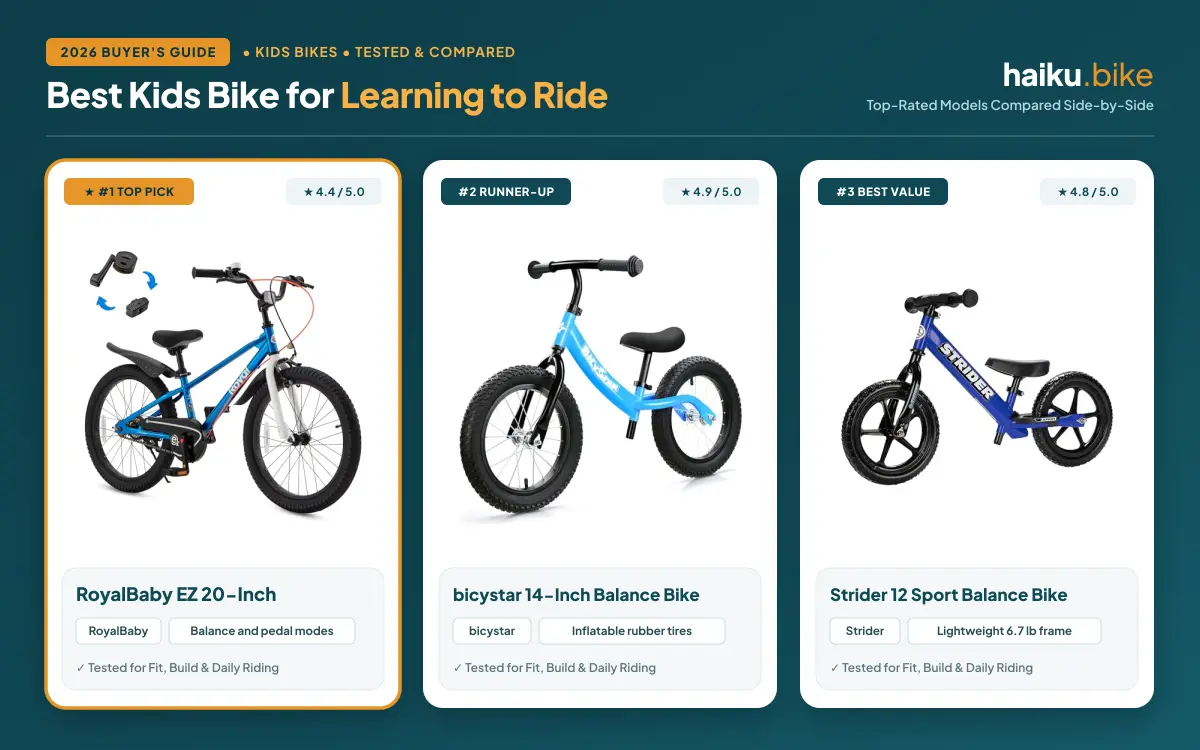
Skip these options if the child cannot stand over the frame, reach the controls, or manage the bike’s braking setup. A smaller or simpler bicycle may fit better. Compare alternatives in our guide to bikes for learning to ride and the wider Bikes & E-Bikes category.
FAQs
What size bike does an eight-year-old need?
An eight-year-old may fit an 18-inch or 20-inch bike, but age alone cannot determine the right size. Compare the child’s height and inseam with the maker’s fit guidance, then check standover clearance, handlebar reach, and brake access. A child should be able to control the bicycle comfortably before riding it regularly.
Is a 20-inch bike suitable for an eight-year-old?
A 20-inch bike can suit some eight-year-olds, depending on frame fit and the rider’s proportions. The bikes in this guide list different height ranges, so compare those figures with the child’s height and check the actual fit. The rider should reach the controls and mount and dismount without struggling.
Should an eight-year-old use hand brakes or a coaster brake?
An eight-year-old should use a brake layout the child can reach, understand, and operate reliably. A coaster brake engages when the rider pedals backward, while a hand brake uses a lever. Some bikes combine both types. Practice stopping in a safe area and follow the maker’s instructions before regular riding.
Does an eight-year-old need gears on a bike?
An eight-year-old does not automatically need gears; route and experience matter. A single-speed bicycle can simplify riding on relatively flat paths, while gears may offer more options on changing terrain. A child needs to learn shifting without losing control. Product descriptions do not provide gear ratios for every bike here.
Are training wheels appropriate for an eight-year-old?
Training wheels may suit an eight-year-old who is still developing riding confidence, but they are not necessary for every child. The JOYSTAR and the 18-inch AVASTA include training wheels. Consider the rider’s current balance and experience, and choose a bicycle that fits properly rather than relying on training wheels to compensate for poor sizing.
Which of the Best Kids Bike for 8-Year-Old in 2026 is easiest to assemble?
The RoyalBaby Freestyle Kids Bike has the clearest assembly claim, with the maker describing it as 95% assembled and including tools and instructions. The Schwinn describes one-tool assembly, while other models list partial assembly or an EZ Build system. Adults should follow the specific instructions and confirm the bicycle is secure before the first ride.
What helmet standard should I look for with a kids’ bike?
A bicycle helmet sold for use in the United States should meet CPSC 16 CFR Part 1203. Check the product listing and helmet labeling for certification, then follow the maker’s fit and use instructions. Helmet certification applies to the helmet, not the bicycle, and the helmet must fit the child appropriately.
Where can I compare bikes for younger children?
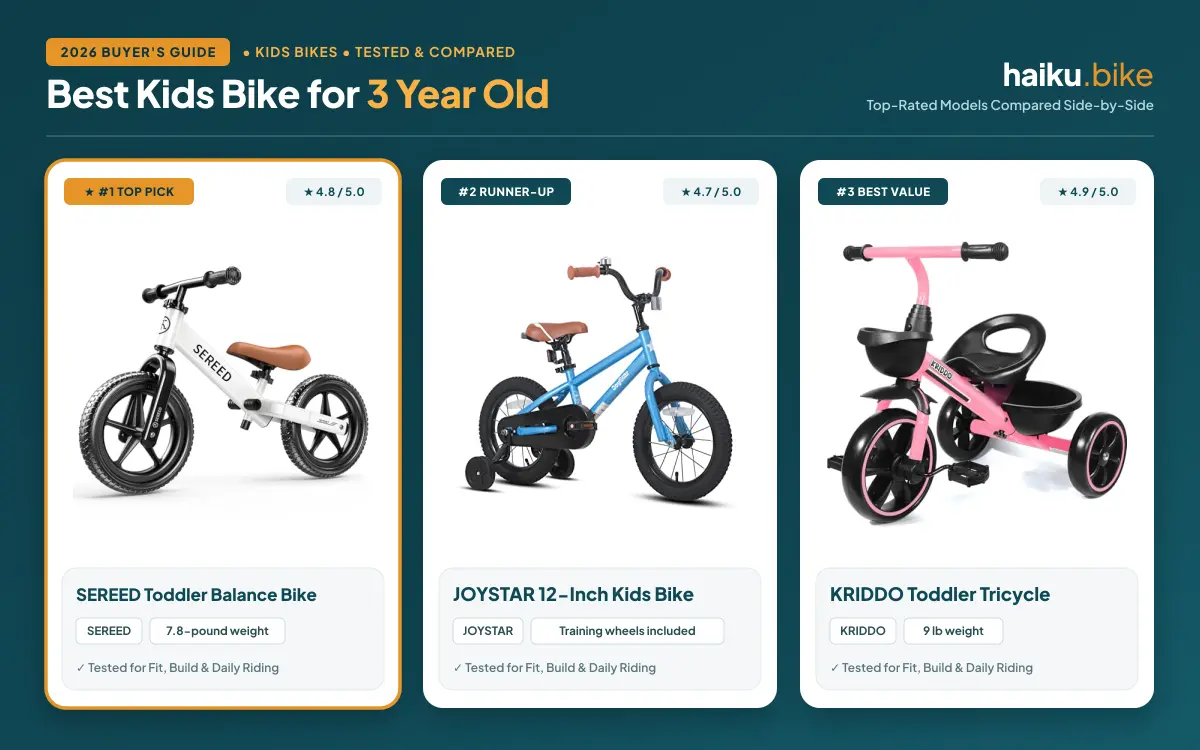
Families comparing bikes for younger children can use age-specific guides as a starting point, then confirm fit for the actual rider. Our guide to bikes for three-year-olds covers a different stage of riding. Check each maker’s sizing guidance, because children of the same age can need different frame sizes.
Write Your Review
No reviews yet. Be the first to share your experience!