

Toddlers need a tricycle that fits their size and current riding skills, while parents may want steering support for supervised walks. The options in this guide range from multi-mode designs with parent controls to a classic tricycle for children ready to pedal independently.
Safety note: Children’s bicycles sold in the United States must meet the CPSC bicycle requirements (16 CFR Part 1512), every rider should wear a helmet certified to the CPSC bicycle helmet standard (16 CFR Part 1203), and an adult or bike shop should confirm fit, assembly, and brakes. Follow the manufacturer’s instructions and local laws. We compared 5 tricycles from Radio Flyer, newyoo, RIDYEE and more for November 2026; our cycling gear guides cover other family riding essentials.
At a Glance: Which One Fits You
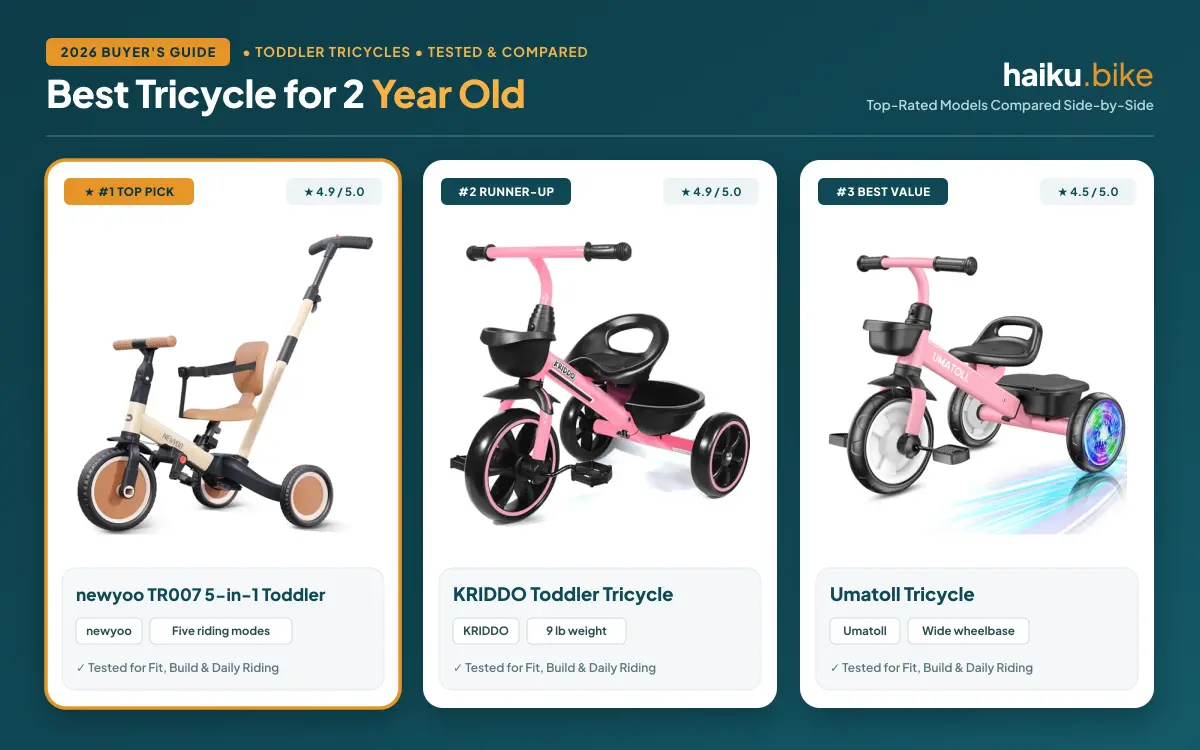
- Best overall: newyoo TR007 5-in-1 Tricycle for Toddlers 1-3 offers five riding modes, adjustable components, and a steering push handle.
- Best value: SEREED 5-in-1 Push Tricycle for Toddlers 1-4 combines tool-free mode changes, adjustable fit, and parent steering.
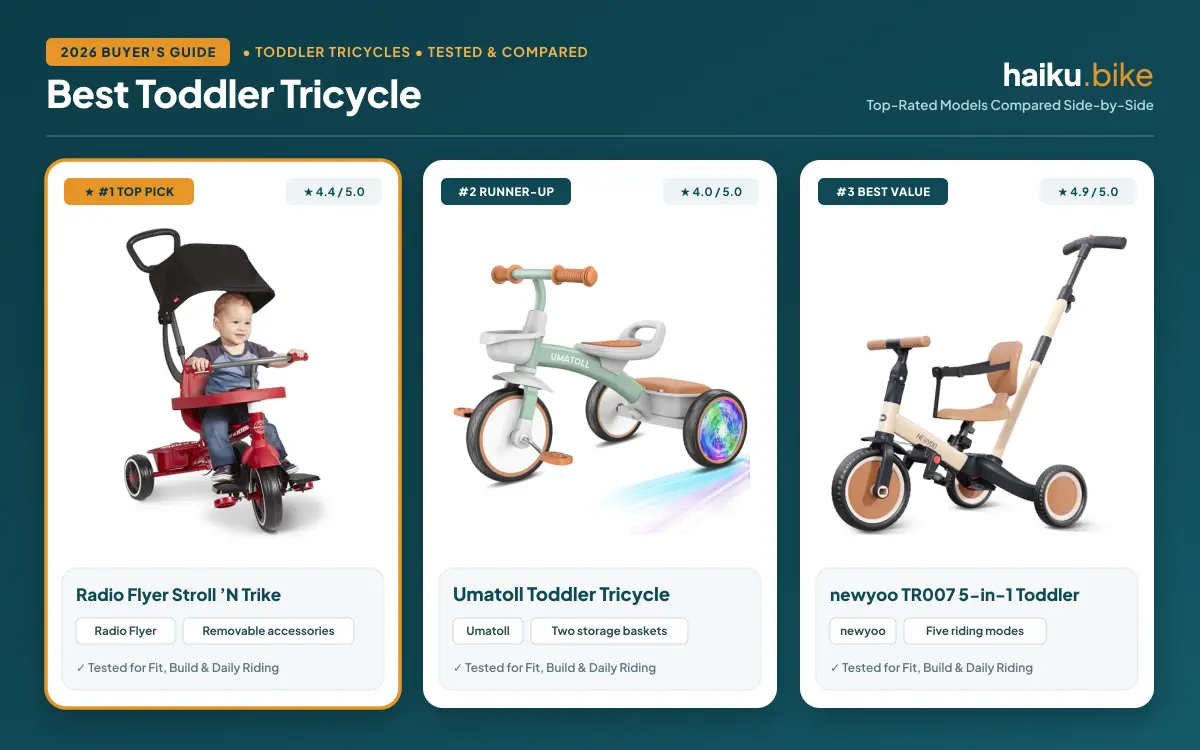
- Best for parent-led outings: Radio Flyer 4-in-1 Pedal & Push Stroll ’N Trike includes a canopy, seat belt, tray, and removable parent handle.
- Best for extended stages: RIDYEE 8-in-1 Toddler Tricycle Ages 1.5-5 offers tool-free mode switching, reversible seating, and removable harness options.

Pros
- Five riding modes
- Parent steering handle
- Adjustable seat and handlebar
- Solid EVA wheels
- 9.7 lb weight
Cons
- Listed only for ages 1 to 3
- Listed height limit of 43.3 inches
- No reviews provided

Pros
- Multiple riding modes
- Parent steering control
- Reversible seat
- Two harness options
- Canopy with mesh window
Cons
- 15.7 lb listed weight
- No safety certification specified
- Skip for children over age 5

Pros
- Four riding stages
- Adjustable UV canopy
- Parent-controlled steering
- Removable accessories
- High-density foam tires
Cons
- 13.7 lb listed weight
- 36 inches long

Pros
- Five riding modes
- Detachable parent steering handle
- Adjustable seat and handlebar
- Tool-free adjustments
- 12 lb aluminum build
Cons
- Product details do not list age limits by riding mode
- No safety certification listed
- Who should skip it: families seeking a standard pedal bike

Pros
- Adjustable seat
- Stable three-wheel design
- Steel frame
- Bell and tassels included
- Designed for ages 2 to 4
Cons
- Adult assembly required
- Adult supervision required
- Who should skip it: children outside ages 2 to 4
Side-by-Side Comparison
| Tricycle | Stated ages | Modes or stages | Parent control | Notable features |
|---|---|---|---|---|
| newyoo TR007 5-in-1 Tricycle for Toddlers 1-3 | 1 to 3; under 43.3 inches | Five modes | Rotating, adjustable steering push handlebar | Carbon steel frame, EVA wheels |
| RIDYEE 8-in-1 Toddler Tricycle Ages 1.5-5 | 1.5 to 5 | Eight modes | Two-height push handle and steering clutch | Reversible seat, removable harness and guardrail |
| Radio Flyer 4-in-1 Pedal & Push Stroll ’N Trike | 1 to 5 | Four stages | Height-adjustable removable push handle | Canopy, tray, headrest, seat belt, footrest |
| SEREED 5-in-1 Push Tricycle for Toddlers 1-4 | 1 to 4 | Five modes | Detachable, height-adjustable steering handle | Aluminum frame, tool-free adjustments |
| Flybar Classic Retro Tricycle For Toddlers Ages | 2 to 4 | Not listed | Not listed | Steel frame, adjustable seat, bell |
Parent control and riding-stage flexibility create the clearest differences among these tricycles. Families who want help steering can compare the adjustable handles on newyoo, RIDYEE, Radio Flyer, and SEREED, while Flybar suits riders seeking a simpler pedal tricycle.
Common Mistakes to Avoid
Choosing by age alone can lead to a poor fit because children vary in height and ability to reach pedals and handlebars. The newyoo TR007 has a stated height limit, and the other makers provide age guidance; compare those limits with your child and check the instructions before purchase.
Assuming every parent handle steers in the same way can create confusion during use. newyoo describes a rotating steering handlebar, RIDYEE lists a steering clutch, and Radio Flyer and SEREED describe parent push handles. Read each maker’s instructions to understand how adult control works.
Overlooking assembly and protective equipment is another avoidable mistake. Assemble each tricycle according to its instructions, inspect the finished ride, and confirm the child can sit securely and reach controls. Check helmet certification and fit, and keep an adult close during every ride.
Buying extra modes without considering daily use can also lead to a poor match. RIDYEE and newyoo list several configurations, but each transition still needs to suit the child’s stage and the family’s routine. Compare the adjustment steps and included accessories before deciding which features matter.
Best Toddler Tricycles Under $100: Buying Guide
Fit, Age Range, and Reach
Fit determines whether a child can sit securely and reach the tricycle’s controls comfortably. Treat the maker’s age range as guidance rather than a guarantee, and compare your child’s size with any stated height limit or fit instructions.
newyoo lists the TR007 for children ages 1 to 3 who are under 43.3 inches. Radio Flyer describes stages from toddler trike through classic trike for ages 1 to 5, while Flybar lists ages 2 to 4. Check each product’s current instructions for configuration-specific fit.
Seat and handlebar adjustment can help accommodate a growing child, but adjustment range is not specified for every option. Before ordering, check whether the child can reach the pedals in the intended mode and whether the seat and handlebars can be positioned appropriately.
Parent Steering and Supervision
Parent steering matters when an adult needs to guide a toddler during early rides. Check whether the handle steers the tricycle, assists with pushing, or offers a way to switch between adult and child control.
newyoo describes a rotating handlebar that controls steering and speed, while RIDYEE uses a clutch system for parent or child steering. Radio Flyer and SEREED list adjustable parent handles. Those descriptions differ, so consult the manufacturer’s instructions to understand operation before a child rides.
A parent handle does not replace close supervision. Choose a flat, open riding area away from traffic, driveways, steep slopes, and other hazards. Stay close enough to respond, and follow the manufacturer’s age and use guidance even when an adult controls the tricycle.
Modes and Adjustability
Multiple riding modes let a tricycle change as a child moves from adult-assisted outings toward independent riding. The number of modes matters less than whether the available configurations match your child’s abilities and are practical for your household to change.
newyoo lists five modes, including push tricycle, balance bike, and bike modes, with adjustable handlebars, seat, and pedal positions. SEREED also lists five modes and tool-free adjustments. RIDYEE describes eight configurations and tool-free changes, while Radio Flyer offers four stages.
Ask how each configuration changes, which parts must be removed, and whether the instructions clearly explain the transition. More modes can add flexibility, but a simpler tricycle may suit families who expect to use one primary setup rather than switch frequently.
Harnesses, Seat Support, and Accessories
Seat support and accessories affect how a tricycle is configured for supervised outings. RIDYEE lists a reversible seat, removable three-point and five-point harnesses, a guardrail, and two footrest options. Radio Flyer lists a seat belt, headrest, tray, canopy, footrest, and parent handle.
Check what the manufacturer includes and how accessories attach or come off as a child gains independence. A canopy may be useful on sunny walks, while a tray or footrest may matter to some families. Do not assume an accessory replaces supervision or protective equipment.
newyoo, SEREED, and Flybar emphasize different combinations of riding modes, construction, or simple riding features. Their listed details do not establish that they include the same restraint or comfort accessories as RIDYEE and Radio Flyer. Verify the exact configuration before choosing.
Construction, Wheels, and Riding Surface
Frame and wheel details help explain how a tricycle is built, but they do not establish suitability for every surface. newyoo lists a carbon steel frame and EVA wheels, SEREED lists an aluminum build, and Flybar lists a steel frame.
Radio Flyer specifies high-density foam tires, while the other products do not provide the same wheel description here. Consider where a child will ride, such as a smooth sidewalk or backyard, and check the maker’s instructions for intended use and care.
Check the frame and moving parts regularly according to the manufacturer’s maintenance guidance. Do not infer that a material or wheel label makes rough terrain appropriate. Stop using a tricycle if a part appears damaged or loose, and contact the manufacturer for guidance.
Assembly and Safety Information
Assembly instructions and safety information help adults prepare a tricycle for supervised use. Check the product listing and maker’s documents for age guidance, warnings, assembly steps, and any stated certification, rather than treating a feature description as proof of compliance.
newyoo states EN188 and ASTM approval for the TR007, but confirm current certification details with the manufacturer. The published product descriptions do not establish certification for the other tricycles. Children’s bicycles sold in the United States must meet CPSC requirements under 16 CFR Part 1512.
Use a helmet certified to the CPSC bicycle helmet standard, 16 CFR Part 1203, and follow its fitting instructions. An adult or bike shop should confirm fit, assembly, and brakes. Review the bike safety gear guidance alongside the tricycle maker’s instructions.
How We Chose
We score each option with the Haiku Ride Score: core performance 30%, build and weather resistance 20%, ease of use 20%, compatibility and fit 15%, and value 15%. For toddler tricycles, compatibility and fit means considering stated age or height guidance, adjustability, riding modes, and parent-control features.
We evaluate manufacturer specifications, fit information, and long-term owner feedback where available. We research and draft our guides with software tools, including AI, then run automated checks on product fit, sourcing, and our editorial rules. Our editor spot-checks guides rather than reading each one before publication. Our how we review page explains our method.
Price and Value: What Each Budget Gets You
Budget
At the lower end of this guide’s budget, buyers can find multi-mode designs with adjustable components and parent steering. SEREED pairs tool-free adjustments with an aluminum build, while Flybar takes a simpler classic-tricycle approach with a steel frame and adjustable seat. Buyers may give up the extensive seat accessories or multiple parent-control features found on other options.
Mid-Range
Mid-range choices in this guide add combinations of riding stages, steering assistance, and comfort features. newyoo offers five modes and adjustable parts, while Radio Flyer combines four stages with removable accessories, including a canopy and footrest. Compare the exact mode changes and accessories, because a longer feature list helps only when your family will use it.
Premium
At the upper end of this guide’s budget, RIDYEE emphasizes an eight-mode setup, reversible seating, removable harnesses, a guardrail, and an oversized canopy. Those features may suit families seeking several parent-assisted configurations. Buyers who want a basic independent pedal tricycle may not need the added parts and adjustment options.
Choosing Something Else
A balance bike may suit a child who is ready to practice balancing without pedals, while a simple ride-on toy can work for short supervised play. Either alternative may be easier to store or manage than a multi-mode tricycle. Check age guidance, fit, assembly instructions, and safety information before choosing another ride.
Final Thoughts
Families who want one tricycle to shift between assisted and more independent riding should consider the newyoo TR007 5-in-1 Tricycle for Toddlers 1-3. Its five modes, adjustable components, and steering handle offer flexibility, but its stated age and height guidance still needs to match the child.
For families who value parent-led outings and included accessories, the Radio Flyer 4-in-1 Pedal & Push Stroll ’N Trike combines four stages with a canopy, tray, headrest, seat belt, and footrest. The RIDYEE 8-in-1 Toddler Tricycle Ages 1.5-5 offers more configuration options and removable harnesses, but its additional features may be unnecessary for simpler needs.
Choose the SEREED 5-in-1 Push Tricycle for Toddlers 1-4 if tool-free adjustments and parent steering fit your priorities. The Flybar Classic Retro Tricycle For Toddlers Ages may suit a child ready for a more traditional pedal tricycle, though parent-control details are not listed. Browse our bike accessory guide for other family ride essentials.
Skip these tricycles if your child is outside the maker’s age or fit guidance, or if you need a balance bike or another type of ride. A multi-mode tricycle is not automatically a better match than a simple option. Confirm fit, intended use, assembly, and safety information before buying.
FAQs
What age can a toddler start riding a tricycle?
A toddler can start using a tricycle when the product’s age and fit guidance suit the child. The options here list different age ranges, from starting around age 1 to starting at age 2. Check the maker’s instructions, confirm the child can sit securely and reach controls, and supervise every ride.
How do I choose the right tricycle size for my toddler?
The right toddler tricycle size lets the child sit securely and reach the pedals and handlebars in the intended mode. Compare the maker’s age and height guidance with your child’s fit, rather than relying on age alone. The newyoo TR007 lists a maximum height, and buyers should check other makers’ current fit instructions.
Do toddler tricycles need parent steering?
Parent steering can help an adult guide a toddler who is not ready to control a tricycle independently. newyoo describes a steering handlebar, RIDYEE lists a steering clutch, and Radio Flyer and SEREED include parent handles. Compare how each system operates, and remember that adult steering does not replace close supervision.
Should my toddler wear a helmet on a tricycle?
A child should wear a properly fitted helmet certified to the CPSC bicycle helmet standard, 16 CFR Part 1203. Follow the helmet maker’s fitting and use instructions, and keep an adult close during rides. Children’s bicycles sold in the United States must meet CPSC requirements under 16 CFR Part 1512.
Are multi-mode toddler tricycles worth choosing?
Multi-mode toddler tricycles can suit families who want configurations for parent-assisted and more independent riding. newyoo and SEREED list five modes, RIDYEE lists eight, and Radio Flyer describes four stages. Check how changes work and whether each configuration suits your child, since unused modes add complexity without practical value.
Can toddlers ride tricycles on rough paths?
Do not assume a toddler tricycle is suitable for rough paths based only on its wheel material. The makers describe different wheel and frame features, but those details do not establish approved riding surfaces. Check the manufacturer’s instructions, choose an appropriate smooth area, and supervise the child throughout the ride.
What should I check before assembling a toddler tricycle?
Before assembling a toddler tricycle, read the maker’s instructions and confirm that the required parts and accessories are present. Follow each assembly and adjustment step, then inspect the finished tricycle before use. An adult or bike shop should confirm fit, assembly, and brakes; ask the manufacturer about unclear safety information.
Where can I find more guidance on family cycling?
Haiku Bike’s cycling gloves guide covers gear for adult riders, while this tricycle comparison focuses on child-sized rides. Use product instructions and current safety information when choosing equipment for a child. Compare fit, riding stage, parent control, and the accessories your family will use.
Write Your Review
No reviews yet. Be the first to share your experience!