
We earn commissions if you shop through the links on this page.
Toddlers learning to pedal need a tricycle that fits their reach, suits their confidence, and works for the places your family rides. A parent handle can help an adult guide early outings, while a straightforward trike may suit a child ready to steer and pedal independently.
Our guide compares 8 toddler tricycles from brands including Radio Flyer, KRIDDO, JMMD and more, focusing on fit, steering, adult controls, and useful extras. Follow the manufacturer’s instructions and local laws, supervise every ride, and browse our Kids & Family Cycling category for more family riding gear.
At a Glance: Which One Fits You
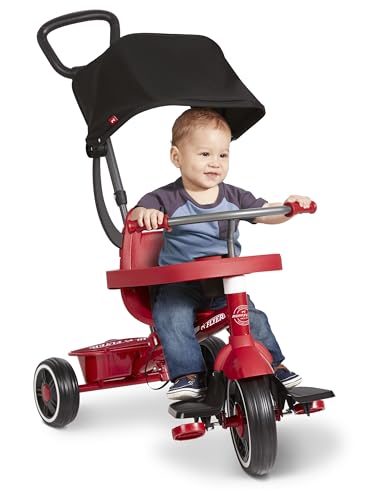
- Best overall: Radio Flyer 4-in-1 Pedal & Push Stroll ’N Trike earns this spot because its four stages include a height-adjustable parent handle, canopy, seat belt, and removable accessories.
- Best value: Umatoll Toddler Tricycle for 18 Months to 4 Years earns this spot because its three-position seat, two baskets, and battery-free light-up rear wheels cover practical basics.
- Best for conversion: newyoo TR007 5-in-1 Tricycle for Toddlers 1-3 earns this spot because it changes among push tricycle, balance bike, tricycle, and bike modes.
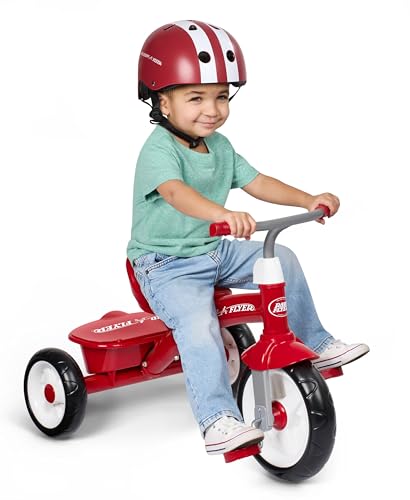
- Best classic first trike: Radio Flyer Red Rider Trike, for Ages 2.5-5 earns this spot because its adjustable seat and covered rear bin suit straightforward neighborhood play.
Pros
- Four configurations for ages 1 to 5
- Parent-controlled steering
- Removable accessories
- Adjustable UV canopy
- Quiet, smooth foam tires
Cons
- Limited to riders ages 1 to 5
- Large 36.3 x 17.8 x 37.2-inch footprint

Pros
- Three-position adjustable seat
- Two storage baskets
- Battery-free light-up rear wheels
- Non-slip pedals
- Carbon steel frame
Cons
- No stated weight limit
- No stated wheel size

Pros
- Five riding modes
- Parent steering handle
- Adjustable seat and handlebar
- Solid EVA wheels
- 9.7 lb weight
Cons
- Listed only for ages 1 to 3
- Listed height limit of 43.3 inches
- No reviews provided
Pros
- Adjustable seat
- Covered rear storage bin
- Quietride wheels
- Seat-back carry grip
- 9.9 lb listed weight
Cons
- One size listed
- No brake details provided

Pros
- Wider wheelbase for added stability
- Indoor and outdoor wheels
- Silent, shock-absorbing wheels
- 9 lb weight
- Non-slip grips
Cons
- Conflicting age guidance: 2-5 years or 24-48 months
- Pink color only listed

Pros
- Lightweight 6.6 lb frame
- Three-position adjustable seat
- Two-position adjustable handlebar
- Battery-free glowing rear wheels
- Detachable front and rear baskets
Cons
- Small size
- No age-specific fit measurements provided
- No safety certification listed

Pros
- Wide wheelbase
- Two-position adjustable seat
- Removable front and rear baskets
- Rear wheels light up without batteries
- Carbon-steel frame
Cons
- Only two seat positions
- Weight capacity not listed
- Braking details not provided

Pros
- Parent push handle adjusts for height
- Multiple riding configurations
- Adjustable seat and handlebar
- 12-inch puncture-proof rubber wheels
- Folds for storage
Cons
- No stated bike weight
- No stated child weight limit
- Multiple configurations require adjustments
Side-by-Side Comparison
| Product | Maker-stated age | Adjustment | Parent control or modes | Notable features |
|---|---|---|---|---|
| newyoo TR007 5-in-1 Tricycle for Toddlers 1-3 | 1-3 years; under 43.3 inches | Adjustable seat and handlebar | Five modes; rotating push handlebar | Carbon steel frame, EVA wheels |
| KRIDDO Toddler Tricycle for Toddlers Age 2-5 | 24-48 months | Not listed | Not listed | Wide wheelbase, quiet wheels |
| JMMD 6 in 1 Toddler Bike with Push Handle for Kids | 18-60 months | Adjustable seat and handlebar | Six modes; rotating push handle | Hand brake, folding frame |
| Umatoll Tricycle for 2-5 Year Old | 2-5 years | Two-position seat | Not listed | Two baskets, light-up rear wheels |
| Radio Flyer Red Rider Trike, for Ages 2.5-5 | 2.5-5 years | Adjustable seat | Not listed | Covered rear bin, carry grip |
| Radio Flyer 4-in-1 Pedal & Push Stroll ’N Trike | 1-5 years | Height-adjustable push handle | Four stages | Canopy, seat belt, tray, footrest |
| SEREED Colorful Lighting Kid Tricycle Gift Toy | 2-5 years | Three-position seat; two-position handlebar | Not listed | Removable baskets, light-up wheels |
| Umatoll Toddler Tricycle for 18 Months to 4 Years | 18 months-4 years | Three-position seat | Not listed | Two baskets, light-up wheels |
Parent control and adjustment make the biggest difference for families whose children are still learning to steer or pedal. The Radio Flyer Stroll ’N Trike, JMMD, and newyoo offer guided or convertible configurations, while classic designs keep the riding setup simpler.
Common Mistakes to Avoid
Choosing by age label alone can lead to a poor fit because children of the same age differ in height, reach, and coordination. Compare the maker’s age guidance with your child’s ability to sit securely, reach the pedals, and hold the grips. The newyoo TR007 also states a maximum child height.
Assuming every convertible tricycle offers the same stages can leave a family with unnecessary complexity or missing features. The newyoo TR007 lists five modes, JMMD describes six, and Radio Flyer Stroll ’N Trike uses four stages. Check each configuration and the parts that need to move before choosing.
Treating a push handle or seat belt as a substitute for supervision creates avoidable risk. These features support guided rides, but adults still need to stay close and follow the manufacturer’s setup and use instructions. Check that controls suit your child’s ability and that the adult can manage the handle comfortably.
Overlooking storage and intended riding surfaces can make a tricycle less useful at home. Radio Flyer Red Rider has a covered rear bin, while Umatoll and SEREED models include baskets. Check maker guidance for suitable surfaces, and consider whether the trike’s size works in your indoor riding area.
Best Toddler Tricycle Buying Guide
Fit, Age Range, and Adjustability
Fit matters because a child needs to sit securely and reach the pedals and handlebars without straining. Start with the maker’s age guidance, then look for a stated height limit and seat or handlebar adjustment. Age labels can narrow choices, but they cannot confirm that a tricycle fits your child.
The newyoo TR007 is intended for children under 43.3 inches, and its seat and handlebar adjust. Radio Flyer Red Rider has an adjustable seat, while SEREED describes a three-position seat and two-position handlebar. Compare these adjustment details with your child’s seated reach and the space available for comfortable movement.
Before ordering, check the product’s dimensions and fit guidance, especially if your child is near a stated limit. A child should be able to reach controls without stretching or sliding forward. When a useful measurement is missing, ask the manufacturer rather than relying on an age range alone.
Stability and Steering
Wheel layout and steering determine how manageable a tricycle feels as a beginner learns to turn. KRIDDO describes extended rear wheels and a wider wheelbase intended to help prevent tipping, and Umatoll also highlights an extended rear-wheel layout. These are design details to compare, not guarantees against tipping.
Look for grips your child can hold, a tricycle width that suits your riding space, and steering controls that match your supervision plan. JMMD lists a 60-degree steering limiter, and its parent handle rotates 135 degrees. More controls can provide options, but they also make it important to understand setup and operation.
Product descriptions may call a tricycle stable without explaining how it behaves on every surface. Compare the wheel placement, grip design, and maker’s intended use instead of treating a stability claim as a promise. Keep rides supervised, especially while a child is still learning to steer and stop.
Parent Guidance and Child Independence
A parent push handle lets an adult guide the tricycle while a young child learns to steer or pedal. Radio Flyer Stroll ’N Trike and JMMD include parent handles, and newyoo describes a rotating handlebar for adult steering and speed control. These features suit families who want an adult to help direct early rides.
Check whether a handle adjusts to the adult’s height and whether it can be removed when the child rides independently. Radio Flyer describes a height-adjustable handle that can be removed; JMMD and newyoo also describe adjustable parent controls. Confirm how each design changes between guided and independent use.
A confident pedaler may prefer a conventional tricycle without parent controls. Fewer mechanisms can make setup and storage more straightforward, though the adult has less direct steering control. Choose based on your child’s current ability and the kind of outings your family expects to take.
Convertible Modes and Long-Term Use
Convertible modes can let one frame serve different early-riding stages, but the advertised mode count does not show whether each setup will suit your child. The newyoo TR007 describes five configurations, JMMD describes six, and Radio Flyer Stroll ’N Trike describes four developmental stages.
Check which components move or come off and how each configuration changes. Read the maker’s instructions to understand the adjustments and whether a tool is needed. A mode has little value if it does not match your child’s ability or if the family does not want to manage frequent changes.
Families who value a simpler purchase can compare convertible designs with Radio Flyer Red Rider. A conventional tricycle avoids choosing among multiple configurations, though it does not list parent steering or balance-bike modes. Consider how your child may use each stage rather than choosing by the largest advertised number.
Frame, Wheels, and Riding Surface
Frame and wheel descriptions can help you compare construction and the maker’s intended riding experience. The newyoo TR007 lists a carbon steel frame and EVA wheels, JMMD lists an aluminum alloy frame and puncture-proof rubber wheels, and Radio Flyer Red Rider lists steel construction.
Material names alone do not establish how a tricycle will feel or whether it suits every surface. KRIDDO describes quiet wheels for indoor and outdoor use, while Radio Flyer describes high-density foam tires on Stroll ’N Trike. Compare those claims with the surfaces where your family expects to ride.
For indoor rides, consider floor space, nearby furniture, and whether wheel noise matters in your home. For outdoor rides, follow maker guidance and supervise around driveways, slopes, and shared paths. A product description cannot choose a safe riding area for your family.
Assembly, Storage, and Useful Extras
Assembly and storage affect how easily a family can bring a tricycle along or keep it at home. JMMD says its tricycle arrives mostly assembled and folds, while SEREED describes spring-loaded assembly. Check the maker’s instructions before choosing, especially when a folding mechanism or removable part will be used regularly.
Accessories can add convenience, but they should come after fit and adult guidance. Radio Flyer Stroll ’N Trike includes a canopy, tray, headrest, seat belt, and footrest, while Radio Flyer Red Rider has a covered rear bin. Check which parts are removable and whether the family has space to store them.
Baskets and light-up wheels can make rides more engaging, as shown on Umatoll and SEREED options. Consider whether removable baskets suit the items your child carries and whether loose parts could be misplaced. For more category coverage, browse our Toddler Tricycles category.
How We Chose
We compare toddler tricycles using the Haiku Ride Score, with core performance at 30%, build and weather resistance at 20%, ease of use at 20%, compatibility and battery at 15%, and value at 15%. For this category, we assess fit guidance, stability features, adult controls, mode changes, and useful accessories.
Our evaluation draws on manufacturer specifications, compatibility information, and long-term owner feedback when available. We research and draft our guides with software tools, including AI, then run automated checks on product fit, sourcing, and our editorial rules. Our editor spot-checks guides rather than reading each one before publication. Our how we review page explains our approach.
Price and Value: What Each Budget Gets You
Budget
Entry-level toddler tricycles typically focus on basic pedaling, a stable wheel layout, and a few practical extras rather than parent steering or multiple riding stages. The Umatoll Toddler Tricycle for 18 Months to 4 Years pairs a three-position seat with baskets and battery-free light-up wheels. Buyers may give up a push handle, extensive conversion options, or more elaborate accessories.
Mid-Range
Mid-range designs often add more seat adjustment, storage, or a feature that supports guided learning without turning every ride into a complex setup. Radio Flyer Red Rider has an adjustable seat, covered rear bin, and carry grip, while SEREED adds adjustable seating and removable baskets. These tricycles may lack the multi-stage conversion and parent steering found on more elaborate designs.
Premium
More elaborate tricycles can combine parent control, multiple configurations, and accessories intended to serve different early-riding stages. Radio Flyer Stroll ’N Trike includes four stages, a height-adjustable push handle, canopy, and removable accessories; JMMD folds and describes six modes. Families give up simplicity and may need to manage more parts and adjustments than a basic trike requires.
Choosing Something Else
A balance bike may suit a child ready to practice gliding and steering rather than pedaling, while a stroller can work better for longer outings when a toddler cannot ride independently. A conventional tricycle is another straightforward choice for short, supervised play. Match the alternative to your child’s ability, the outing length, and your family’s need for adult control.
Final Thoughts
Families who want parent guidance and equipment for several developmental stages should consider Radio Flyer 4-in-1 Pedal & Push Stroll ’N Trike. Its four stages, adjustable push handle, canopy, and removable accessories suit supervised outings. The trade-off is a larger set of parts than a child needs for straightforward, independent pedaling.
For a child progressing toward independent riding, newyoo TR007 5-in-1 Tricycle for Toddlers 1-3 offers several configurations and adjustable parts. Families who want a classic design with storage can consider Radio Flyer Red Rider Trike, for Ages 2.5-5, though its listed features do not include parent steering.
Families who value baskets and light-up wheels can compare Umatoll Toddler Tricycle for 18 Months to 4 Years. For a wide wheelbase and quiet wheels, consider KRIDDO Toddler Tricycle for Toddlers Age 2-5. Review fit and controls first, then browse our toddler tricycle coverage.
Skip these tricycles if your child cannot sit securely or reach the pedals, or if your family needs a stroller for longer outings. A balance bike may better suit a child ready to glide, while every toddler ride still requires close adult supervision. Ask the manufacturer about missing fit details before ordering.
FAQs
Which Best Toddler Tricycle features matter most in 2026?
The most important features on a toddler tricycle are correct fit, manageable steering, and controls suited to your child’s ability. Check the maker’s age and height guidance, seat adjustment, and wheel layout before considering accessories. A parent handle can help with guided rides, but it does not replace close supervision or confirm that the tricycle fits.
How do I choose the right toddler tricycle size?
The right toddler tricycle size lets a child sit securely, reach the pedals, and hold the handlebars without straining. Compare the manufacturer’s age and height guidance with your child’s measurements and abilities. If a useful fit measurement is missing, ask the maker rather than relying on the age label alone.
Are parent push handles useful on toddler tricycles?
A parent push handle can help an adult guide a toddler tricycle while a child learns to steer or pedal. Check whether the handle adjusts for adult height, how steering works, and whether the handle can be removed later. Adult guidance remains necessary, and the handle does not replace supervision.
Can a toddler tricycle be used indoors?
A toddler tricycle may suit indoor riding when the maker describes indoor use and its wheels suit the floor. KRIDDO describes its wheels as quiet and suitable for indoor and outdoor riding. Clear obstacles, follow the instructions, and supervise around furniture, steps, and other hazards.
Do toddler tricycles need a helmet in the United States?
Helmet requirements for children riding tricycles vary by location, so check applicable local requirements before riding. For bicycle helmets, look for a CPSC 16 CFR Part 1203 certification label and check the product listing for certification. Follow the helmet maker’s fit instructions and supervise the child throughout the ride.
How should I maintain a toddler tricycle?
Maintain a toddler tricycle by following the manufacturer’s instructions and checking its parts before use. Confirm that fasteners remain secure, wheels turn as intended, and adjustable components stay in position. Clean the frame and wheels as directed, and stop using the tricycle if a part appears damaged.
Are convertible tricycles worth choosing?
A convertible tricycle can suit families who expect to use its different configurations as a child develops. Compare the actual modes, adjustment steps, and included parts instead of assuming every stage will be useful. A simpler design may suit a child ready to pedal independently or a family wanting fewer mechanisms.
Where can I compare more toddler tricycles?
You can compare more options in our Toddler Tricycles category. Review maker-stated age and height guidance, adjustment range, and supervision features before choosing. Product descriptions may omit useful fit or assembly details, so contact the manufacturer when you need clarification.
Write Your Review
No reviews yet. Be the first to share your experience!