

For riders whose bikes crowd a garage, shed, or apartment, a wall mount can clear floor space while keeping a bicycle accessible. The right setup depends on your bike’s frame, tire width, fenders, weight, and the wall structure where you plan to install it.
We compare 5 bike wall mounts for November 2026, including horizontal hangers, vertical swivels, and fixed hooks from PRO BIKE TOOL, Housolution, Gootus and more. Check your bike’s fit and wall construction before buying, then follow the manufacturer’s installation instructions. Browse our Racks & Storage category for other ways to organize gear.
At a Glance: Which One Fits You
- Best overall: monTEK Swivel Bike Wall Mount earns this spot because its vertical rack pivots up to 150 degrees and supports bikes with fenders.
- Best value: Housolution Bike Wall Mount with Fixed Hook earns this spot because its rubber-coated hook has a safety locking mechanism.
- Best for easier loading: monTEK No-Lift Swivel Bike Wall Mount earns this spot because you roll a compatible bike into position rather than hoisting it.
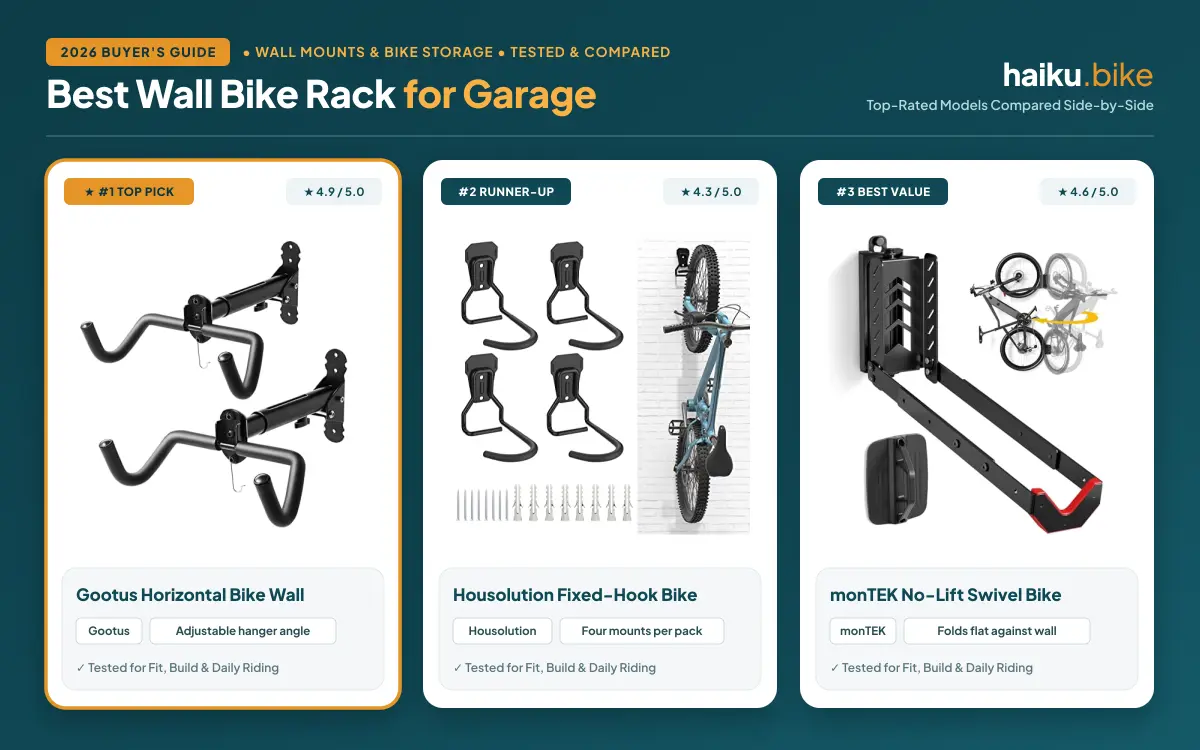
- Best for horizontal storage: Gootus Bike Wall Mount Hanger earns this spot because its extendable beam and adjustable hook angle help level a compatible bike.

Pros
- Two mounts per pack
- Pivoting storage position
- Rated for loads up to 66.2 lb
- Rubber-coated contact points
- Hardware included
Cons
- Requires wood studs or concrete
- Tires limited to 3.54 inches wide
- Not for unsupported plasterboard

Pros
- Roll-on loading without lifting
- Swivels up to 120 degrees
- Folds flat against wall
- Fits 16- to 29-inch wheels
- Rated for bikes up to 77 lb
Cons
- Not compatible with fenders
- Requires wood stud or concrete wall
- Not for unsupported plasterboard

Pros
- Horizontal storage saves floor space
- Adjustable hanger angle
- Padded hook helps prevent scratches
- Rated for bikes up to 48.5 lb
- Screws and plugs included
Cons
- Not suitable for step-through frames
- Not suitable for fat or long-wheelbase bikes
- Requires solid wall or supporting stud

Pros
- Two mounts per pack
- Rubber-coated hooks
- Locking mechanism
- Listed for several bike types
Cons
- Requires wall installation
- Hooks must face the correct direction

Pros
- Horizontal wall storage
- Pre-drilled mounting holes
- Rated for up to 48.5 lb
- Designed for various bike types
Cons
- Installation hardware not specified
- Bike size limits not specified
Side-by-Side Comparison
| Product | Storage position | Fit and exclusions | Listed capacity | Standout feature |
|---|---|---|---|---|
| monTEK Swivel Bike Wall Mount | Vertical, up to 150-degree swivel | Tires up to 3.54 inches; fenders supported | 66.2 lb | Rubber-coated rack and tire stop |
| monTEK No-Lift Swivel Bike Wall Mount | Vertical, 120-degree pivot | 16 to 29-inch wheels; tires up to 3.54 inches; no fenders | 77 lb | Roll-in loading; folds flat |
| Gootus Bike Wall Mount Hanger | Horizontal | Excludes step-through frames, fat bikes, long wheelbases, and handlebars over 31.5 inches | 48.5 lb | Extendable beam and adjustable hook angle |
| Housolution Bike Wall Mount with Fixed Hook | Fixed hook | Most bikes; exact limits not listed | 77 to 99 lb | Rubber coating and locking mechanism |
| PRO BIKE TOOL Bike Rack for Garage Wall Mount | Horizontal | Adjustable fit; exact limits not listed | 48.5 lb | Pre-drilled mounting holes |
Fit restrictions and loading method matter more than capacity alone. Riders with fenders can consider the regular monTEK Swivel, while riders seeking horizontal storage should compare their frame, wheelbase, and handlebar clearance with the Gootus restrictions.
Common Mistakes to Avoid
Choosing a mount before checking bike compatibility can leave the bicycle unstable or impossible to hang as intended. Gootus excludes step-through frames, fat bikes, long wheelbases, and especially wide handlebars, while the monTEK No-Lift excludes bikes with fenders. Compare your complete bike with the maker’s stated restrictions before ordering.
Installing a loaded bike mount into unsupported drywall creates a serious failure risk. The makers call for solid support, such as a stud, beam, masonry, or concrete, with hardware suitable for the wall. Locate the structure behind the surface and follow the installation directions rather than relying on drywall alone.
Capacity does not prove that a mount fits a bike or wall. Compare the stated limit with your complete bicycle’s weight, including accessories, and check the intended loading orientation. Housolution says its fixed hooks must face the direction shown in its instructions, since incorrect orientation can cause uneven stress.
Ignoring loading effort can make a space-saving installation inconvenient for daily use. Conventional horizontal hangers may require lifting and positioning the frame, while the monTEK No-Lift lets riders roll in a compatible bike. That design excludes fenders, so weigh the easier loading against that restriction.
Best Bike Wall Mount Buying Guide
Bike Compatibility and Fit
Bike compatibility determines whether a mount can hold your bicycle in its intended position without interfering with the frame, tires, or fenders. Check wheel size, tire width, frame shape, handlebar width, and the maker’s stated exclusions before choosing a design. Broad claims such as “fits most bikes” do not replace checking specific limits.
The monTEK No-Lift lists 16 to 29-inch wheels and tires up to 3.54 inches wide, but excludes bikes with fenders. The regular monTEK Swivel supports fenders and lists the same tire-width limit. Gootus excludes step-through frames, fat bikes, long wheelbases, and handlebars wider than 31.5 inches.
Measure your bicycle in its current configuration, including accessories that affect clearance or loading. Check the maker’s fit guidance if the product description does not identify your frame style or tire size. The Wall Mounts & Bike Storage category includes other formats to compare.
Wall Construction and Installation
Wall construction matters because the mount and loaded bicycle need solid structural support. Products in this guide call for installation into a wood stud, beam, brick, masonry, or concrete, and warn against unsupported drywall. Identify the wall structure before choosing a location or drilling mounting holes.
Included hardware may not suit every wall material, so read the maker’s directions for your mounting surface. The monTEK mounts specify wood studs or concrete, while Gootus lists studs, beams, brick, masonry, or concrete. Resolve any uncertainty about wall construction before hanging a bicycle.
Installation position affects how the bicycle hangs and how much clearance it needs. Check nearby doors, vehicles, shelves, and stored bikes before fixing the mount in place. A suitable spot lets you load and remove the bicycle without striking objects or putting strain on the rack.
Storage Position and Available Space
Storage position determines how a bicycle uses wall space and how easily you can reach it. Horizontal hangers hold the bike across the wall, while vertical mounts store it upright. Measure the usable area, including room for handlebars and pedals, instead of comparing the mount’s footprint alone.
The monTEK Swivel pivots up to 150 degrees, allowing riders to angle the bicycle toward the wall or a more accessible position. The No-Lift version lists a 120-degree pivot and folds flat when unused. A fixed hook has fewer moving features, but does not offer the same swivel access.
Consider the path you use to bring a bicycle into storage, especially in a narrow apartment or shared garage. A vertical mount may save wall width, while a horizontal hanger may suit a space with limited height. Compare other formats in Bike Travel Cases when wall storage is not practical.
Loading Effort and Bike Weight
Loading effort affects whether a wall mount feels manageable in daily use. The monTEK No-Lift is designed for riders to balance a bike on its rear wheel and roll it into place, reducing the need to hoist the bicycle. Conventional hooks and horizontal racks generally require lifting or positioning the bike at the mount.
Compare the mount’s stated capacity with your complete bicycle’s weight, including accessories, and follow its loading instructions. The listed capacities vary, and capacity does not confirm compatibility with every frame or wall. PRO BIKE TOOL lists 48.5 lb, while Housolution lists a range of 77 to 99 lb.
Mounting height matters alongside the capacity label. A mount may support your bicycle but still feel awkward if you must lift it above shoulder height or maneuver in a tight space. Choose a loading method you can manage consistently, and never exceed the maker’s stated limit.
Contact Points and Bike Protection
Contact points matter because a mount may rest against a bicycle’s tire, wheel, or frame during storage. Gootus wraps its hook in sponge, while monTEK describes rubber-coated components intended to protect bike parts. Housolution also lists rubber-coated hooks and a locking mechanism intended to prevent accidental release.
Inspect where the mount will touch your bicycle, especially if you are concerned about frame finish or wheel placement. Protective coating does not make an incompatible mount suitable, and a hook designed for one contact point may not fit every tire profile. Check the intended contact area against your bike’s shape.
Follow the manufacturer’s directions for securing and removing the bicycle after installation. Keep contact surfaces and the mount clear of debris that could interfere with placement. If the bicycle does not sit as described or the mount shifts, stop using it and review the installation instructions.
Adjustability and Household Storage
Adjustability can help position a bicycle, while spacing determines how many bikes a household can store. Gootus describes an extendable beam and adjustable hook angle to help level compatible bikes. Check the maker’s product description to confirm which adjustments apply to the specific version you are considering.
PRO BIKE TOOL offers an adjustable fit and pre-drilled mounting holes, while the monTEK No-Lift lists four length settings. These features can help with positioning, but they do not remove the need to confirm frame, tire, and wall compatibility. Treat adjustment as a fit aid, not proof that every bicycle will work.
For multiple bicycles, plan spacing around handlebars, pedals, and the room needed to remove each bike. Every mounting point still needs suitable structural support. Compare the layout with your available space, or consider a bike travel case when wall storage does not suit your household.
How We Chose
We evaluate each bike wall mount with the Haiku Ride Score: core performance 30%, build and weather resistance 20%, ease of use 20%, compatibility and battery 15%, and value 15%. Battery does not apply to passive storage products, so our comparison focuses on fit, practical operation, mounting requirements, and published specifications.
Our research compares manufacturer specifications, compatibility information, and long-term owner feedback where available. We research and draft our guides with software tools, including AI, then run automated checks on product fit, sourcing, and our editorial rules. Our editor spot-checks guides rather than reading each one before publication. Read our how we review methodology for more about our approach.
Price and Value: What Each Budget Gets You
Budget
At the lower end of this category, fixed hooks can provide a straightforward way to lift a bicycle off the floor. The Housolution Bike Wall Mount with Fixed Hook adds rubber coating and a safety locking mechanism. Riders give up swivel movement and specialized roll-in loading, and should check hook orientation and wall support carefully before installation.
Mid-Range
Mid-range designs often add position adjustment or a swivel that can make a crowded storage area easier to use. The monTEK Swivel combines vertical storage, a pivoting rack, and fender compatibility; Gootus offers horizontal storage with an extendable beam. Riders still need to check restrictions, and added movement does not resolve poor wall support or a bike-fit mismatch.
Premium
At the upper end of this selection, buyers can find more specialized loading or adjustment features rather than a different basic storage purpose. The monTEK No-Lift lets riders roll a compatible bike into place and folds flat, while PRO BIKE TOOL offers horizontal storage and an adjustable fit. These features do not suit every frame, and the no-lift design excludes fenders.
Choosing Something Else
A floor-standing bike rack suits renters and riders who cannot confirm that a wall can support a loaded mount. It avoids drilling into a wall, but takes up floor space and may be less convenient in a crowded room. A bike travel case serves a different need, protecting a bicycle during transport rather than storing it for everyday access.
Final Thoughts
Riders who want vertical storage, a swivel, and fender compatibility should consider the monTEK Swivel Bike Wall Mount. It accommodates tires up to 3.54 inches wide and lists a 66.2 lb capacity. Choose another mount if your bike exceeds its limits or your preferred loading position differs.
The monTEK No-Lift Swivel Bike Wall Mount suits riders who prefer rolling a compatible bicycle into storage rather than lifting it. Its fender restriction rules it out for some bikes, so check that fit detail first. For horizontal storage, the Gootus Bike Wall Mount Hanger offers beam and hook adjustments, but excludes several frame and bike types.
Riders who want a fixed-hook arrangement can consider the Housolution Bike Wall Mount with Fixed Hook, which has rubber coating and a safety locking mechanism. The PRO BIKE TOOL Bike Rack for Garage Wall Mount provides horizontal storage and pre-drilled mounting holes. Verify wall support and bike fit for either design.
Skip wall mounts if your bicycle falls outside listed fit limits, your wall lacks suitable structural support, or lifting and positioning would be uncomfortable. A floor-standing rack avoids wall installation but occupies floor space. Compare Racks & Storage options before settling on a setup.
FAQs
How do I choose the right bike wall mount?
The right bike wall mount matches your bicycle’s frame, wheel size, tire width, weight, and fender setup while fitting a structurally suitable wall. Decide whether horizontal or vertical storage works better and how much lifting you can manage. Compare the product’s specific limits and installation directions with your bike and mounting location.
Can I install a bike wall mount on drywall?
A bike wall mount should not go into unsupported drywall, according to the installation cautions for products in this guide. Makers call for solid support such as a stud, beam, brick, masonry, or concrete. Identify the wall structure and use hardware and directions appropriate to that surface before hanging a bicycle.
Will a bike wall mount fit a bike with fenders?
A bike wall mount’s fender compatibility depends on its design. The monTEK No-Lift Swivel Bike Wall Mount excludes bikes with fenders, while the regular monTEK Swivel Bike Wall Mount supports them. Check the exact product’s restrictions, tire limits, and wheel fit before choosing, because similar product names do not guarantee identical compatibility.
Which bike wall mount works with wide tires?
The monTEK Swivel Bike Wall Mount and monTEK No-Lift Swivel Bike Wall Mount list a maximum tire width of 3.54 inches. Gootus excludes fat bikes, so its horizontal hanger does not suit many wide-tire bicycles. Measure your tire at its widest point and confirm wheel and tire compatibility in the maker’s product description.
Are horizontal or vertical bike wall mounts better?
Horizontal bike wall mounts hold a bicycle across the wall, while vertical mounts store it upright and may reduce wall width used. Neither layout fits every room or bike. Consider available wall length, ceiling height, nearby objects, and loading effort. A swivel changes access angle, while fixed hooks offer a simpler arrangement.
Which Best Bike Wall Mount options in 2026 suit apartments?
Best Bike Wall Mount options in 2026 can suit apartments when installation is allowed and the wall has appropriate structural support. A wall mount clears floor space, but not every apartment wall can support one. Renters who cannot drill or confirm wall construction can consider a floor-standing rack. Browse bike wall storage formats for alternatives.
How much weight can a bike wall mount hold?
Bike wall mount capacity varies by product, with stated limits in this guide ranging from 48.5 lb to 99 lb. Compare the limit with your complete bicycle’s weight, including accessories, and follow the manufacturer’s mounting directions. Capacity does not replace correct installation, solid wall support, or compatibility checks for your frame and wheels.
Can a bike wall mount scratch a frame?
A bike wall mount can contact a frame, wheel, or tire, so inspect contact points before hanging your bicycle. Gootus lists a sponge-wrapped hook, while monTEK and Housolution describe rubber-coated parts. Protective materials may reduce direct contact, but they do not make an incompatible mount suitable or remove the need to position the bike correctly.







Write Your Review
No reviews yet. Be the first to share your experience!