
Riders who want speed, distance, and route guidance without handling a phone can keep key ride information on the handlebar with a bike computer. Budget units vary widely: some record GPS routes and basic metrics, while others add mapped navigation, sensor connections, color displays, or training features.
Our guide compares 10 options for November 2026, including models from CYCPLUS, CooSpo, iGPSPORT and more. Start with the features you will use, then compare this guide with our bike computer guide for gravel riding if your routes include rough roads or remote turns.
At a Glance: Which One Fits You
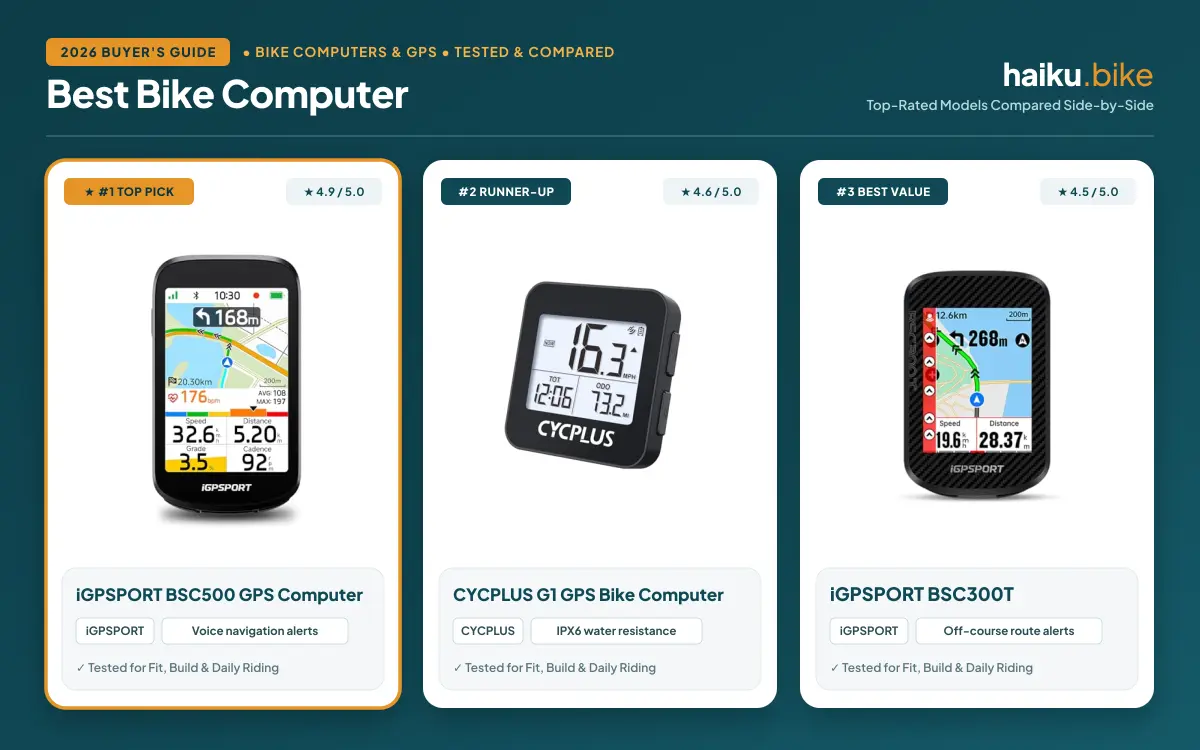
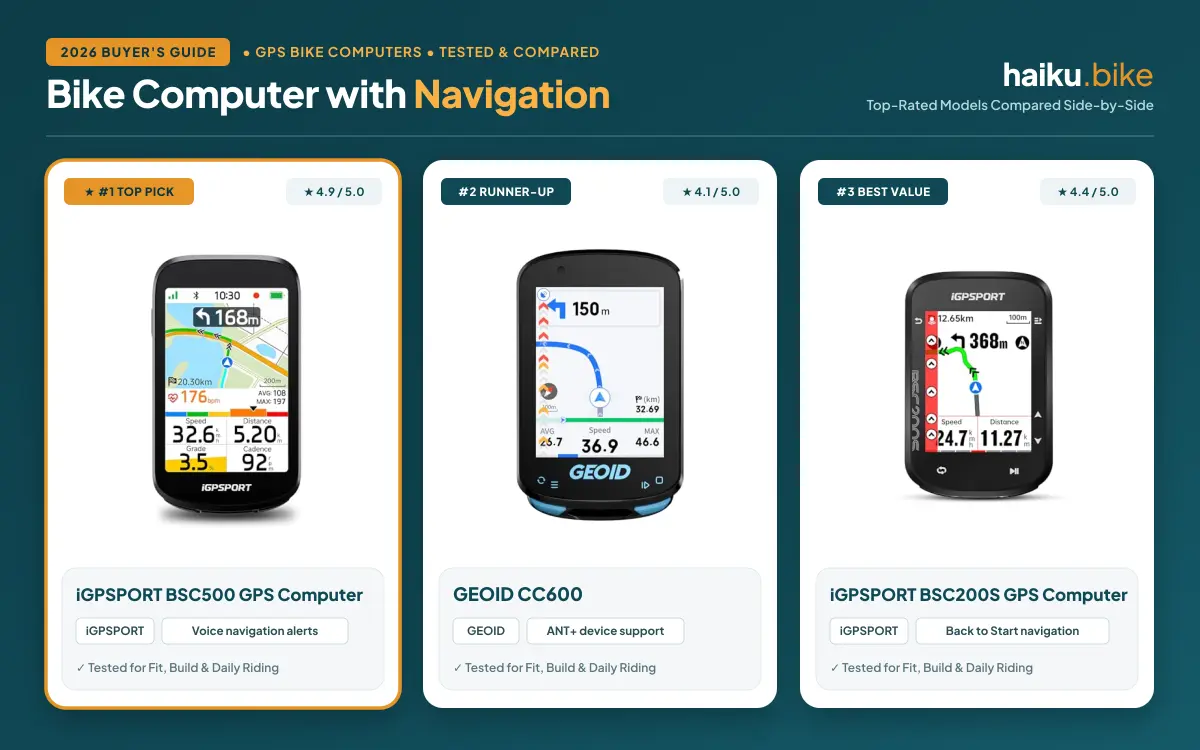
- Best overall: iGPSPORT BSC500 GPS Bike Computer earns this spot because mapped routes, automatic rerouting, turn reminders, and voice cues support navigation with less screen-glancing.
- Best value: iGPSPORT BSC100S GPS Bike Computer earns this spot because its 40-plus data fields, ANT+ and Bluetooth 5.0 support, and listed runtime of up to 40 hours cover everyday ride tracking.
- Best for long runtime: CYCPLUS Wireless GPS Bike Computer G1, 70g earns this spot because CYCPLUS lists more than 55 hours of operation and IPX6 water resistance.
- Best for affordable route guidance: GEOID CC600 Color Screen Bike/Cycling Computer earns this spot because it supports imported GPX routes, turn reminders, and automatic rerouting.

Pros
- Touchscreen and button controls
- Up to 12 data fields per page
- Strava and Komoot route imports
- Automatic off-course rerouting
- Voice navigation alerts
Cons
- Battery life not listed
- Water-resistance rating not listed
- Wireless connectivity details not listed

Pros
- Routes from Strava, Ride with GPS, and Komoot
- Back to Start navigation
- More than 100 riding data fields
- Up to 25-hour maker-rated battery life
- USB-C charging
Cons
- Water-resistance rating not listed
- Wireless protocols not specified
- Requires iGPSPORT app for route setup

Pros
- More than 55-hour maker-rated runtime
- IPX6 water resistance
- Automatic backlight
- GPS route and altitude data
- About 2.5 oz
Cons
- No listed app connectivity
- No listed sensor pairing

Pros
- GPS tracking without wheel sensor
- Up to 28-hour rated runtime
- Altitude and ascent data
- Automatic backlight and ride recording
- USB-C charging
Cons
- No listed ANT+ or Bluetooth support
- No listed app compatibility

Pros
- Up to 40-hour battery life
- 2.6-inch anti-glare screen
- Strava and Komoot sharing
- ANT+ and Bluetooth 5.0
- IPX7 water resistance
Cons
- Mapping not listed
- Sensor compatibility may be needed for some metrics
Pros
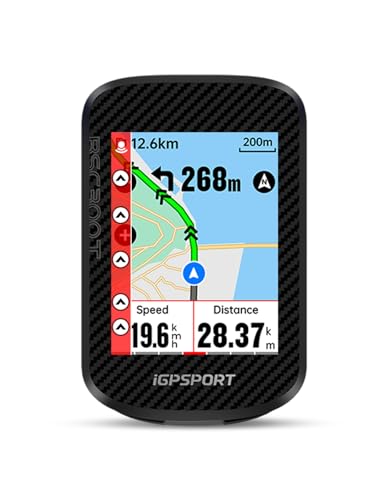
- 2.4-inch touchscreen and six buttons
- Offline maps and turn prompts
- Off-course route alerts
- ANT+ and Bluetooth 5.0
- Strava and Komoot sharing
Cons
- Battery life not listed
- Water-resistance rating not listed
- Mount details not listed

Pros
- Built-in GPS
- No wheel sensor or spoke magnet needed
- Maker-rated 28-hour runtime
- IPX7 water resistance
- Altitude and climbing data
Cons
- No listed app or sensor compatibility
- Charging port not specified

Pros
- Color route navigation with automatic rerouting
- WiFi and Bluetooth data transfer
- ANT+ device support
- Customizable data pages and layouts
- Indoor smart-trainer workouts
Cons
- Battery life not specified
- Water resistance rating not listed
- Mount compatibility not specified

Pros
- 2.4-inch color touchscreen
- GPS and GLONASS tracking
- Route upload and breadcrumb navigation
- 36-hour maker-rated battery life
- Bluetooth and ANT+ connectivity
Cons
- Sensors sold separately
- Extension mount not included
- Compatible accessories required for power data
Pros
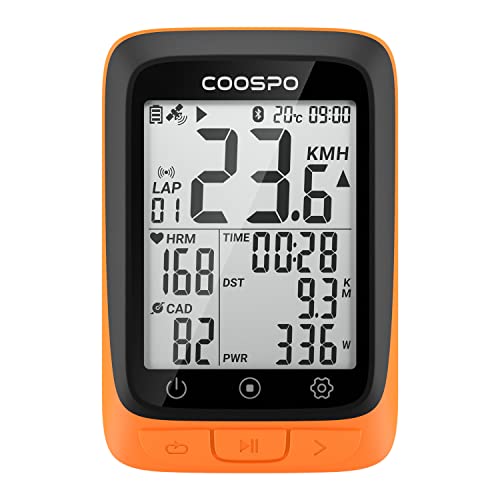
- GPS and BeiDou positioning
- ANT+ sensor support
- Strava syncing through CoospoRide
- GPS can be disabled indoors
- Compact, lightweight design
Cons
- No Bluetooth sensor pairing
- Strava sync requires CoospoRide app
- Extension front mount sold separately
Side-by-Side Comparison
| Bike computer | Display | Navigation | Listed battery life | Water resistance | Connectivity |
|---|---|---|---|---|---|
| iGPSPORT BSC500 GPS Bike Computer | 3.3-inch touchscreen and buttons | Maps, turn reminders, rerouting, voice cues | Not listed | Not listed | Not listed |
| Bikevee GPS Bike Computer, 2.4" Screen, Altitude | 2.4-inch LCD | Not listed | Up to 28 hours | IPX7 | Not listed |
| CYCPLUS Wireless GPS Bike Computer G1, 70g | 2.0-inch FSTN screen | Not listed | More than 55 hours | IPX6 | Not listed |
| iGPSPORT BSC300T GPS Bike Computer | 2.4-inch touchscreen and buttons | Offline maps, route preview, turn prompts | Not listed | Not listed | iGPSPORT app |
| iGPSPORT BSC200S GPS Bike Computer | 2.4-inch color screen | Route guidance, back-to-start | Up to 25 hours | Not listed | iGPSPORT app |
| iGPSPORT BSC100S GPS Bike Computer | 2.6-inch anti-glare screen | Not listed | Up to 40 hours | IPX7 | ANT+, Bluetooth 5.0 |
| COOSPO Bike Computer Wireless GPS | 2.4-inch LCD | GPS track route map | Not listed | Not listed | ANT+ sensors; Bluetooth app connection |
| BKVTOP Wireless GPS Bike Computer, 50g | 2.4-inch LCD | Not listed | Up to 28 hours | IPX7 | Not listed |
| GEOID CC600 Color Screen Bike/Cycling Computer | 2.4-inch color screen | Turn reminders, GPX routes, rerouting | Not listed | Not listed | Bluetooth, ANT+, Wi-Fi |
| COOSPO Color Touchscreen GPS Bike Computer CS600 | 2.4-inch color touchscreen | Route navigation, breadcrumb trail | Up to 36 hours | IPX7 | Bluetooth, ANT+ |
Navigation and sensor compatibility create the biggest practical differences in this comparison. Choose a mapped unit if you follow unfamiliar routes; prioritize a clear screen and long listed runtime if you mainly record distance and speed.
Common Mistakes to Avoid
A common buying mistake is assuming that every GPS computer provides turn-by-turn guidance. The CYCPLUS Wireless GPS Bike Computer G1, 70g records ride data, but its listed features do not describe route navigation; the iGPSPORT BSC500 GPS Bike Computer explicitly supports maps, turn reminders, rerouting, and voice cues.
Sensor support also needs closer inspection than a Bluetooth label suggests. The COOSPO Bike Computer Wireless GPS connects to ANT+ sensors, while Bluetooth pairs the computer with its CoospoRide app; its listed specifications do not support Bluetooth sensor connections.
Choosing by screen size alone can leave you with controls or data layouts that do not suit your rides. Compare display readability, touch and button operation, and page customization; the iGPSPORT BSC500 GPS Bike Computer can show up to 12 data items per page.
Water-resistance ratings are not interchangeable, so check the rating and care instructions for the exact computer. Bikevee lists IPX7 protection, while CYCPLUS lists IPX6 for the G1; neither rating means you should ignore manufacturer guidance about wet use or charging.
Best Budget Bike Computer Buying Guide
GPS Positioning and Ride Recording
GPS positioning lets a bike computer record routes and calculate ride metrics without relying on a wheel sensor. Bikevee and BKVTOP both describe built-in GPS tracking without a wheel sensor or spoke magnet, which simplifies setup for riders who want basic recording.
Satellite support can affect positioning in places where signal reception is less consistent. The iGPSPORT BSC100S GPS Bike Computer supports GPS, BeiDou, GLONASS, Galileo, and QZSS; the GEOID CC600 supports those systems and can sync assisted GPS data over Wi-Fi. Compare stated satellite systems rather than assuming all GPS units offer identical coverage.
Navigation and Route Features
Navigation determines whether a computer can guide you along a planned route or only record where you ride. The iGPSPORT BSC200S GPS Bike Computer accepts routes from services including Strava, Ride with GPS, and Komoot, and offers turn reminders and back-to-start guidance.
Check how routes transfer to the device and what happens when you leave the planned path. The GEOID CC600 accepts GPX files through its phone app and supports automatic rerouting; the iGPSPORT BSC500 also replans off course and provides voice cues. For more route-focused options, see our GPS bike computer category.
Battery Life and Charging
Battery life determines whether a computer suits short commutes, long day rides, or repeated outings between charges. CYCPLUS lists more than 55 hours for the G1, iGPSPORT lists up to 40 hours for the BSC100S, and the BSC200S is listed for up to 25 hours.
Compare maker-listed runtime with your longest typical ride, while allowing for navigation, screen brightness, and connected sensors to affect charging frequency. The BSC200S lists a USB-C charging port and a full charge time of 1.5 hours. Check the charging connection before buying so your setup fits your routine.
Sensor Support and App Compatibility
Sensor support matters when you want heart rate, cadence, speed, or power data beyond GPS-derived metrics. The iGPSPORT BSC100S supports ANT+ and Bluetooth 5.0 connections, while the GEOID CC600 supports Bluetooth and ANT+ devices.
Confirm each sensor’s connection protocol before purchase, because an app connection does not guarantee sensor compatibility. The COOSPO Bike Computer Wireless GPS supports ANT+ sensors and uses Bluetooth to pair with CoospoRide; the app can sync activity files to Strava. Review the app and service requirements if ride sharing is important to you.
Screen Readability and Controls
Screen readability affects how quickly you can check ride data while keeping attention on the road or trail. The iGPSPORT BSC500 has a 3.3-inch touchscreen with button operation, while the BSC100S uses a 2.6-inch anti-glare display.
Consider whether physical buttons or touch controls suit your gloves and typical riding conditions. A larger screen may provide more room for information, but layout and contrast also matter; check how many data fields fit on a page and whether the display can be customized.
Weather Resistance and Mounting
Water-resistance ratings help you judge whether a computer suits rides in changing weather, but compare the stated rating rather than treating products as equivalent. BKVTOP lists IPX7 protection, while the CYCPLUS G1 lists IPX6. Follow each maker’s guidance for cleaning, wet conditions, and charging.
Mounting hardware and handlebar space can affect whether a computer fits your cockpit. BKVTOP includes a standard mount, while COOSPO says its extension long front mount must be purchased separately if needed. Riders comparing units for rougher routes can also review our bike computers under $50 guide for additional context.
How We Chose
We score each computer with the Haiku Ride Score: core performance accounts for 30%, build and weather resistance for 20%, ease of use for 20%, compatibility and battery for 15%, and value for 15%. This framework weighs everyday usefulness alongside durability, setup, and the features that distinguish one unit from another.
Our evaluation draws on manufacturer specifications, compatibility information, and long-term owner feedback. We research and draft our guides with software tools, including AI, then run automated checks on product fit, sourcing, and our editorial rules. Our editor spot-checks guides rather than reading each one before publication. Our how we review page explains our approach.
Price and Value: What Each Budget Gets You
Budget
Entry-level computers tend to prioritize GPS recording, essential ride fields, and simple displays over detailed maps or broad sensor support. Bikevee and BKVTOP list GPS tracking without a wheel sensor, automatic ride functions, and up to 28 hours of runtime. These features suit riders who mainly want speed, distance, and elevation information, but advanced route guidance may be absent.
Mid-Range
Mid-range options can add color displays, route guidance, sensor connections, and app-based ride sharing. The iGPSPORT BSC200S offers imported routes, turn reminders, back-to-start guidance, and up to 25 hours of listed battery life. The GEOID CC600 adds GPX route import and automatic rerouting. Riders should still compare screen controls, runtime, and required apps because features differ substantially.
Premium
Higher-tier budget computers can combine larger displays with more complete navigation and training data. The iGPSPORT BSC500 includes mapped routes, automatic rerouting, voice cues, and a 3.3-inch touchscreen with buttons. The trade-off is that advanced functions do not guarantee a longer runtime or a published water-resistance rating, so compare those details separately before choosing.
Choosing Something Else
A smartphone in a secure handlebar mount can suit riders who already navigate by phone and rarely review ride metrics. A phone can run route apps without adding a dedicated computer, but it may require more frequent charging and exposes an expensive device to weather and vibration. Riders wanting a glanceable display and dedicated ride recording may prefer a computer.
Final Thoughts
Riders who want mapped routes, turn prompts, and spoken navigation should consider the iGPSPORT BSC500 GPS Bike Computer. Its touchscreen and physical buttons offer two control methods, and its rerouting can help when you leave a planned route. Its listed specifications do not state battery life or water resistance, so riders prioritizing those details should compare alternatives.
For ride recording and sensor connections, the iGPSPORT BSC100S GPS Bike Computer combines ANT+ and Bluetooth 5.0 support with up to 40 hours of listed runtime. Riders who place battery life first can consider the CYCPLUS Wireless GPS Bike Computer G1, 70g, which CYCPLUS lists at more than 55 hours, though its listed features do not describe route navigation.
For route guidance in a color display, compare the GEOID CC600 Color Screen Bike/Cycling Computer with the iGPSPORT BSC200S GPS Bike Computer. The GEOID supports imported GPX routes and automatic rerouting, while the iGPSPORT offers route imports and back-to-start guidance. Riders who want more options can browse the Bike Computers & GPS category.
Skip a dedicated bike computer if you rarely check ride data and already use a phone for directions. Riders seeking extensive training analysis or specific sensor support should compare compatibility carefully and consider other models in the broader bike computer category, since budget units do not all offer the same functions.
FAQs
Do budget bike computers need a wheel sensor?
Many budget GPS bike computers record speed, distance, and route information without a wheel sensor by using satellite positioning. Bikevee and BKVTOP both describe GPS tracking without a wheel sensor or spoke magnet. A compatible external sensor can still be useful when you want heart rate, cadence, or other data beyond GPS-based ride metrics.
Which Best Budget Bike Computer features navigation in 2026?
Several computers in this Best Budget Bike Computer guide offer route features, but navigation tools vary by model. The iGPSPORT BSC500 supports mapped routes, turn reminders, rerouting, and voice cues; the GEOID CC600 supports GPX imports and automatic rerouting. Check how a computer receives routes and which app or file format it requires before choosing.
Can a budget bike computer connect to heart rate or cadence sensors?
Some budget bike computers connect to heart rate or cadence sensors, but compatible wireless protocols differ by device. The iGPSPORT BSC100S supports ANT+ and Bluetooth 5.0, while the COOSPO Bike Computer Wireless GPS supports ANT+ sensors and uses Bluetooth for its companion app. Check the sensor’s protocol and the computer’s stated compatibility before buying.
How long do budget bike computer batteries last?
Budget bike computer battery life depends on the model and use of its screen, navigation, and connected sensors. CYCPLUS lists more than 55 hours for the G1, while iGPSPORT lists up to 40 hours for the BSC100S and up to 25 hours for the BSC200S. Compare maker-stated runtime with your longest usual ride and charging routine.
Are budget bike computers waterproof?
Some budget bike computers state a water-resistance rating, but the ratings vary and should not be treated as identical. Bikevee lists IPX7 protection, while CYCPLUS lists IPX6 for the G1. Follow the manufacturer’s care instructions and check the specific rating before riding in heavy rain or charging a wet device.
Will a budget bike computer sync rides to Strava?
Some budget bike computers sync ride files to Strava through a companion app, while others support different services. The COOSPO Bike Computer Wireless GPS can sync activity to Strava through CoospoRide, and the iGPSPORT BSC200S supports sharing through the iGPSPORT app. Review app requirements and connection steps before purchase; our bike computer category covers related options.
Can I use a budget bike computer on a mountain bike?
Many GPS bike computers can record mountain bike rides, but route tools and mounting setup affect how well a unit suits your use. The iGPSPORT BSC300T states support for mountain bikes, and Bikevee lists mountain biking among its intended uses. Check that the included mount fits your handlebar and place the display where you can view it safely.

Write Your Review
No reviews yet. Be the first to share your experience!